During the school day, lunch time is a chance for busy students to take a break, relax with friends, and refuel. Refueling with healthy foods and drinks is vital. At two high schools in the Chicago suburbs, a concerned school board member saw a disconnect between the emphasis on healthy eating at lunch and the large sugary drink selection in cafeterias. The concern turned into a semester-long discussion between students, food services managers, and administrators that resulted in a new beverage policy for the school district that reduced the number of unhealthy drinks and marketed healthy ones in creative ways.
The Issue of Sugary Drinks
Awareness/Learn: The Latino student population is small—but rapidly growing—at Glenbrook High School District 225, which is commonly known as ...
Estrella Hernandez grew up in San Antonio, a predominantly Hispanic (63.2%) city with a 28.5% rate of obesity in its population of over 1.3 million people. When she was in middle school she began to take a look around her city and found that there was a big problem with obesity and overweight, especially with kids her age. She knew that there had to be a way to get her classmates and peers to become healthier, while still having fun. Estrella came up with the idea of an interactive mobile app she titled WeWalk, which combined active living, healthy eating, and gaming. As she worked with members of the San Antonio community she began to discover that together as a city they could change the obesity epidemic while having fun through exercise.
The Problem of Physical ...
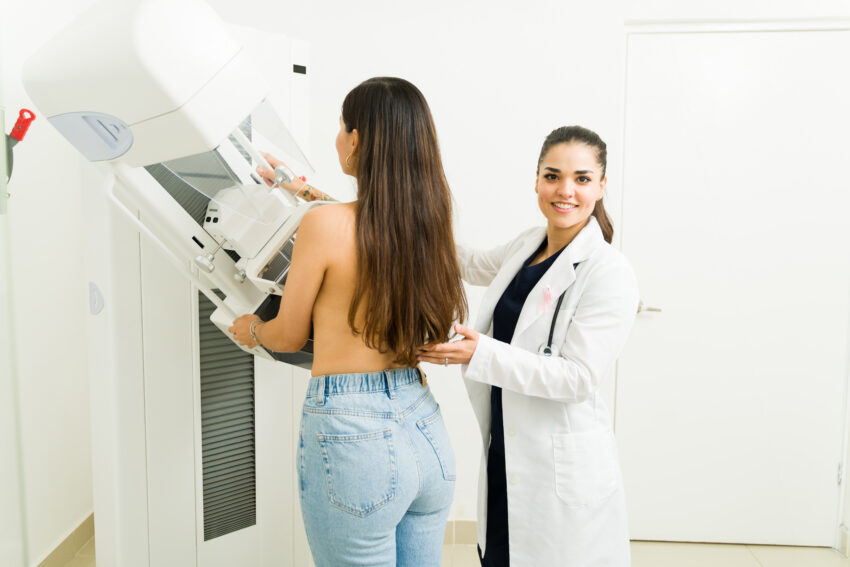
Imagine that a woman's mammogram turns up an abnormality that is classified as "probably benign." Even though the chance of breast cancer is only 2-4%, a doctor typically would ask the woman to return for another screening within six months, just to be sure. However, some women experience delays, and appointments may be missed and they may skip subsequent screenings altogether. This can set the stage for confirmatory diagnoses at more advanced stages of cancer with lower survival probability. How can that be avoided? You're invited to a webinar that explores how patient navigators—trained healthcare workers who support patients and help them overcome barriers related to transportation, child care, insurance coverage, language, etc.—were able to reduce those potentially ...
Counselors at New Britain High School were concerned about the future of teens who were not passing PE and risked not graduating. Fortunately, a local nonprofit taught a group of teens how to take photos and use them to inspire action—a technique called photovoice. Their efforts helped unite the nonprofit, the New Britain YWCA, and New Britain High School, who together pushed to establish an after-school PE credit recovery program. Now, girls are getting the physical education they need to lead a healthy lifestyle, and the ongoing collaboration between community organizations has led to the development of a new hub for health called The House of Teens (HOT).
Examining the Health of the Local Community
Awareness/Learn: The 37% Latino town of New Britain, Conn., was struggling ...
When Cecil Whisenton of San Antonio, Texas, transitioned his career from the restaurant industry to the installation of healthy vending machines, he learned of the tremendous burden of obesity across the country. So, in his work with HUMAN Healthy Vending—a Los-Angeles-based company that has franchisees working to place healthy vending machines across the country—Whisenton brought the machines to local YMCAs and a San Antonio high school. He hopes to bring the healthy vending machines to more schools in the future to give kids healthier snack and drink options earlier in life. He believes schools facing the pending changes under the USDA’s Smart Snacks standards can turn to companies like Human Vending to redesign the snacking for students.
The Problem of Unhealthy School ...
Lonnie Sclerandi, a Spanish teacher and soccer coach at Austin Independent School District, downsized his home a few years ago and no longer had land for a garden for fresh produce. He asked his school principal if he could plant a small garden outside the portable building where he taught. The principal said, "Yes." Sclerandi then researched online about what produce would be seasonal for central Texas, and how to cultivate a garden in the area. He bought gardening tools and seeds with his own money, and got started. He tended the garden for a year. Then his students started to ask him what he was doing—which eventually grew a cool new healthy change.
How the Garden Started
Food service leaders at Austin Independent School District (AISD), which is about 60% ...
In Tulare County, many people work for little pay on large farms in California’s fertile Central Valley. Some of these families aren’t getting proper nutrition, leading to diet-related conditions, like obesity and diabetes. When the local food bank revamped their nutrition policy to encourage more fresh produce donations, Sarah Ramirez, a local health leader used her hard-earned knowledge and passion to support that policy, and implemented a creative way to get the valley’s extra fruits and veggies into the hands of those who need them.
The Problem of Unhealthy Food in the Community
Awareness: In Tulare County in California’s fertile Central Valley, fresh produce grows all over the place. But for many area residents, this healthy produce doesn’t end up on their ...
Arely Perez loves to step outside her comfort zone. In college, she studied and enjoyed kinesiology—the study of human movement—but wasn’t as familiar with how it translated to the health of the community. So, as a graduate student at UT San Antonio, she got jobs in the labs of Drs. Meizi He and Zenong Yin, where she learned all about public health and coordinated studies of local programs to improve nutrition and reduce obesity in child care centers. “I became passionate about improving people’s health, thanks to both Drs. He and Yin, who gave me great opportunities to expand my knowledge and skills,” Perez said. Today Perez is applying her passion for health as a researcher at the Institute for Health Promotion Research at UT Health San Antonio. She also ...
A wave of shock swept over Olga Cardona as she listened to her doctor. “You have breast cancer.” Cardona knew nothing about cancer. She thought it was a death sentence. She was scared. She worried more when her insurance wouldn’t cover all chemotherapy. How could this be happening to me? A patient navigator calmed her fears. The navigator, a trained community health worker, taught Cardona what cancer is, got her in a breast cancer support group, and led her to resources to cover her treatment. Cardona, years later, now is in remission—and she became a promotora to promote health at the San Ysidro Health Center in California, where she was first diagnosed. “I wanted to pay it forward because I felt so grateful to everyone that had helped me through my ...