Salud America! Guest Blogger
Jefferson Dental Clinics Fewer than 1 in 3 people floss daily. On top of that, the U.S. federal government recently made a controversial ruling to quietly remove flossing from its list of dietary guidelines, after having supported floss since 1979, due to mixed research results on the benefits of flossing. We can all toss the floss, right? Wrong. Flossing remains an effective method to remove food particles and buildup from between the teeth, and help people reach the plaque where it does form between the teeth, said Dr. Leslie Renee Townsend, regional dental director for Jefferson Dental. "Leaving particles and buildup trapped between the teeth is a quick route to developing decay and disease around the teeth and gums," Townsend ...
The United States spends far more on health care than any other developed nation; a record 17.5% of the country’s gross domestic product in 2014 was spent on health care. However, life expectancy in the U.S. is lower, maternal and infant mortality is higher. Also, the prevalence of chronic illness is far more common in the U.S. than in European countries. These poor health outcomes are also connected to another type of spending where the country falls far below multiple European countries. In terms of social services that target education, housing, nutrition and poverty, the U.S. is spending significantly less. The Robert Wood Johnson Foundation (RWJF) analyzed this spending in 2011 and found the ratio of social service to medical care spending was associated with “better health ...
A new study, soon to be published in Obstetrics & Gynecology, has shown that the number of women in Texas dying from pregnancy complications have inexplicably doubled. The study’s authors don’t speculate as to what the causes for this startling trend are, but the trend seems isolated to the Lone Star State. One trend noted by the study’s authors was the possible linkage toward the increase in maternal mortality rates and the Texas Legislature’s decrease in funding to family planning agencies in 2011. Vital statistics personnel in Texas and at the National Center for Health Statistics couldn’t determine that there was a correlation between the two incidences. In order to reduce health disparities, it is critical to address inequities in programs, practices, and ...
Would the millions of children suffering from hunger and food insecurity in the United States be healthier, and have homes full of fresh produce if we started re-designing old abandoned buildings to new-tech farms? AeroFarms, co-founded by Marc Oshima and David Rosenberg, vertical farm entrepreneurs, hope to build a way to bring more farm fresh produce to urban citizens, no matter what the weather. Planning to produce over 2 million pounds of fresh vegetables per year in an old New Jersey steel mill, they also see their business as a way to help the areas of Newark that are underprivileged. Rosenberg explained to the Chicago Tribune, that there are many areas of Newark (33.8% Latino) that do not have economic development or access to supermarkets, that's why they chose to put ...
The U.S. Department of Health and Human Services (HHS) awarded more than $100 million to over 1,300 health centers across the United States to invest in health center quality improvement. The centers will use these funds to “expand current quality improvement systems and infrastructure.” The centers will use the funds to improve systems and infrastructure as well improve some of the primary care services they deliver in their communities. “Millions of Americans rely on health centers to provide them with quality health care,” said Dr. Mary Wakefield, HHS Acting Deputy Secretary. “These quality improvement awards will support health centers to continue to deliver superior health care that engages patients, improves care coordination and bridges overall access to ...
Being the new kid in school is always tough, from finding friends to adapting to new teachers and homes. More than 6.5 million students nationwide are frequently the “new kid,” and studies have shown that Latino, black, and lower-income students have the highest rates of student mobility, which refers to students changing schools during the middle of any given school year for any other reason besides matriculation. Frequently, student mobility is detrimental to children's social and academic development, according to data collected by the University of California, Santa Barbara. Understanding this data can also help put them on a path toward academic achievement. “To be sure, multiple moves are a dangerous signal, but even one move increases the [student’s] risk of not ...
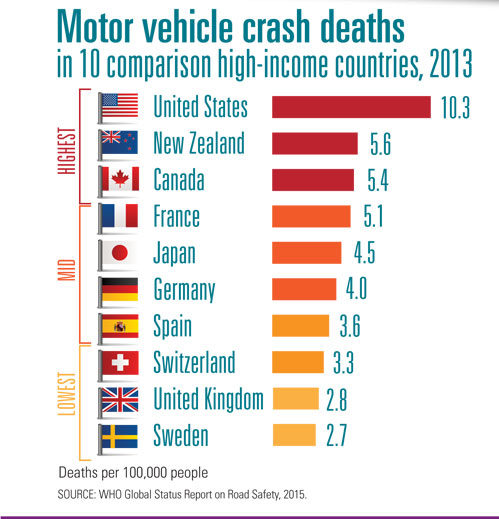
When it comes to traffic safety, the U.S. lags far behind other countries. The National Highway Traffic Safety Association's (NHTSA’s) analysis of 2015 data shows that 35,200 individuals were killed on U.S. roads last year, which is the largest year-over-year percentage increase (7.7%) since national record-keeping began. Traffic safety is a public health issue. It is also a social justice issue because there are drastic disparities in fatalities and injuries among people walking and biking, and minorities. "We won’t save the number of lives we aim to without shifting our understanding of traffic violence from an individual behavior problem to a design, policy, and organizational practices problem," according to the Vision Zero Network. Moreover, the shift in ...
An investment as little as $10 per person per year in evidenced-based, community prevention programs, such as those that increase physical activity and improve nutrition, could create health care savings of more than $16 billion annually within five years. In 2012, the Massachusetts (11.2% Latino) became the first state to use a wellness trust as an effort to reduce health care costs by preventing chronic conditions when the Massachusetts Legislature established the Prevention and Wellness Trust (PWTF) through a one time assessment on acute hospitals and payers, totaling $57 million. The Trust supports nine community-based partnerships, including municipalities, clinical organizations, healthcare systems, community-based organizations, businesses, regional planning organizations, ...
Researchers in the Department of Public Health at Grand Valley State University in Grand Rapids, Mich. reveal that limited access to healthy food stores, walkable neighborhoods, and healthy social environments may set the stage for heart disease. In the study, researchers studied over 5,000 adults over a twelve year period, checking coronary artery calcium and amounts of atherosclerosis in their arteries, a disease that can harden arteries and increase the risk of heart disease. The common thread among the 86 percent of adults with coronary artery calcium, was the decreased access to heart-healthy food. Co-lead author Ella August, Ph.D., explained in a recent article that the only significant factor that deters or increases the risk of calcium build-up in the arteries were if ...