A rising number of middle and high school kids, especially Latinos, are smoking electronic cigarettes, according to a National Institutes of Health report. What are real dangers behind e-cigs and similar products? Can these hook kids into smoking cigarettes? This is a critical question given that Latino kids are 67% more likely than their White peers to start smoking and develop a daily habit, according to a study. Let’s use #SaludTues on June 13, 2017, to tweet how e-cigs and other products affect the health of Latino teens and minority populations. WHAT: #SaludTues Tweetchat: “The Truth About E-cigs and Tobacco Products and Their Impact on Latinos”
TIME/DATE: 1-2 p.m. ET (12-1 p.m. CT), Tuesday, June 13, 2017
WHERE: On Twitter with hashtag #SaludTues
...
For 30 years, a group of small community health centers have provided primary healthcare to residents in Maricopa County, Ariz. (30% Latino population). A few years ago, center leaders Dr. Avein Saaty Tafoya and Lisa Blue recognized that local residents continued to face cultural, language, financial, and other barriers to proper comprehensive healthcare. They felt compelled to change the entire approach of their centers. Adelante Healthcare began to seek grants and partnerships to add personnel to expand beyond their historical focus on primary care. Today their new team—primary care physicians, specialists, bilingual health coaches, mental and behavioral health social workers, and others who connect families to insurance, health education, and more—provides more ...
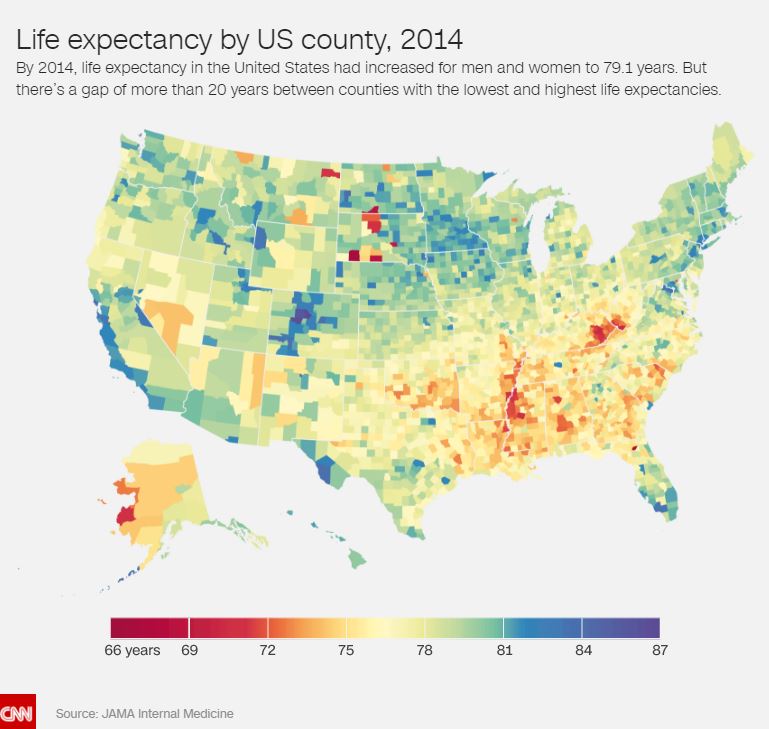
Fact: Where you live greatly impacts how healthy you will be. Lifespans differs by as much as 20 years at birth between the longest- and shortest-rated counties United States, revealing massive health inequities in different parts of the country, especially Latino-centric area, according to a new study, CNN reports. For the study, researchers from the Institute for Health Metrics and Evaluation (IHME) at the University of Washington in Seattle examined county data for life expectancy from 1980-2014. They then applied mathematical models to estimate the average lifespan. Findings showed life expectancy at birth increased by 5.3 years for adults (going from age 73.8 to 79.1) between 1980 and 2014. Over that time, men gained 6.7 years (going from age 70 to 76.7) while women ...
Fact – where you greatly determines how healthy you will be. A recent study by the Institute for Health Metrics and Evaluation at the University of Washington determined that the life expectancy at birth differs by as much as 20 years between the lowest rated and highest rated counties surveyed in the United States. Dr. Christopher J.L. Murray and his team studied the life expectancy of each U.S. county from 1980-2014 analyzing county-level data and applied mathematical models to estimate the average length of lives. According to the findings, life expectancy at birth increased by 5.3 years for both men and women (from 73.8 years to 79.1 years) between 1980 and 2014. Over that time, men gained 6.7 years (going from 70 years on average to 76.7 years) while women gained four ...
Editor's Note: This story was originally published by California Healthline San Francisco has unveiled a tough anti-tobacco proposal that would ban the retail sale of menthol cigarettes and other flavored tobacco or tobacco-related products that are often the first choice of minority group members and teenagers who smoke. Supervisor Malia Cohen, sponsor of the proposed ordinance, joined Tuesday with public health experts and community advocates to announce the measure, which she said goes beyond more narrow laws on flavored tobacco in cities such as Chicago, Berkeley and New York. “The legislation I’ve authored is a full restriction on the sale of all flavored tobacco products, and that does include menthol. There are no exemptions,” Cohen said. This includes cigarettes, ...
When it comes to smoking, there is always “good news” and “bad news.” The good news is that smoking rates have been steadily declining in the U.S. for decades. Bonus good news: Latino adults generally have lower rates of smoking than other racial/ethnic groups with the exception of Asian Americans. Now, the bad news. A study from the University of Colorado has determined that about 15% of all adults in the country – over 36 million – continue to smoke cigarettes. Of that number, nearly 3 of 4 are plagued by one or more key social disadvantages: low income, no college education, no health insurance, or a disability. According to the study’s findings, Americans with lower socioeconomic status “suffer from epidemic smoking rates.” “In the last ...
Have you seen Pepsi's soda ad that it yanked after big public outrage? It shows a staged protest with good-looking multicultural crowd and model Kendall Jenner. Jenner gives a Pepsi to a police officer. He smiles, everyone's happy. Social justice delivered and police brutality solved—by soda. The ad sparked a storm of criticism, for some obvious reasons. Even scarier is that sugary drink marketers continues to exploit Latino and Black youth, and stir obesity issues in these groups, according to commentaries by Vox's Julia Belluz and The Washington Post's Michelle Singletary. Belluz writes: "The public health community has long argued that big soda’s targeting of African Americans and Latinos is exacerbating health problems in those communities. We now have a big ...
Listening to community needs is critical to solving health disparities. Kendra Cruz embodies this goal, as she has displayed a willingness to listen intently and a passion for addressing any identified health concerns in the community. Cruz is already working on studies on smoking cessation and HPV, and she’s interested in working with rural Latinos to learn their needs and identify ways to best provide resources. Her desire to listen and respond to people’s health needs is just as beautiful, if not more so, than the amazing traditional dresses she keeps from her native Oaxaca, Mexico. Cruz came to the states at age 8 without speaking any English, but was fortunate to learn the language in a school year. At 14, she returned to Mexico to be closer to her family, but at 17 ...
Beatrice, a Latina mom of two, quit smoking in her late 30s. Her sons were her inspiration. “When my son was 11, he wrote me a letter and in it he asked me to quit smoking,” said Beatrice, who started smoking at age 7, in a video segment on why she quit. “And when I was going through the process of quitting, that letter was very motivating for me. I want to be here for my family.” Beatrice, who tells her story in the CDC’s Tips From Former Smokers video series, is an example of how campaigns can encourage Latinos to quit smoking by focusing on cultural differences, language, and the importance of family, experts say, according to a report by American Heart Association News. Smoking rates vary among Latino ethnic groups. Although smoking rates are lower among U.S. ...