by
by Share On Social!
Nicotine-based vapes, or e-cigarettes, are likely to cause cancers of the lung and oral cavity, according to a new study led by the UK’s University of South Wales.
“[Our study] is the most definitive determination that those who vape are at increased risk of cancer compared to those who don’t,” said study leader Bernard Stewart.
Let’s dive into what the study results mean for those who vape.
E-Cigarettes and Cancer Risk
Little attention has focused on whether e-cigarettes might cause cancer on their own.
So, study researchers – pharmacists, epidemiologists, thoracic surgeons, and public health experts – examined clinical studies, animal experiments, and laboratory research to understand the chemicals produced by e-cigarettes, according to a news release.
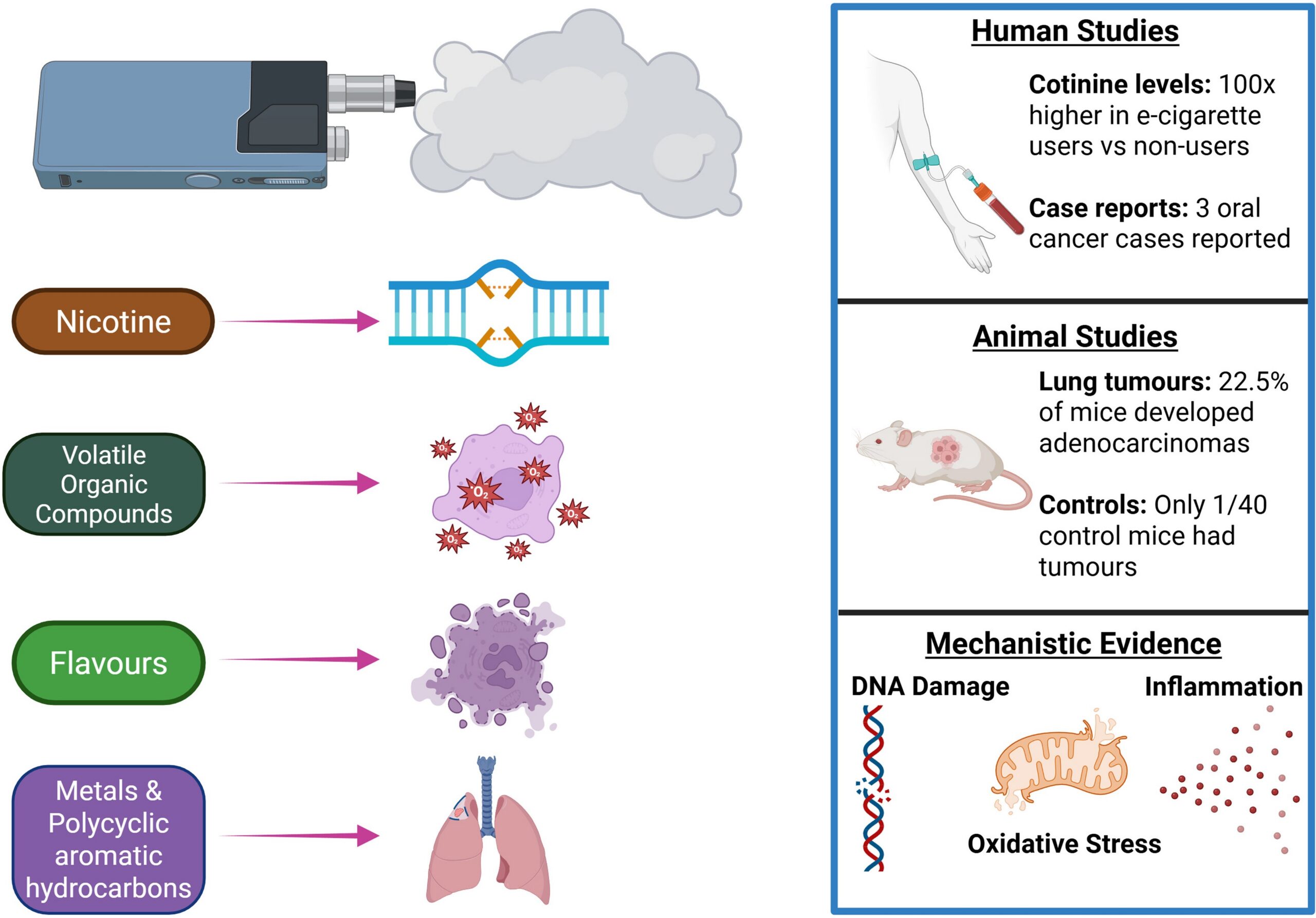
They identified numerous carcinogenic compounds in e-cigarette aerosols, including volatile organic chemicals and metals released from heating coils.
“They examined several types of evidence: biomarkers in people showing DNA damage, oxidative stress and tissue inflammation; experiments in mice that caused lung tumours; and laboratory studies showing cellular damage and disrupted biological pathways linked to cancer,” according to the news release.
Taken together, the evidence points to potential cancer causation, although the exact number of attributable cancer cases remains unclear, researchers said.
“Our assessment is qualitative and does not involve a numerical estimate of cancer risk or burden. We’ll only be able to determine the precise risk once longer-term studies are available,” Stewart said.
study results mean for those who vape.
E-Cigarettes on the Rise in Young People
The new UK study is troubling, given the rise of e-cigarette use.
In the US, e-cigarettes were the most commonly used tobacco product among middle and high school students in 2024, according to the CDC. In addition, a greater percentage of Latino students in high school had ever used vaping products (34.7%) than the overall student population (33.8%), according to federal data.
Similarly, many young people who vape also use other tobacco products, including cigarettes and cigars, according to the CDC.
U.S. states have varying restrictions and regulations on vaping and e-cigarettes.
While e -cigarettes are known to be a gateway to cigarette smoking and cancer risk, the extent to which they may cause cancer in their own right had not received as much attention in research, according to Freddy Sitas, co-author of the UK study.
“The evidence was remarkably consistent across fields,” Sitas said. “It dictated an unequivocal finding now, though human studies that estimate the risk will take decades to accumulate.”
Study leaders also cite evidence that many smokers who switch to vaping don’t quit cigarettes.
“What we do know from recent epidemiological evidence from the USA is that those who both vape and smoke are at an additional four-fold increased risk of developing lung cancer,” according to Sitas.
Study researchers urge quick action to confirm the link between vaping and cancer.
“It took nearly a century of scientific investigation – from the mid-1800s to the landmark US Surgeon General’s report in 1964 – before smoking was officially recognized as a cause of lung cancer,” the researchers said, according to a news release.
“E-cigarettes were introduced about 20 years ago. We should not wait another 80 years to decide what to do,” Sitas said.
You Can Join Quitxt Today!
If you’re interested in quitting smoking or quitting vaping, try Quitxt!
Quitxt is a bilingual service from the Institute for Health Promotion Research at UT Health San Antonio and the Cancer Prevention and Research Institute of Texas that sends texts messages to phones to help South Texas adults quit smoking. Messages help with motivation to quit, quit date, handling stress, and using nicotine replacement, if needed.
To join Quitxt in English, text “iquit” to 844-332-2058.
For Spanish, text “lodejo” to 844-332-2058.
More than 1 in 5 Quitxt users fully quit smoking after completing the English version of the program, according to a study.
“There’s no better time than now to stop smoking with help from Quitxt,” said Dr. Amelie G. Ramirez, director of the Institute for Health Promotion Research and head of community outreach and engagement team at the Mays Cancer Center at UT Health San Antonio.
“Quitting smoking is proven to improve your health, increase your life span, and save money.”
By The Numbers
142
Percent
Expected rise in Latino cancer cases in coming years