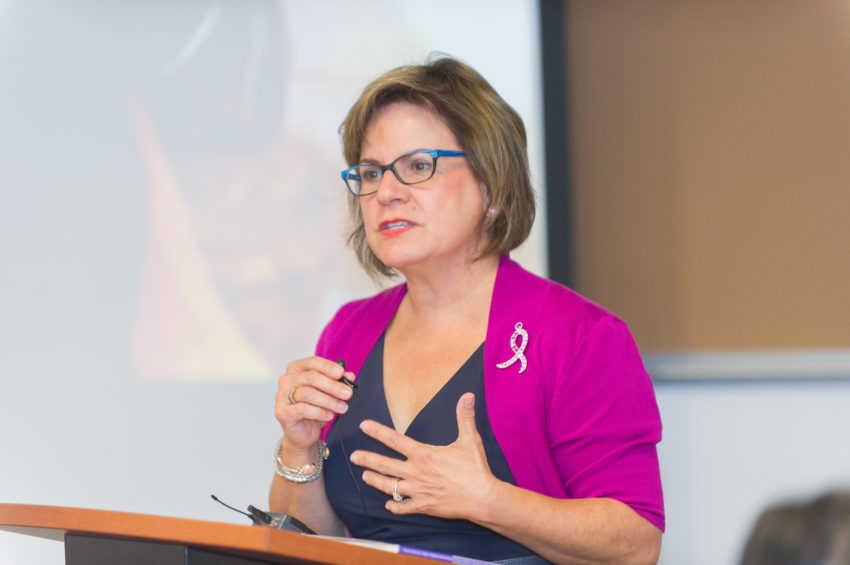
I recently had the privilege of attending and presenting my Susan G. Komen-funded research on boosting breast cancer survivorship through Patient Navigation at the 5th International Cancer Control Congress (ICCC) on Nov. 3-6, 2013, in Lima, Peru. As a member of Komen’s Scientific Advisory Board, I was excited to be among the more than 400 health researchers and community leaders from throughout the world came together for this important meeting. Dr. Simon Sutcliffe of Vancouver, Canada, president of the ICCC and chair of the international steering committee, cited five key drivers for the group: improving human development;
mobilizing a societal response to reduce cancer and other non-communicable diseases;
improving population health;
improving cancer treatment, ...
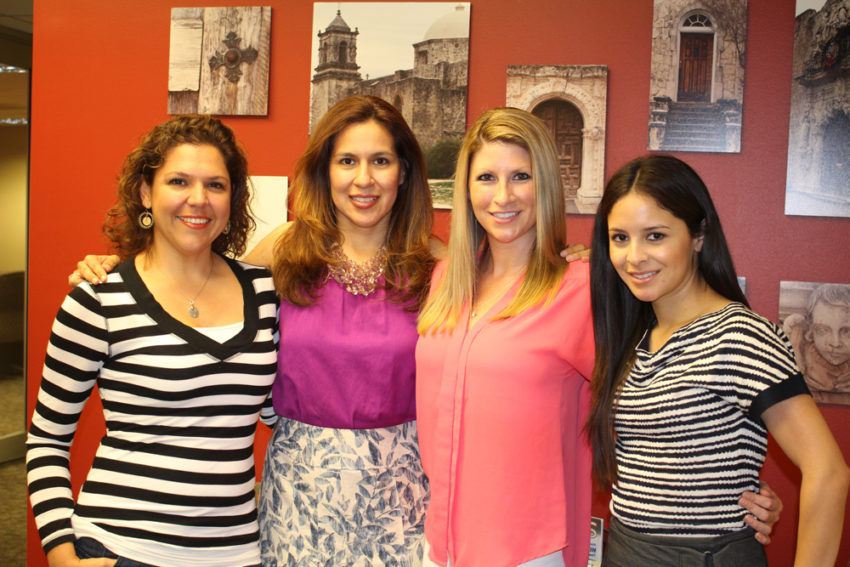
Amy Cleveland, fresh out of college and just starting a career in marketing, discovered a coarse lump in her breast while putting on some tanning oil. Only age 22, she was diagnosed with breast cancer. “It was a struggle for me because I was young and there was no one my own age I could relate to or confide in about having cancer. People always say, ‘My mom had that,’ or, ‘My grandma had that.’ But it’s tough for young people,” Cleveland said. Fortunately, Cleveland—now age 28 and free of cancer—found some “Breast Friends Forever,” thanks to a unique support group for young breast cancer survivors in San Antonio (63% Latino) developed by the Institute for Health Promotion Research (IHPR) at the UT Health San Antonio and Susan G. Komen San Antonio. The ...
Diabetes and obesity are the two most significant health threats in South Texas, according to a new report published online in Springer Open Books by the Institute for Health Promotion Research (IHPR) in the School of Medicine at UT Health San Antonio. The South Texas Health Status Review, originally self-published in 2008, was updated this year to study more than 35 health conditions and risk factors and how people in South Texas are affected compared to those in the rest of Texas or nation. The Review, in addition to singling out diabetes and obesity, also indicates that the South Texas region faces higher rates than the rest of Texas or nation for: Cervical, liver, stomach and gallbladder cancers
Child and adolescent leukemia
Neural tube defects
Other birth ...
Latinas who have an abnormal mammogram result take 33 days longer to reach definitive diagnosis of breast cancer than non-Hispanic white women, according to a new study by the Institute for Health Promotion Research (IHPR) at the University of Texas Health Science Center at San Antonio. Such a time delay can have a critical impact on tumor size, stage at diagnosis, treatment, prognosis, and survival of subsequent breast cancer. For this study, published online in SpringerPlus in March 2013, IHPR researchers worked with partners in the federally funded Redes En Acción program to evaluate the differences in time to diagnosis of breast cancer among 186 Latinas and 74 non-Hispanic whites who received an abnormal mammogram result in six U.S. cities. Analysis showed that Latinas’ ...
Extra support for patients, called “patient navigation,” can lead to faster diagnosis for women after an abnormal mammogram result, according to a new study by the Institute for Health Promotion Research (IHPR) at UT Health San Antonio. The study, published this week by the journal Cancer, also suggests that patient navigation should be carefully targeted to have the greatest impact on eventual health outcomes. IHPR researchers worked with partners in the federally funded Redes En Acción program to examine the experiences of 425 Latinas in six cities nationwide. Each woman had received an abnormal result in initial breast cancer screening and was referred for further evaluation. About half of the women received help from trained patient navigators, who provided culturally ...
Armida Flores was a professional abuela—babysitting her granddaughters, volunteering at their schools, etc.—until they moved to California a few years ago. Then Flores wasn’t sure what to do with her newfound spare time. So the Mexico native, who was 30 years removed from school, didn’t know much English and had no career training, decided to enroll in bilingual nursing classes at Palo Alto College in San Antonio and simultaneously earned her GED in Spanish in 2008. She also took beginner and advanced English to polish her language skills, and in May 2012 earned an associate’s degree in social work, psychology and Spanish. “The biggest obstacle I had to overcome was to accept that I am not too old to start a new process in my life,” said Flores. “Now that I ...