
 by
by 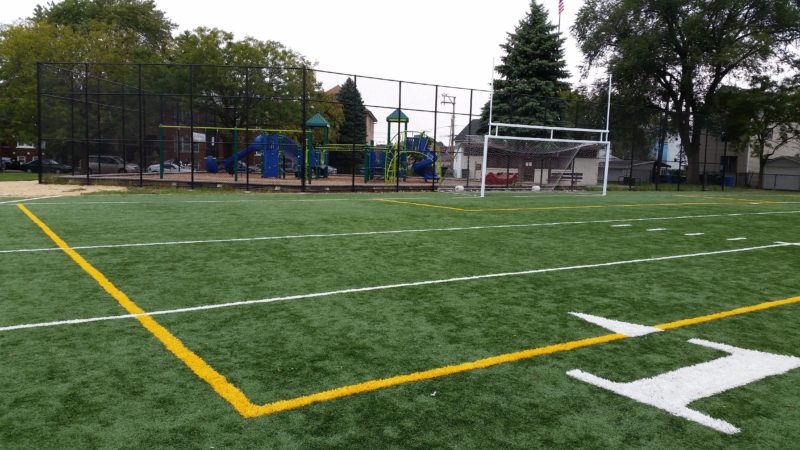
Share On Social!
In the past 10 years, the Thomas Kelly High School girls’ soccer team has been one of the winningest teams in Chicago.
But they don’t even have their own field to practice or play on.
The school is in Southwest Chicago’s Brighton Park Neighborhood (83% Latino), an area that is burdened by high rates of obesity and physical inactivity due to less options for safe, quality recreational facilities than other parts of Chicago.
The Brighton Park Neighborhood Council (BPNC) organized a campaign to renovate Kelly Park, the park adjacent to Kelly High School, to build a turf football/soccer field to make the park safer for students and families.
The Issue of No Safe Places for Physical Activity
Awareness: Patrick Brosnan, Sara Reschly, and other Brighton Park residents saw how environmental injustice negatively affected the Brighton Park community (83% Latino), contributing to crime, physical inactivity, and adverse health outcomes, such as obesity.
Brighton Park is a low-income, industrialized neighborhood and is growing faster than the rest of the city. The average per capita household income ($16,782) is 38% lower than Chicago and 40% lower than the rest of the nation. About 98% of students qualify for free or reduced-price lunches.
Brighton Parks lacks green space and falls far below Chicago’s city standard of two acres of open space for every 1,000 residents.
“We are one of the most park-poor communities in Chicago,” Reschly said.
According to Chicago city standards, Brighton Park should have almost 98 acres of open space. However, it only has a combined total of 10.6 acres. Compare this to another Chicago neighborhood of similar size, Buffalo Grove (4.9% Latino), which far exceeds the city standard at over 400 acres.
Source: Sara Reschly
The primary park in the neighborhood is Kelly Park. It is seven acres, is the only green space for 49,000 residents, and has not been improved in more than 65 years.
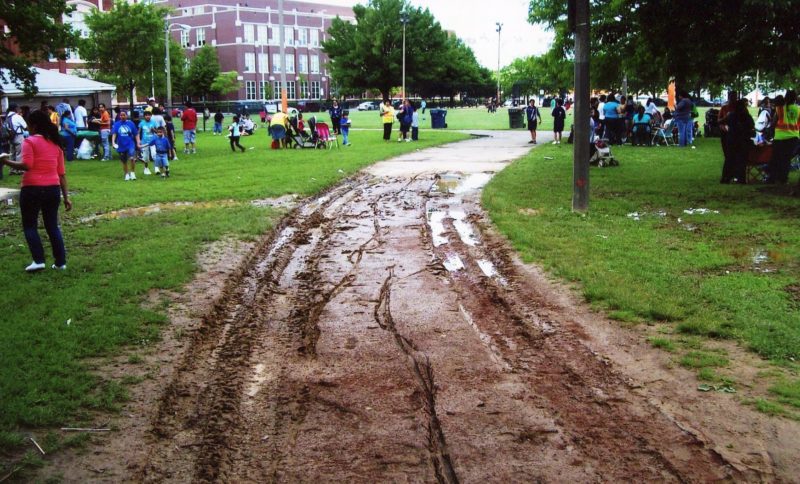
According to Reschly and Brosnan, the park was plagued by violence and crime, which reduced residents’ interest in using the park. The sports fields were also plagued by drainage issues, putting athletes at risk for injury.
Brighton Park’s lack of green space is more alarming among community members because it has remained even 30 years after a 1983 decision that required the Chicago Park District to disperse park dollars in a better manner, after the district was sued.
“More than half of the $500 million spent on Park District improvements since 2011 went to just 10 of the city’s 77 neighborhoods – seven of them are increasingly … affluent and have access to outside money,” according to the Chicago Reporter.
Learn: Brighton Park residents learned firsthand that lack of green space and poor quality of facilities is negatively influences safety and health.
Because the high school’s football and soccer teams did not have their own field to practice or play on, and because they couldn’t use the water-damaged fields at Kelly Park, the teams had to be bused to other schools and parks. This caused burdensome schedules for the players and coaches; safety issues due to crossing into opposing street gang areas; and extra costs to the already poorly funded school district.
In 2013, two incidents galvanized the need for Kelly High School students to have their own sports fields: the coach and soccer team were threatened while practicing at one of the neighboring fields, and one player and members of his family were attacked after a game.
Unfortunately, a lack of school funding and of leadership had stymied Brighton Park residents from solving this issue in the past.
Lack of school funding is a problem in low-income neighborhoods, like Brighton Park, due to Illinois’ education system, which allows affluent districts to receive more money per student, while less affluent schools, like Kelly High School, have to make sacrifices and cuts. The fact that Kelly High School is one of the top 30 largest high schools in Chicago (out of almost 200), yet does not have their own football, soccer or baseball fields is an example of statewide issues in school funding.
The lack of elected leadership is a problem in Brighton Park due to the division of Chicago’s legislative wards (Chicago is divided into 50). Brighton Park is one of very few Chicago neighborhoods split between two wards, meaning it has two aldermen (ward representatives).
A 2002 study of Chicago neighborhoods found that, Brighton Park was in the center of a “service donut” with no investment and no service infrastructure.
“The neighborhood was always very low resource,” Brosnan said. “There was a real … gap.”
Frame Issue: The Brighton Park Neighborhood Council (BPNC), a state- and private-funded neighborhood group that includes both Brosnan and Reschly among its leaders, has worked since 1997 to develop the capacity of residents to organize resources, to hold elected officials accountable, and to overcome decades of health issues.
How could BPNC work to overcome safety and health issues related to a lack of green space?
Revitalizing the area’s lone park, Kelly Park, and filling it with more people could help address many issues, Reschly said.
“Because the park was so ugly and difficult to use, it was used little during the day, and once dusk would come, it was taken over by a gang,” Brosnan said. “Reclaiming the park was a big part of what we knew we needed to do. Not only to make it a better physical space, but a safer place to provide families something to do at all times.”
Revitalizing Kelly Park to Increase Safe Places for Physical Activity
Education: In 2011, BPNC conducted a parent leadership program to identify and develop a neighborhood project to improve protective factors in their community and reduce violence through a state funded grant.
Part of the program was to educate parents on bullying, gang awareness and gang prevention; another facet of the program was to discuss other non-medical drivers of health issues.
In 2012, the parents agreed that they wanted to renovate Kelly Park as their campaign.
In addition to violence prevention, this campaign would target multiple non-medical drivers of health related to mental health, physical health, and obesity prevention because they are all related to the built environment.
“Why is it that Kelly High School with over 2,000 students doesn’t have [its] own football/soccer field, while other schools have beautiful football stadiums,” Brosnan said. “You know, why does this [happen]?”
Mobilization: At the time, the campaign to renovate Kelly Park had no specific funding, but fell under BPNC’s overall commitment to improve the community.
BPNC conducted public meetings to raise awareness of local issues and the need to renovate Kelly Park.
More than 350 residents attended the first public meeting, and support grew from there.
A group of community leaders started going to park officials and elected officials to talk about the park renovation and volunteers for this need. However, BPNC and the parents found that the Chicago Park District would not really listen to community members, but would listen to a park advisory council.
“The park district won’t meet with us until we have an advisory council,” Brosnan said. “OK, well, how do we form one of those? Let’s do that.”
Brosnan and Reschly explored what it would take to start an advisory council for Kelly Park by looking into park district requirements and talking with park advisory councils. They learned they needed to organize meetings, vote in members, follow open meeting rules, and take minutes.
They established a Kelly Park advisory council and got community members to join, as well as representatives from an independent baseball league, schools, and school health councils.
Youth leaders played a “huge role” in the campaign by attending community and school meetings to put pressure on the park district and elected officials, Brosnan said.
Youth leaders testified at community meetings and to local leaders. They even coordinated an event to get the Kelly High School soccer players to meet at a newly built private field on the other side of town.
They wanted to draw attention to this field because it was built using funds from a tax increment financing (TIF) district, which is a funding tool to promote public and private investment in low-resource areas. This new private field was not in a low-resources area, but was connected to an expensive condominium development in a more affluent neighborhood.
“We have no place to play and you are building this nice private field using our tax dollars. So we will come play here,” members of the soccer team ironically threatened.
“We would do stuff like that to highlight the [issues] and to show how unfair it was and that we really needed more attention paid to the southwest side and our community,” Brosnan said.
Debate: Financing became the campaign’s biggest issue.
Park renovations were estimated at $3.2 million, and the park district offered to fund half.
How were BPNC and the Kelly Park advisory council going to come up with more than $1.6 million?
A Plan to Revitalize Kelly Park to Increase Safe Places for Physical Activity
Activation: They Kelly Park advisory council would regularly go to park board and district meetings and set up individual meetings directly with park board members and district staffers. Through those discussions they worked through some of the design and cost issues of the park.
“We went to meeting, after meeting, after meeting to put pressure on the park district to do something about this park,” Reschly said.

Source: Sara Reschly
Community leaders surveyed Brighton Park residents to identify the top renovation priorities to determine what these residents really wanted and what they were willing to sacrifice. The football/soccer field and lights were the major priorities. Redoing the playground and resurfacing the baseball field and basketball courts followed closely behind. Installing a water play feature was also a priority.
“There is so much need, but we have to compromise which facilities are most important,” Reschly said. “The drainage issues, the turf field and lighting were top priorities.”
Frame: The Kelly Park renovation campaign eventually was divided into three phases.
The first phase for $2 million would address park drainage issues to avoid standing water on the field. It would also replace the grass with an artificial turf football/soccer field and install lighting, fencing and landscaping.
BPNC and the Kelly Park advisory council began to seek outside sources to leverage funding from the park district. They applied for grants with Local Initiatives Support Cooperation (LISC), the NFL, and the U.S. Soccer Foundation, and held a variety of community fundraising events.
“If we were able to do fundraising that would help us leverage more support and funding,” Brosnan said. “And if we could get the park district on board, then the money would eventually start pooling and then elected officials would want to be part of it.”
Another tactic they used to put pressure on the park district was highlighting a park budget item—like a $200,000 dog park in an upscale Northside Chicago area—to illustrate issues among green space options in Brighton Park, Brosnan said.
“There’s no money for kids on the southwest side, but there’s money for dogs on the north side?” Brosnan questioned. “We made a situation where you couldn’t say no.”
Change: After a state-level realignment of districts, Brighton Park was now represented by a new senator, Sen. Martin Sandoval. In July 2013, after 6 months representing Brighton Park, Sandoval presented them with a $210,000 check, from state appropriations, for the Kelly Park renovation project.
Also in 2013, the NFL and LISC announced their grant approval for $200,000.
The park district had committed to match the raised money to construct the field, so the park district agreed to contribute $500,000 from its capital funds. The school district also committed funding.
Mayor Rahm Emanuel, Chicago Park District General Superintendent and CEO Michael Kelly, and members of the Brighton Park community gathered at Kelly High School to announce plans to build a new artificial turf field at Kelly Park in July 2014.
“This was a big victory for the community”, Reschly said. “The fact that the Park District had not touched the park in so long and that community members were able to rally together and put enough pressure on park district and elected officials and tell them they need to do something about this.”
Implementing a Plan to Revitalize Kelly Park to Increase Safe Places for Physical Activity
Implementation: In early 2014, the park was closed for renovations.
It reopened on May 15, 2015 with a new turf football/soccer field, a new playground, and new lights.
The renovation immediately brought more activity to Kelly Park.
“When you drive by the park, you can see a huge difference. It has been packed with kids and families,” Reschly said.
In addition to increasing accessing to green space for all residents, BPNC continues working to build health in Brighton Park in education, school funding, and access to health care, Reschly said.
Language services have always been a huge need in Brighton Park and have always been a priority for BPNC. Early in their work, they ensured that services and programs were being provided in Spanish, that school staff were bilingual, that parent meetings were bilingual, and that they could answer parents’ needs.
“It was really important symbolically for the community to witness. We are on the map. We are a neighborhood. It doesn’t matter how many city council members or how many state legislators represent us, we are a vital part of their districts and they need to recognize and respond with … resources when needed,” Brosnan.
Meanwhile, although unrelated, an independent filmmaker, the one behind the award-winning documentary film Hoop Dreams, was filming a movie about the challenges that youths face in Chicago.
The movie, called It’s a Game, is about the Kelly High School girls’ soccer team and draws attention to the challenges and burdens that Kelly High School athletes faced.
Sustainability: Compared to temporary programs and services, improvements to the built environment are far longer lasting.
BPNC anticipated that they would need to build a turf field because it is more durable than grass and because this was the only field for 49,000 residents.
Residents use the park all day and night with continuous daily and nightly programming, compared to before, when people would only play soccer in the park two days per week and families would leave the park early in the evening.
Kelly High School can now play their football games and soccer games at Kelly Park. P.E. classes use the field during the school day. Park district programs and youth and adult soccer leagues use the field, as well. The Park District even offers youth flag football on the weekends.
“The end result has really proven that the park has been reclaimed,” Brosnan said. “Now there is this beautiful vibrant green space over taken by families all night. Gangs aren’t around when there are 400 other people there.”
“It took us four years to bring Brighton Park kids a soccer field, and that’s just phase one,” Reschly said. “Now we are trying to secure funding for phases two and three. We applied for a grant with Cubs charities.”
Explore More:
Green & Active SpacesBy The Numbers
33
percent
of Latinos live within walking distance (<1 mile) of a park
This success story was produced by Salud America! with support from the Robert Wood Johnson Foundation.
The stories are intended for educational and informative purposes. References to specific policymakers, individuals, schools, policies, or companies have been included solely to advance these purposes and do not constitute an endorsement, sponsorship, or recommendation. Stories are based on and told by real community members and are the opinions and views of the individuals whose stories are told. Organization and activities described were not supported by Salud America! or the Robert Wood Johnson Foundation and do not necessarily represent the views of Salud America! or the Robert Wood Johnson Foundation.