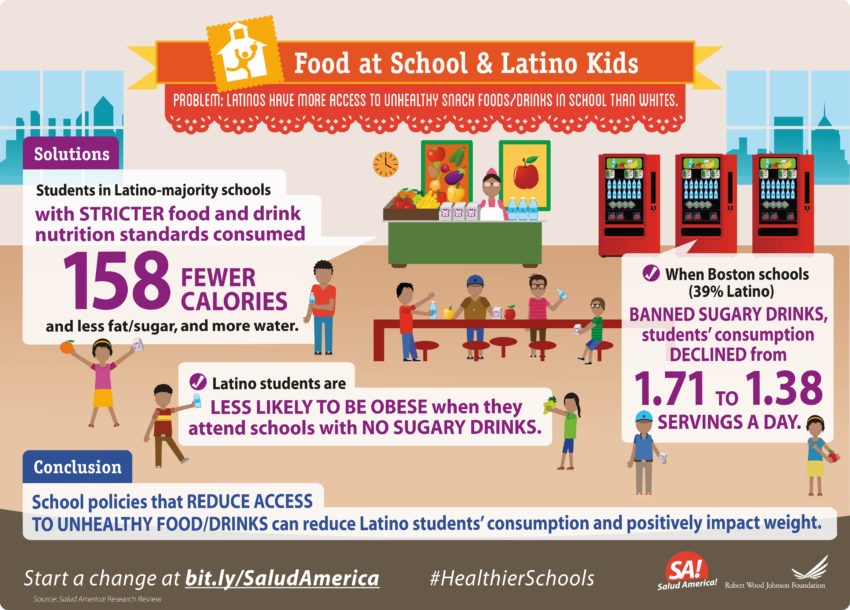
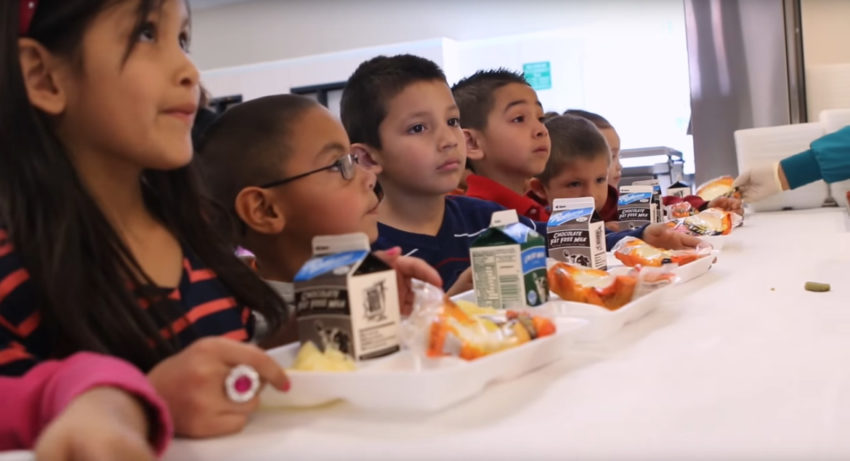
Many kids have access to unhealthy snacks in schools. But when schools take action and set stricter nutrition standards, students consume 158 fewer calories and less fat/sugar, and more water, according to our new infographic on food at school and kids. The infographic is part of Salud America!’s Healthier Schools and Kids research review, which tackles the latest issues on the school health environment and offers recommendations. Share this infographic today! Salud America! is a Robert Wood Johnson Foundation-funded national childhood obesity prevention and communication ...
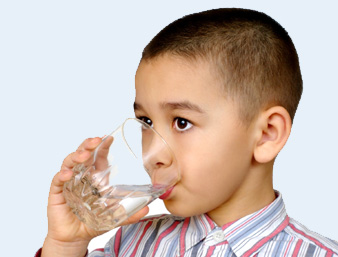
A new study suggests offering water to students may help reduce childhood obesity, CBS News reports. In the U.S., children struggle with overweight or obesity, but researchers at NYU Langone found “that thousands of New York City School children lost weight and lowered their body mass index after self-serve water dispensers were placed in schools.” “We looked at over a million kids in just over 1,200 schools in grades K-8,” Brian Elbel, study co-author and associate professor at the NYU Langone Medical Center, told CBS. “They ended up being about four or five pounds lighter after the introduction of this intervention as compared to a kid in a school that didn’t get a water jet.” According to the authors of the study when students have access to water jets sales of ...
Schools are where kids consume half of their daily calories. But many kids are widely exposed to unhealthy foods at school, and are less likely to engage in physical activity in school, according to a new research review from Salud America!, a national network for childhood obesity prevention and communication funded by the Robert Wood Johnson Foundation. Salud America!’s Healthier Schools and Kids research review shows that Latino-majority schools tend to: have weaker policies on school snacks and drinks than other schools; may be less likely to implement nutritional guidelines; and offer few programs or access to facilities for physical activity. Solutions are emerging to create healthier schools: School policies that reduce access to unhealthy snacks and drinks are likely ...
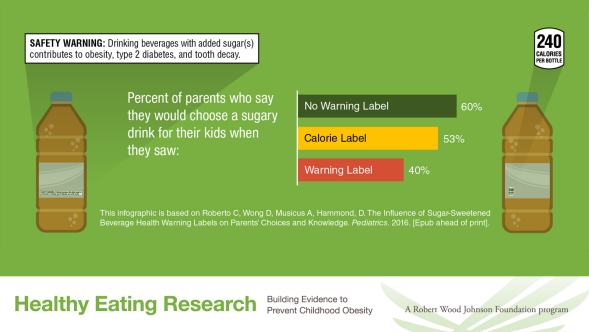
According to a recent poll directed by The California Center for Public Health Advocacy, 78 percent of California voters are in support for putting warning labels on sugary beverages. The poll was conducted through telephone where voters were asked if they would support warning labels that explain that daily consumption of sugary drinks is linked to health risks like diabetes, obesity, and tooth decay. Over fifty percent were "strongly" in favor of the warning labels, with 85 percent of Latino voters supporting the labels. Why? Many consumers (28%) wanted to have the "right to know the truth" about products they purchase and stated that labels may help parents make healthier choices and help reduce sugar consumption for their children. Studies have shown that having health ...
In January 2016, MotherToBaby launched a new bilingual (English/Spanish) digital initiative for expectant or breastfeeding moms and health care providers to get free expert information about the risks of medications and other exposures during pregnancy and breastfeeding through free, private instant messaging. In addition to live chatting, MotherToBaby also provides emailing-an-expert, texting an expert, and a library of free downloadable facts sheets in both English and Spanish. Expectant or breastfeeding moms can access instant messaging or emailing an expert by visiting www.MotherToBaby.org, or access texting with an expert by texting questions to ...
SaludToday Guest Blogger
Jefferson Dental Clinics Women with gum disease have up to a 36% higher risk of breast cancer, according to a recent study. That’s alarming given that 6 in 10 Latinos have gum disease (known as periodontal disease). Gum disease, which is mainly caused by poor oral health and smoking, occurs when pockets in the gums form around teeth, allowing the growth of bacteria that can cause teeth to loosen and even fall out. The connection between gum disease and cancer is profound. “Women with periodontal disease who were former smokers had a 36% higher risk of breast cancer, women who were smoking at the time of the study had a 32% higher risk of breast cancer, and non-smokers with gum disease were still at a 14% elevated risk,” said Dr. Leslie Renee ...
All kids, including Latinos, need a healthy school environment. How can we healthy schools become then norm? Some students are more exposed to unhealthy food in and out of school. Stronger nutrition standards for snack foods and drinks will help all students access to healthier snacks at school, which can positively influence body mass index (BMI) trends for all populations. In addition, some students also engage in less physical activity in school, and before and after school. Implementing relevant programs that reduce challenges can increase activity opportunities for Latino and all kids. See the Full Research Review with references (PDF)
Read the Issue Brief in English (PDF)
Read the Issue Brief in Spanish (PDF)
Contents
Introduction & Methods. This Salud America! ...
Recent data show communities living under the U.S. poverty line are more aware of the human papillomavirus (HPV) vaccine and vaccination rates in some of these communities is higher than in more affluent ones, The Guardian reports. However, not all patients are completing the entire vaccine series. For the article The Guardian interviewed Dr. Daisy Morales-Campos, a research instructor at the Latino Research Initiative at The University of Texas at Austin (formerly with Institute for Health Promotion Research at UT Health San Antonio). Dr. Morales-Campos directs Entre Familia, an HPV campaign aimed at people in South Texas. There are still a lot of challenges to access, according to Morales-Campos. “People there [in Hidalgo County] often do not have the transportation ...
What does a healthy school look like? Most people would agree that a healthy school would include learning well, eating well, and having time for breaks that include physical activity. Unfortunately, many kids are losing out on recess to increase activity in schools. Studies suggest that children are less likely to meet the recommendations for daily physical activity and are more likely to engage in sedentary behaviors. So how can we ensure all kids, including Latinos, eat and play well for a healthier life? Schools are where kids spend most of their time and consume half of their daily calories. Follow #SaludTues to tweet with us on Jan. 19, 2016, as we unveil the results of a new study that explores the impacts of unhealthy foods and unhealthy school environments that ...