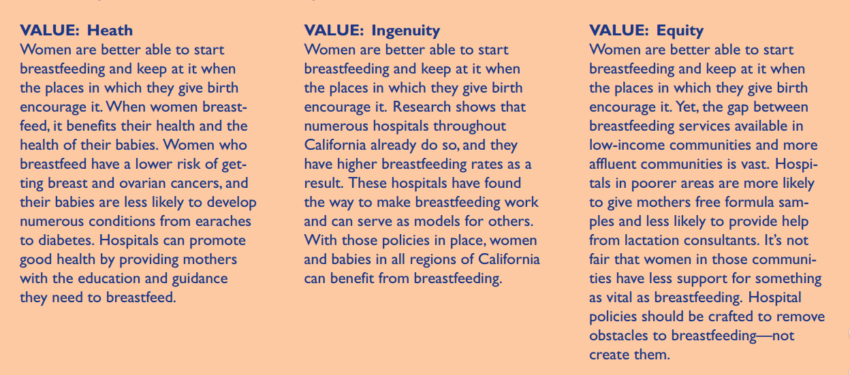
We all know that breastfeeding saves live and money, yet many moms, especially Latina moms, do not meet their own personal breastfeeding goals. Why not? According to a framing brief by Berkeley Media Studies Group (BMSG), the story on breastfeeding is narrowly framed around a portrait of the mother and baby rather than the context of real women's lives in which it takes place. Consider why Starbucks' executives get lactation rooms, but baristas have to lock themselves in the bathroom to pump breast milk. Advocates should look beyond the portrait towards to the landscape-social, cultural, political, structural, and environmental factors that make it difficult to breastfeed, like lack of support in hospitals, insufficient time and space in the workplace, unfriendly businesses, ...
Halloween and Dia de los Muertos are a few days away. Thanksgiving and Christmas after. Yup, holiday season is upon us. That's why, as holiday parties and performances stack up on busy calendars, pediatrician Diana Bojorquez of Kaiser Permanente has five big tips to keep Latino adults and kids healthy and happy, and lower their risk of weight gain and associated health issues.
1. Get enough sleep.
It’s important for everyone to maintain a regular shut-eye schedule – sleep restores and repairs our bodies, not to mention plentiful sleep helps with weight loss and mental capacity, among other health benefits. Adults should get 7 to 8 hours of sleep, and children need more, with very young ones needing as much as 12 hours nightly.
2. Prevent illness.
There are little things, ...
Making healthy choices is complex. In this digital age, people are bombarded by conflicting health messages and face social and environmental barriers to carry out the most basic essentials of healthy lifestyles-eating healthy and being physically active. Latinos face added barriers to making healthy choice due to lack of access to healthy food and safe places to walk and play. It's Time Texas interviewed 50 individuals in the government, healthcare, insurance, K-12 education, academic, business and community sectors across Texas to get a better understanding of these barriers and identify local opportunities and strategies to address and remove these barriers. They compiled these interviews into a white paper and six case studies, Building a Healthier Texas. The health and ...
Data-driven policy is winning in Santa Monica, Calif. (13.1 %Latino). Santa Monica is committed to improving resident's health by looking at housing, transportation, parks, and youths, thus was one of seven communities to receive the 2016 RWJF Culture of Health Prize. In 2012, Santa Monica developed a Wellbeing Index to measure what was hampering or helping the well-being of residents. “The options we give people really affect their ability to access things that can improve the quality of their lives," Francie Stefan, Santa Monica mobility manager, said to the RWJF. Housing. Santa Monica started improving resident's ability to access to affordable housing decades ago. Santa Monica requires developers to set aside a percentage of newly constructed units for affordable ...
From age 2 to 5, nearly 1 in 7 Latino boys are obese; by middle school, these rates go up to 22%. These facts and more about the overall health and education of young Latino males are discussed in a new report from the National Research Center on Hispanic Children & Families. The status is particularly important as Latino children currently make up nearly 25% of the all children in the United States and by 2050 are projected to be nearly 30%. With nearly half of all children male, how Latino boys and young men fare has a great impact overall on the country’s social and economic well-being. In order to reduce health disparities, it is critical to address inequities in programs, practices, and policies. Join our site, connect with others, and get involved. Other ...
In the rural Columbia Gorge region of Oregon and Washington, collaboration has truly been the key to elevating the culture of health of everyone in the area. This vast area is larger than the state of Connecticut, however only 75,000 people live in this extreme environment. While many high-tech companies have moved into new the riverfront properties in Washington (11.74% Latino population) and Oregon (12.15% Latino population), many in remote areas live in poverty and the nearest medical care is over an hour’s drive away. Orchards in the region produce bounties of pears, apples, and cherries and yet 1 in 5 people are food insecure on a regular basis. To bridge these disparities, the people of the Columbia Gorge region have turned an “ordinary requirement” into an extraordinary ...
Latino boys and young men are an often overlooked segment of our population. But it's important to understand the health habits and trends among Latino males, such as educational status, mental and physical health, chronic diseases, substance use, and more. Let’s use #SaludTues on Tuesday, September 20, 2016, to tweet about ideas and solutions to help address the needs of Latino boys and young men: WHAT: #SaludTues Tweetchat: "The Health & Education of Latino Boys & Young Men"
DATE: Tuesday, Sept. 20 2016
TIME: 1-2 p.m. ET (Noon-1 p.m. CT)
WHERE: On Twitter with hashtag #SaludTues
HOST: @SaludToday
CO-HOSTS: @NRCHispanic, @HispanicEd, and @MBK_Alliance We will open up the discussion to everyone so you all can share your insights, experiences, and ...
Physical activity and play are critical to a child’s physical, social, and mental development. Afterschool and out-of-school time programs are uniquely positioned to support physical activity, play, and healthy eating for children, especially Latinos who are less physically active than their peers. Let’s use #SaludTues on Sept. 13, 2016, to tweet about how out-of-schools providers can promote a healthy weight and spur lifelong healthy habits among Latino children. WHAT: #SaludTues Tweetchat: “How Out-of-Schools Programs Can Impact #LatinoHealth”
TIME/DATE: 1-2 p.m. EST Tuesday, September 13, 2016
WHERE: On Twitter with hashtag #SaludTues
HOST: @SaludToday
CO-HOSTS: National AfterSchool Association (@NatlAfterSchool), Texas State Alliance of YMCAs ...
The United States spends far more on health care than any other developed nation; a record 17.5% of the country’s gross domestic product in 2014 was spent on health care. However, life expectancy in the U.S. is lower, maternal and infant mortality is higher. Also, the prevalence of chronic illness is far more common in the U.S. than in European countries. These poor health outcomes are also connected to another type of spending where the country falls far below multiple European countries. In terms of social services that target education, housing, nutrition and poverty, the U.S. is spending significantly less. The Robert Wood Johnson Foundation (RWJF) analyzed this spending in 2011 and found the ratio of social service to medical care spending was associated with “better health ...