by
by 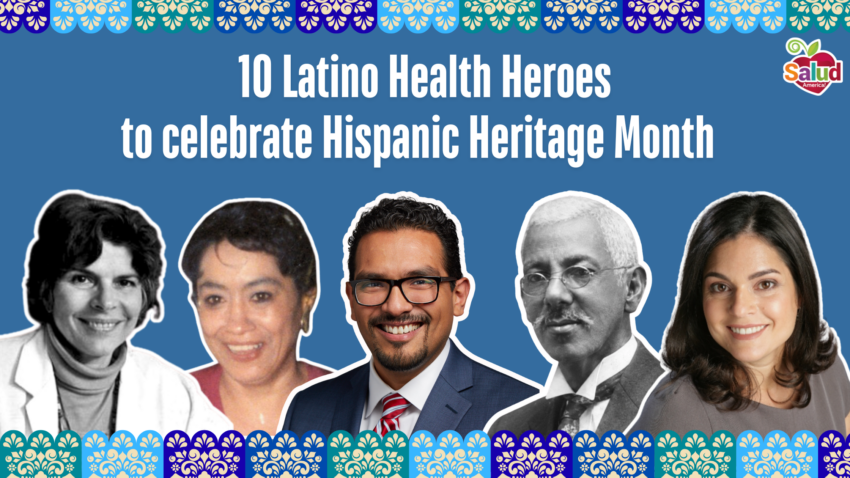
Share On Social!
Whether it’s in hospitals and clinics, out in the community, or online, there are many Salud Heroes who have helped improve health for all the people in their communities.
During Hispanic Heritage Month, Salud America! recognizes figures both throughout history and today who serve as health role models.
Let’s look at 10 Salud Heroes who have championed Latino health.
1. Dr. Jose Celso Barbosa
Dr. José Celso Barbosa Alcalá, also known as José Celso Barbosa, was the first Afro-Latino to obtain a medical degree in the United States.
Born in Bayamón, Puerto Rico, Barbosa valued education.
He graduated in 1880 from the University of Michigan Medical School as the valedictorian of his class, becoming the first Puerto Rican to earn a medical degree in the continental United States.
Records show that while Barbosa did face issues due to his background, he managed to thrive academically and helped change his community.
“He is best remembered in Puerto Rico not for his contributions to health care, however, but for his significant role in seeking independence from Spain and in [pushing] for statehood,” The University of Michigan states.
2. Dr. Martha Bernal
Dr. Martha Bernal blazed a trail as the first Latina to receive a PhD in psychology in the United States.
A Texas native, Bernal contributed significantly to two areas of psychology: learning theory and multicultural studies.
Through her work, she helped champion for more ethical and empirically valid interventions for child treatment.
Later in her career, Bernal focused on training, recruitment, and research for psychologists.
“She provided guidance and inspiration to a wide range and large number of psychologists of color, men and women,” according to Society for the Psychology of Women.
3. Dr. Franciso G. Cigarroa
Dr. Cigarroa serves as Senior Executive Vice President for Health Affairs and Health System at The University of Texas at San Antonio.
Throughout his illustrious career, Cigarroa has held many titles, including being named as the first Latino chancellor of The University of Texas System.
Cigarroa was introduced to medicine early in life through his father and grandfather and would eventually have a career as a pediatric surgeon.
Dr. Cigarroa would also serve as president of UT Health San Antonio from 2000 to 2009.
Through his career, he has worked to champion and address Latino health gaps.
“You don’t go into medicine to become an administrator. You [go] into medicine to take care of patients and to try to make life better. Opportunities are going to come before each and every point, one way or the other … but if it’s for the right reason then do it,” Cigarroa said.
4. Dr. Eneida Nemecek
Dr. Eneida Nemecek developed a passion for health at a young age.
Born and raised in Puerto Rico, Nemecek saw the dedication and effort her parents put into their education and was inspired to do the same.
Today she’s helping improve Latino health through clinical trial participation as associate director for clinical research at the Oregon Health & Science University (OHSU) Knight Cancer Institute and professor of pediatrics and medical oncology at OHSU.
“We have a responsibility, not only to educate our patients to participate, we also have a lot of responsibility to educate the people that are in medical school right now,” Nemecek said.
5. Dr. Helen Rodriguez Trias
Dr. Rodriguez Trias forged a path in public health as the he first Latina president of the American Public Health Association.
After obtaining her medical degree, Rodríguez-Trías would establish the first center for the care of newborn babies in Puerto Rico.
In New York, she would focus on community-based medicine as the director of pediatrics at Lincoln Hospital.
Throughout her career, Rodríguez-Trías would become a prominent supporter within the women’s health movement, focusing on the areas of reproductive rights and maternal health.
In 1993, Rodríguez-Trías became the first Latina to be elected president of the American Public Health Association.
“We cannot achieve a healthier us without achieving a healthier, more [fair] health care system, and ultimately, a more [fair] society,” Rodríguez-Trías said.
6. Dr. Jorge Moreno
Originally from Mexico, Dr. Jorge Moreno moved to New York at the age of 6.
Dr. Moreno’s parents didn’t speak English, with Jorge often serving as a translator when the family went to see the doctor.
These experiences inspired Jorge to become a doctor who could provide culturally competent care.
During the height of the COVID-19 pandemic, Moreno served as a liaison for the Latino community.
“I was happy to be able to do this outreach for the Latino community because it was much needed,” Jorge said.
Today, Dr. Moreno is an Assistant Professor of Medicine in the Section of General Internal Medicine at Yale School of Medicine and serves as the Assistant Medical Director of Yale Internal Medicine Associates.
7. Lupe Hernandez
Clean hands are critical to reduce the spread of infection.
In 1966, nursing student, Lupe Hernandez, realized alcohol in gel form could be an effective way to clean hands when soap and water weren’t available.
Over 50 years later, Hernandez’s invention is still saving lives against threatening diseases and protecting brave medical professionals.
Hand sanitizers are an important supplemental health habit, but not an alternative to washing hands. Social distancing is the safest way to slow the spread of the novel coronavirus.
8. Erik Cardenas
Growing up, Erik Cardenas saw the health gaps that Latinos experience first-hand.
Cardenas would develop a passion for technology and eventually bring telehealth services, including COVID-19 care, to patients in seconds.
His work made a huge impact on keeping Amazon employees healthy during the COVID-19 pandemic.
Eventually, Cardenas decided to start his own telehealth company focused on providing affordable primary healthcare for Latino families.
“Our goal was to reduce the cost of care while improving health outcomes for the Latino community. We didn’t want Latinos to choose between paying for a medication or other essential expenses,” Cardenas said.
9. Dr. Gus Alva
Dr. Gus Alva had a goal to help Latinos heal from diseases like Parkinson’s.
That’s why he teamed up with Acadia Pharmaceuticals and StoryCorps nonprofit for the “Yours, Truly” campaign, a bilingual effort to use multicultural storytelling to bring awareness to the non-motor symptoms of Parkinson’s disease.
Alva serves as the medical director of ATP clinical research, a neuropsychiatric clinical research company in Costa Mesa, Calif. (35.6% Latino).
He is also an associate professor in the Department of Psychiatry and Human Behavior at the University of California, Irvine.
“Anything that speaks toward advocacy and enhances education for the public about areas that are really important, such as Parkinson’s disease psychosis, is an area that I always like being involved with,” Alva said.
10. Ildaura Murillo-Rohde
Dr. Murillo-Rhode was a nurse and professor who strived to serve overlooked communities and create opportunities for Latinos within health professions.
Early on, she realized there were few Latino nurses working to serve the largely Latino community of San Antonio.
This underrepresentation would inspire Dr. Murillo-Rohde to help Latinos achieve an education to not only better themselves, but also to serve the community.
Dr. Murillo-Rohde founded the National Association of Hispanic Nurses (NAHN), formerly known as the Spanish Speaking/Spanish Surnamed Nurses’ Caucus, in 1975.
“I saw that I was the only Hispanic nurse who was going to Washington to work with the federal government, review research and education grants, etc.,” Dr. Murillo-Rohde said, according to the NYAM Center for History. “There was nobody else. I looked behind me and thought: ‘Where are my people?’”
Explore More:
Increasing RecognitionBy The Numbers
3
Big Excuses
people use to justify discriminatory behavior
This success story was produced by Salud America! with support from the Robert Wood Johnson Foundation.
The stories are intended for educational and informative purposes. References to specific policymakers, individuals, schools, policies, or companies have been included solely to advance these purposes and do not constitute an endorsement, sponsorship, or recommendation. Stories are based on and told by real community members and are the opinions and views of the individuals whose stories are told. Organization and activities described were not supported by Salud America! or the Robert Wood Johnson Foundation and do not necessarily represent the views of Salud America! or the Robert Wood Johnson Foundation.