by
by 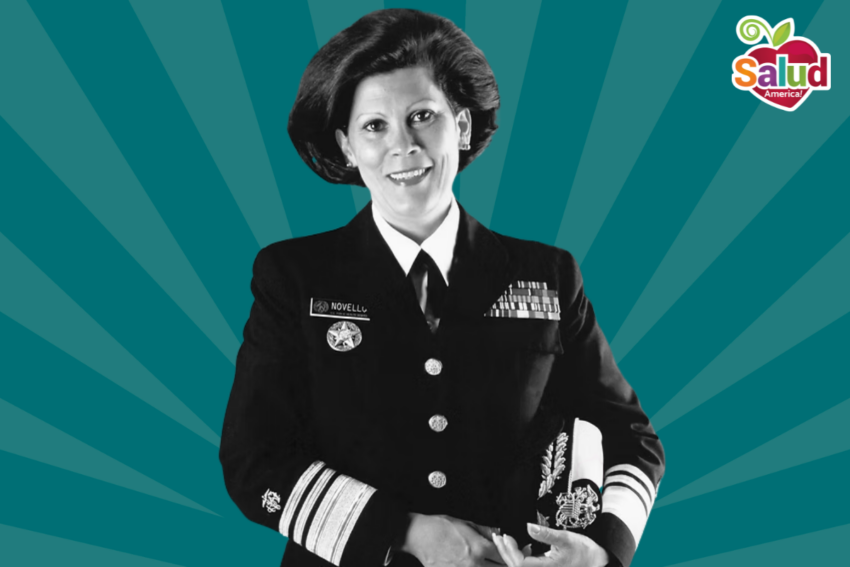
Share On Social!
Our life experiences can shape who we are and what we strive to be in the future.
This can certainly be said about Dr. Antonia Novello, the first woman and Latina to be appointed as Surgeon General in the United States.
During Hispanic Heritage Month, Salud America! is celebrating Latino trailblazers, historical figures, and inspirational stories.
This year we are recognizing Dr. Antonia Novello, a physician and public health administrator with a strong legacy for promoting health for all.
What Was Early Life Like for Antonia Novello?
Antonia Novello was born Antonia Coello in 1944 in Fajardo, Puerto Rico, an unincorporated territory of the United States.
As the eldest of 3 siblings, Novello experienced health challenges early in her life.
“As a child, Novello suffered from a condition called congenital megacolon, an abnormality of the large intestine. The condition limited her energy and activities,” according to The National Women’s History Museum.
Novello spent her summers getting interim treatment in a local hospital because her family could not afford the surgery that would correct the congenital megacolon.
She ended up getting corrective surgery at age 18 and again at 20.
“This experience left Novello determined to become a doctor, so that she could help other sick children, especially those who struggled to access the medical care they required,” The National Women’s History Museum states.
Antonia Novello Excels in Education and Enters the Medical Field
Novello began higher education at the University of Puerto Rico in 1965.
She went on to attend the University of Puerto Rico School of Medicine, graduating in 1970 and later married her husband and U.S. Navy flight surgeon, Joseph R. Novello.
“She later completed her medical training in nephrology (the study of the kidneys) at the University of Michigan, where she was first woman to be named Intern of the Year,” according to the National Library of Medicine.
During her time in Michigan, Novello completed her residency in pediatrics and her postgraduate work at Georgetown University. Later, she joined the U.S. Public Health Service Commissioned Corps in 1978.
She worked with the National Institute of Arthritis, Metabolism and Digestive Disorders at the National Institutes of Health and became deputy director of the National Institute of Child Health and Human Development, where she focused on pediatric AIDS.
“Novello spent two years in private practice, but found caring for critically ill children emotionally challenging,” according to the National Women’s History Museum.
Novello felt called to the public health field to improve health for the broader population.
So, in 1982, Novello earned her degree in public health from Johns Hopkins School of Hygiene and Public Health.
“In 1982 and 1983 she also served as a congressional fellow on the staff of the Labor and Human Resources Committee, advising the legislators on bills dealing with such health issues as organ transplants and cigarette warning labels,” according to Britannica.
Antonia Novello Becomes U.S. Surgeon General
In the 1990s, then-President George H.W. Bush took notice of Novello’s work.
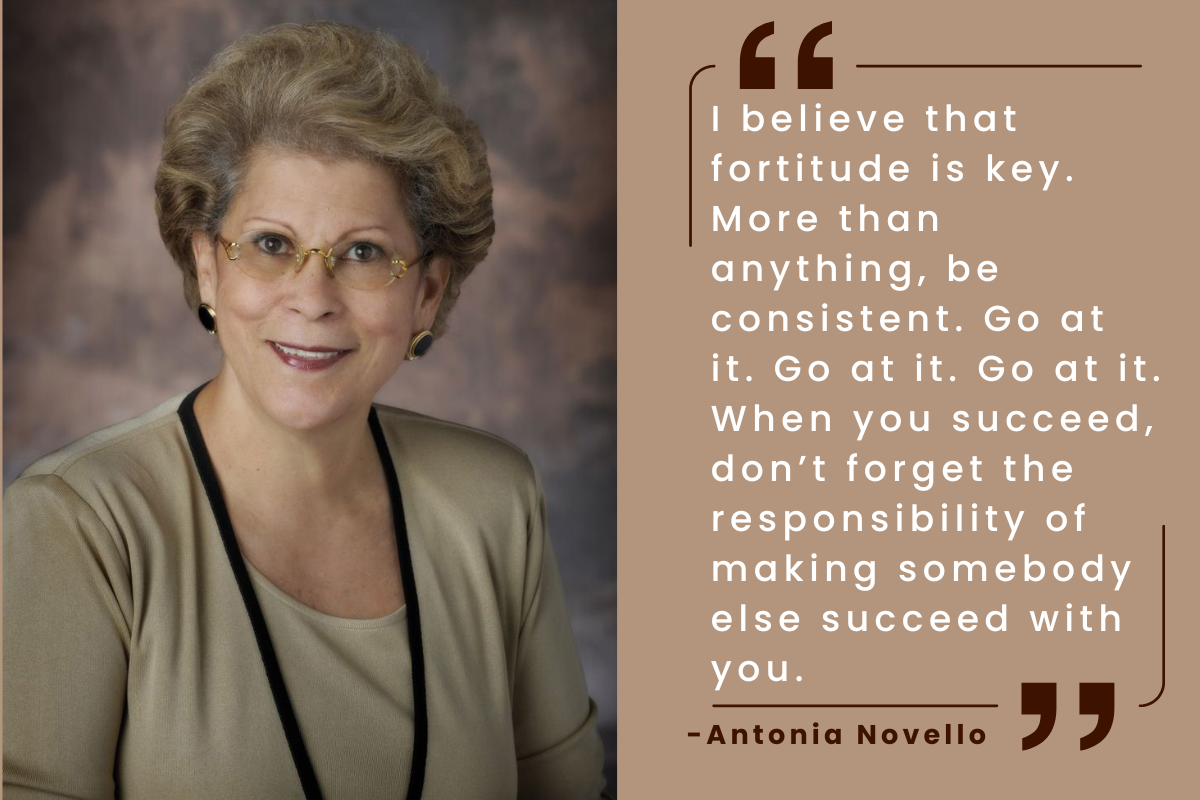
He appointed her as the first Latina woman as Surgeon General of the United States.
As Surgeon General from 1990 to 1993, Novello focused on improving health for women, children, and other populations.
“She issued reports and spoke out on under-age drinking, smoking, drug abuse AIDS (especially among women and adolescents), childhood immunization and injury prevention, and improved health care for Hispanics and other [populations],” according to the National Library of Medicine.
Novello worked to end tobacco advertising aimed at children, such as cigarette ads with the “Joe Camel” cartoon.
She also worked and recognized the need to focus on women with AIDS and to strive to prevent the neonatal transmission of HIV.
Throughout her career, she also promoted early childhood health initiatives such as injury prevention and immunization, and raised awareness about domestic violence in the U.S.
Novello would move on from her role as surgeon general in 1993 and become a representative for the United Nations Children’s Fund (UNICEF).
“She continued to address women’s and children’s health issues, working to eliminate nutritional problems such as iodine deficiency and to prevent substance abuse and smoking,” Britannica states.
Antonia Novello and Later Accomplishments
From 1996 to 1999, Novello served as a visiting professor of health policy and management at Johns Hopkins School of Health and Hygiene.
“In 1998, Novello organized an unprecedented meeting between Surgeon General David Satcher and seven others, besides herself, who had held the office,” according to the Library of Medicine.
In 1999, she became commissioner of the New York State Department of Health, the largest public health agency in the country and served until 2007.
Ultimately, Novello would retire as the Executive Director of Public Health Policy at the Florida Hospital for Children in Orlando from 2008 to 2014.
Despite this, Novello continued to serve others, including helping with hurricane relief and helping administer vaccinations in Puerto Rico.
Throughout her impressive career, Novello also received several awards, including the Public Health Service Commendation Medal, the Congressional Hispanic Caucus Medal, the Order of Military Medical Merit Award, and the James Smithson Bicentennial Medal.
“Service is the rent that you pay for living,” said Novello at the Northwestern University Feinberg School of Medicine in 2016.
How to Make a Difference for Health Like Antonia Novello
You can help your community get healthier.
Start by downloading a Salud America! Health Report Card for your town!
Enter your county name and get auto-generated local data with interactive maps and comparative gauges on several health indicators. This can help you visualize and explore local issues in education, housing, transportation, food, health, and more.
See how your county stacks up compared to the rest of your state and nation.
Then email the Report Card to local leaders to raise awareness, include the data in a presentation or grant proposal, or share it on social media to drive healthy changes in your community!
Explore More:
Increasing RecognitionBy The Numbers
3
Big Excuses
people use to justify discriminatory behavior
This success story was produced by Salud America! with support from the Robert Wood Johnson Foundation.
The stories are intended for educational and informative purposes. References to specific policymakers, individuals, schools, policies, or companies have been included solely to advance these purposes and do not constitute an endorsement, sponsorship, or recommendation. Stories are based on and told by real community members and are the opinions and views of the individuals whose stories are told. Organization and activities described were not supported by Salud America! or the Robert Wood Johnson Foundation and do not necessarily represent the views of Salud America! or the Robert Wood Johnson Foundation.