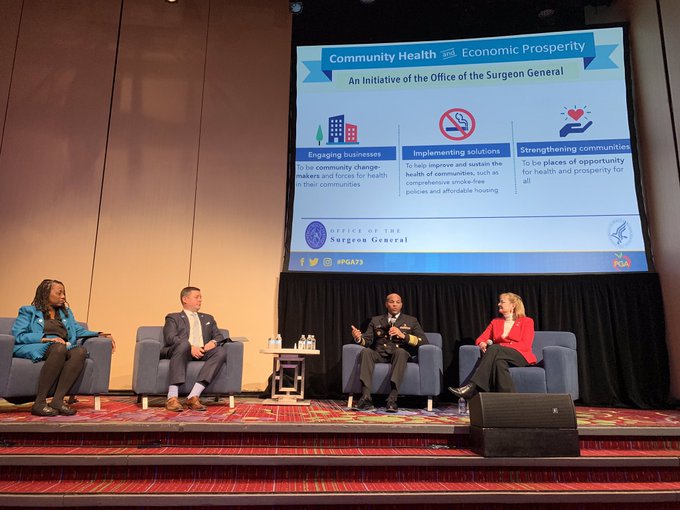
The status quo for health in America is expensive and failing. Medical care is costly for individuals, communities, businesses, and employers. But the U.S. ranks only 27th in life expectancy out of 35 Organization of Economic Cooperation and Development (OECD) countries. It also has the highest prevalence of obesity, with even worse rates among Americans of color. That’s why one of Surgeon General Dr. Jerome Adams’ priorities is to highlight and reverse inadequate investments in disease prevention and inequitable economic opportunities in our communities. Last year, Adams launched the “Community Health and Economic Prosperity” or “CHEP” initiative. “CHEP is the concept that community health and economic prosperity are inextricably linked,” according to the ...
Latinos will account for the largest non-white voter demographic in history, as 2 million Latinos are expected to vote during the 2020 presidential election. Moreover, every 30 seconds, a young Latino in the United States becomes eligible to vote. This data, collected by the Pew Research Center and the U.S. Census, respectively, makes one thing clear: the Latino vote will play a key for the 2020 election outcome. Due to the numerous disparities impacting this community, especially amid COVID-19, issues like the economy and health care—not immigration—will drive the Latino vote in 2020, according to a new report by the UCLA Latino Policy and Politics Initiative. “Latinos will be critical in deciding the most consequential election of our lifetime,” Sonja Diaz, founding ...
Fake news. Alternative Facts. Propaganda. In an election year, disinformation is rampant. Political candidates and organizations may aim to mislead the public about their opponents to get voters in their favor. In recent years, we’ve seen an increase in disinformation from foreign countries seeking to confuse Americans even more. Latinos are particularly at risk of being victims of disinformation in an election year. Many false claims about voting and candidates take aim at Latino voters. It’s important that we learn what disinformation is, how it affects Latinos, and how to avoid it this election season.
What is Disinformation?
Disinformation is false information deliberately and often covertly spread in order to influence public opinion or obscure the truth, according to ...
Ángela García wasn’t planning on becoming an artist. She entered college in the pre-med track, intending to go into a medical career. But then she started taking art history classes. And she kept taking them, despite still being in the pre-med track. “I was like, ‘You know what? I don’t like this. Maybe I don’t like the sciences as much as I thought I did. And I’m really interested in this art history curriculum.’ So, I switched over at the end of my sophomore year,” García said. Now she’s a senior art history major at Trinity University in San Antonio, Texas, with several large-scale art projects under her belt, having rekindled a passion for creative work from her childhood. “I used to do painting when I was younger but I kind of fell out of it for a ...
Breast cancer doesn’t impact every women the same. Among Latinas, breast cancer is the No. 1 cancer killer. Many Latinas face unique survivorship journeys, shaped by cultural and spiritual beliefs and struggles with barriers to care, screening, patient-doctor communication, and other social determinants of health. To recognize Breast Cancer Awareness Month (October), let’s use #SaludTues on Oct. 27, 2020, to tweet about the latest progress in Latina breast cancer data and research, the importance of breast cancer screening, and tips and stories for prevention and survivorship! WHAT: #SaludTues Tweetchat “How to Reduce Breast Cancer and Improve Survivorship among Latinas”
WHERE: Twitter
WHEN: 1-2 p.m. ET (12-1 p.m. CT), Tuesday, Oct. 27, 2020
HOST: Salud ...
Latinos and other people who have diabetes are getting more access to much-needed supplies amid COVID-19. Beyond Type 1—a diabetes nonprofit organization—launched a new bilingual tool last week: GetInsulin.org in English and GetInsultin.org in Spanish. This online platform is a tool to help those using insulin find inexpensive options. It also has assistance programs for patients in any financial circumstances. “The job losses we’ve seen during COVID-19 mean that many individuals who lost their employer-based health insurance due to COVID-19 are experiencing insulin access issues for the first time in their lives,” Christel Marchand Aprigliano, Beyond Type 1's chief advocacy officer, told Healio. “List prices for insulin are high, so a sudden insurance loss may ...
If you interact with Salud America! in any way, we want to hear from you! Take the 2020 Salud America! Survey to let us know what you think about our digital communications for awareness and action around Latino health equity.
1. Take the Survey to Enter to Win an iPad!
Why not get something free?! If you take the survey by Nov. 8, 2020, you can enter a raffle for a free iPad! TAKE THE 2020 SALUD AMERICA! SURVEY
2. Take the Survey Because You Care!
You're on our website right now. We know you care about health, whether you got here from a tweetchat or email or web page or video. If you take our survey, it can help us better understand how our digital content motivates and impacts efforts to promote Latino health equity. We want a society where everyone has a just ...
Children of color continue to struggle with obesity. Obesity rate continues to be significantly higher for Latino (20.7%) and black children (22.9%) than for white children (11.7%) ages 10-17, according to the new State of Childhood Obesity report from the Robert Wood Johnson Foundation (RWJF). Obesity—and other chronic diseases—are more prevalent among those of color and those in poverty because discriminatory systems have disinvested in healthy policies and basic resources for them. In the midst of the current COVID-19 pandemic, which is worsened by obesity, it is more critical than ever to prioritize children’s health. Latino children and young adults account for over 40% of the COVID-19 deaths among people ages 0-24, according to the CDC. To prioritize children’s ...
Latinos face many transportation inequities that impact their ability to build health and wealth. This is due in part to a lack of diversity among decision makers, planners, and engineers and ethnocentric policies, projects, and investments that reinforce the auto-centric status quo. Ultimately, past and present planning practices have failed to be inclusive of Latino needs, failed to represent historic and existing inequities, and failed to responsibly evaluate and measure impacts, targets, and performance. Two new reports from our year-long workgroup of planners and planning scholars provide recommendations to prioritize Latino experiences and needs in the planning process; address inequities and promote racially/economically mixed communities, and modify metrics used to ...