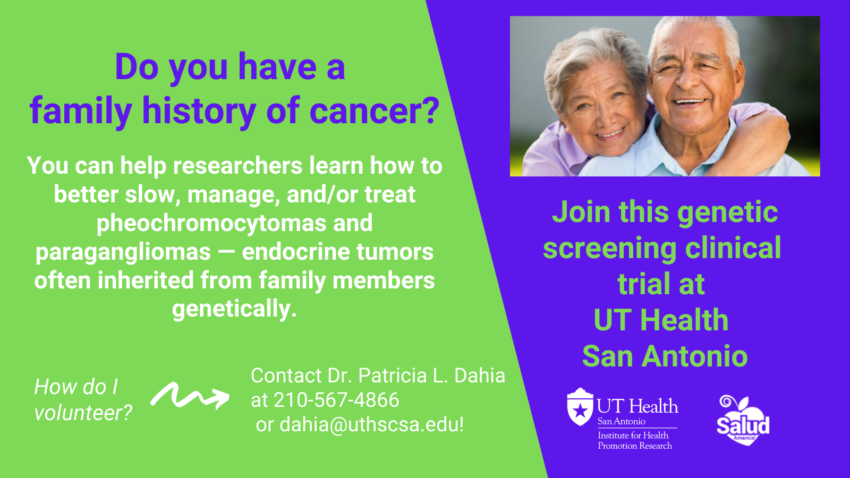
While some cancers develop through unhealthy habits like smoking, others happen through genetics. Clinical trials with volunteers who have a family history of cancer can help researchers learn how to better slow, manage, and/or treat these diseases. This can help save the lives of people whose family experiences cancer generationally. If you have a family history of cancer, you can join a clinical trial at UT Health San Antonio that is studying pheochromocytomas and paragangliomas — endocrine tumors often inherited from family members genetically. “A family history of endocrine tumors could mean you and your loved ones have a higher risk,” said Dr. Amelie Ramirez, director of the Institute for Health Promotion Research and the Salud America! program at UT Health San ...
Volunteering for Christmas and New Year’s helps other people. It gives the volunteer a nice emotional boost, too. So why not volunteer your "voice" or "actions"? We at Salud America! invite you to take these nine actions to promote health equity for Latino and all families this holiday season!
1. Share Stories of Latinos Who Changed Their Hearts and Got the COVID-19 Vaccine!
To help move Latinos from vaccine hesitancy to vaccine confidence, Salud America! is uplifting the stories of real Latinos who overcame misinformation, got the vaccine, reconnected with family, and are helping end the pandemic. Share these “change of heart” heroes in English or Spanish! Rosa Herrera read on Facebook that the vaccine would inject her with a microchip. She learned that was a myth. ...
A new strain of the COVID-19 virus is spreading, and the Omicron variant has already reached North America, experts say. This is yet another mutation, following the Delta variant, that was first identified in South African researchers. It has quickly spread to other continents. Health experts, such as former FDA Commissioner Dr. Scott Gottlieb, urge people to not get over-worried too quickly about Omicron, but still take available precautions like getting the COVID-19 vaccine and booster shot. "Is this making people more ill? There's no indication that it is. And in fact, there's some anecdotal information offered from physicians in South Africa that this could be causing milder illness. Now, that could be an artifact of the fact that initial cases seem to be clustered in younger ...
We know Latinos and other racial/ethnic minorities experience health, social, and environmental inequities that increase their risk for disease. But just how widespread is the problem? Very few states do not face major issues with health inequities and health disparities, according to the Commonwealth Fund’s new report, “Achieving Racial and Ethnic Equity in US Health Care: A Scorecard of State Performance.” The authors of the report list many inequities that make an impact, and they also note that the system that promotes these trends is to blame. “Decades of policy choices made by federal, state, and local leaders have led to structural economic suppression, unequal educational access, and residential segregation, all of which have contributed in their own ways to ...
Stomach cancer, also called gastric cancer, disproportionately impacts Latinos. In fact, U.S. Latino men and women are twice as likely as their White peers to develop invasive gastric cancer, according to a 2021 report. But little is known about regional differences. That is why Dr. Dorothy Long Parma of UT Health San Antonio and her colleagues conducted a study to analyze gastric cancer rates for Latinos in South Texas, Texas, and the United States. "We found that overall stomach cancer incidence rates in Texas and South Texas were higher in Latinos than in non-Latino Whites, despite lower frequencies in the state and South Texas region compared to the United States," said Long Parma, assistant professor/research at the Institute for Health Promotion Research (IHPR) in the ...
The expanded child tax credits are working to help families make ends meet and experience less stress, a new survey shows. As part of the American Rescue Plan, Congress expanded the child tax credit in March 2021. Since July, the IRS has been providing cash benefits to most households with children, including some of the country’s poorest families. Now, given sufficient time to study this effort, a survey by the Center for Law and Social Policy found that the enhanced child tax credit made a difference for many parents and children. Many Latinos and other families of color benefitted, but many immigrants also were left out. “Consistent and broad evidence [shows] that this policy is working as intended,” Zach Parolin, who has studied the tax credit at Columbia University’s ...
Dr. Benjamín Aceves wasn’t sure if he wanted to pursue a PhD. He was hesitant about the commitment. He didn’t have a background in academia that many pursuing PhD programs do. But after attending the Éxito! Latino Cancer Research Leadership Training at UT Health San Antonio, Aceves grew his network of scholars and learned about resources that could help him succeed in a PhD program. “My experience at Éxito! was mind-opening for sure,” Aceves said. He went on to earn his PhD and now is a postdoctoral scholar at the University of California in San Francisco, where he researches the intersection of Latino health, chronic disease prevention, and the social determinants of health.
Learning About Éxito!
Aceves learned about Éxito! from his peers, who encouraged him to ...
The patient economic burden for cancer in the U.S. was $21.09 billion, according to the Annual Report to the Nation on the Status of Cancer in JNCI: The Journal of the National Cancer Institute. “[This total is] made up of patient out-of-pocket costs of $16.22 billion and patient time costs of $4.87 billion,” according to the annual report. As technology, cancer research, and medicine advances, the effectiveness of therapy treatments only seem to proliferate. Though this is good news, the reality is that modern cancer treatments are a financial burden to people of color, who also face barriers to equitable cancer care. Latinos in particular face obstacles such as poor health literacy, concerns about test efficacy, and language and cultural beliefs related to cancer, ...
This week is the American Cancer Society's Great American Smokeout. This observance emphasizes the need to stop youths from smoking or help them quit smoking. One thing that is working is flavored tobacco bans or restrictions. "Policies that restrict the sale of flavored tobacco have the potential to curb youth tobacco use in as few as 6 months," according to a recent study from the Massachusetts Department of Public Health and RAND Corporation. Let's explore how leaders are addressing youth use of flavored tobacco products.
What Did a Massachusetts Study Reveal about Flavored Tobacco Bans?
A 2019 Massachusetts and RAND Corporation study evaluated the short-term impact of a flavored tobacco restriction policy on youth access to, and use of, flavored tobacco products in Lowell, ...