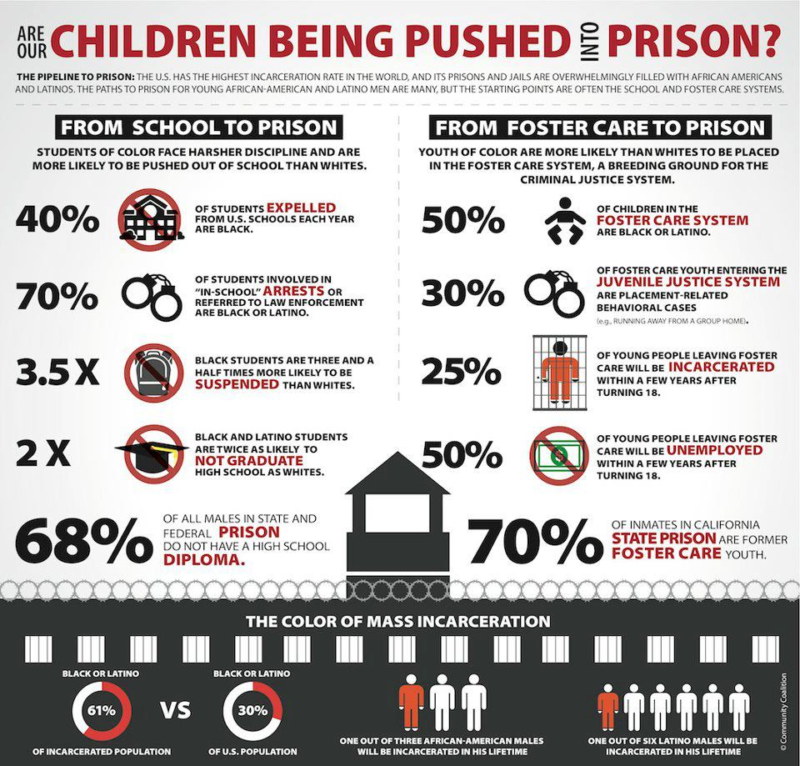
School suspensions are usually thought of as the last resort punishment for severe disruptions in the classroom. But did you know that children as young as three years old are being sent home for behavior problems which could have been addressed with positive school supports? In June of 2017, Texas House Bill 674 was passed which prohibits so called “discretionary suspensions” in Pre-K through 2nd grade children. These types of suspensions create a zero tolerance policy which studies have shown lead to higher rates of school dropout, lower academic performance, and decreased academic performance. This effect is widely known as the “School-to-Prison Pipeline”. Reasons for discretionary suspensions include horseplay, dress code violation, and violation of classroom rules. This ...
Health equity can be a hard-to-understand concept. A new report has a clear, simple definition: "Health equity means that everyone has a fair and just opportunity to be healthier." Achieving health equity means removing obstacles to health. Obstacles like "poverty, discrimination, and their consequences, including powerlessness and lack of access to good jobs with fair pay, quality education and housing, safe environments, and health care," according to the report. The report is by the Robert Wood Johnson Foundation (RWJF) and the University of California, San Francisco. Unfortunately, health equity sometimes doesn't exist. Latinos and other minority and low-income groups suffer health inequities and disparities. These are deeply rooted in socio-economic ...
Despite significant gains made under the Affordable Care Act (ACA), Latinos still remain the largest uninsured population in the country. A lack of access to health care has been one of the most persistent causes of health inequity for many Latino families. One of the main barriers to access is often the cost associated with health insurance. A new report has determined that the costs for healthcare may have leveled off, but that is not necessarily a positive. According to a report from PricewaterhouseCoopers' Health Research Institute (HRI), a “new normal” for medical costs has been determined. The HRI expects the medical cost growth to be 6.5% from where it is this year for 2018. “Even with net growth rate expected to hold at 5.5% for next year, [due to likely changes in ...
We believe in grassroots changes that help families have healthy lives. That's why we at Salud America! at UT Health San Antonio are proud to partner with Univision for a campaign to promote healthy change in San Antonio. The campaign will periodically feature our heroes of change on Univision 41's afternoon news and mid-day digital broadcasts, Edicion Digital. These San Antonio heroes of change, who we call Salud Heroes, are adding fruits and veggies to corner stores, creating community gardens, launching fitness programs in parks, and promoting water over sugary drinks. Our first Univision 41 segment in May 2017 featured the amazing Baby Cafe in San Antonio, which provides support and peer networking for Latina and all moms who breastfeed their babies. The hashtag ...
Drowning is the No. 2 cause of death for toddlers. Many others suffer submersion injuries that may cause major brain injuries, especially among minority children. Why is this? Many Latino and other minority children can't swim and lack access to swimming lessons and pools, which can cause a fear of water. This, in turn, can increase their risk of drowning and lessen their chances of participating in beneficial physical activity in water, from swimming to underwater handstands to water skiing and tubing. Latino children need access to places to learn to swim, which also has been proven to increase children’s confidence, motor skills, and academic achievement. Let's use #SaludTues on June 20, 2017, to tweet about how great swimming is and how to improve Latino kid’s access ...
Access to healthcare is one of the main inequities that many Latinos regularly face. Despite being the largest racial and ethnic minority group in the country, they are still the largest uninsured group in the nation. In California, an effort has been underway for quite some time to help alleviate the problem. However, it has faced a temporary setback. A proposed program in the heavily Latino-populated state of California (38.39% Latino population) that would have given health benefits to all undocumented young adults as part of Medi-Cal failed to make it into the state’s budget. Known as “Health for All Young Adults,” the program has been spearheaded by the Latino Coalition for a Healthy California, the California Immigrant Policy Center, and Health Access California. The ...
A brain aneurysm changed the life of María Emilce López forever—for the better. While a grad student at the University of Minnesota in the 1990s, the Argentine native’s severe headaches led her to be rushed into surgery to treat what turned out to be a brain aneurysm. This was her first, very scary brush with the American medical system. After her ordeal, she decided it was time to help others who might be in a similar position. López, now a senior teaching specialist at the University of Minnesota, helped create new medical Spanish classes that not only teach cultural competency, but also had a unique requirement of students. Update 6/19/20: López passed away in June 2020. Our thoughts and prayers are with her family.
Navigating a health crisis María Emilce ...
Latinos are the youngest major racial or ethnic group in the United States. About 1 in 3 of the nation's Latinos are younger than 18, and nearly 6 in 10 Latinos are either millennial (ages 18-33) or younger, Pew research shows. But, as Latinos and all millennials become a larger portion of the U.S. workforce, the reality of the "millennial wage gap" is growing, Fortune reports. The average wage for millennials is the highest, $40,046 a year, in Washington, D.C. (10.16% Latino population). The lowest by far, $16,999, is in Mississippi (2.9% Latino). The national average is $40,356 for workers ages 35-65. "Millennials may act as if they’re entitled to ultrahigh salaries, but in most parts of the U.S. they still don’t earn them," Fortune reports.
How Much Do Latino ...
For many immigrant families, the current political climate adds a great deal of stress to their lives. Many Latinos already face inequities in health care; they are still the largest uninsured population in the U.S. In South Carolina (5.2% Latino population), this stress is now manifesting in even harsher ways. According to a report in The Post and Courier, many immigrant families in the state are not only foregoing health care services for the adult family members, but also their children. “We’ve gotten calls from the health department of mothers not coming to ... appointments, not showing up for immunizations,” said Julie Smithwick, executive director of the Latino assistance group PASOs. The statewide group connects Latino patients to health care resources across South ...