SaludToday Guest Blogger
Jefferson Dental Clinics Women with gum disease have up to a 36% higher risk of breast cancer, according to a recent study. That’s alarming given that 6 in 10 Latinos have gum disease (known as periodontal disease). Gum disease, which is mainly caused by poor oral health and smoking, occurs when pockets in the gums form around teeth, allowing the growth of bacteria that can cause teeth to loosen and even fall out. The connection between gum disease and cancer is profound. “Women with periodontal disease who were former smokers had a 36% higher risk of breast cancer, women who were smoking at the time of the study had a 32% higher risk of breast cancer, and non-smokers with gum disease were still at a 14% elevated risk,” said Dr. Leslie Renee ...
All kids, including Latinos, need a healthy school environment. How can we healthy schools become then norm? Some students are more exposed to unhealthy food in and out of school. Stronger nutrition standards for snack foods and drinks will help all students access to healthier snacks at school, which can positively influence body mass index (BMI) trends for all populations. In addition, some students also engage in less physical activity in school, and before and after school. Implementing relevant programs that reduce challenges can increase activity opportunities for Latino and all kids. See the Full Research Review with references (PDF)
Read the Issue Brief in English (PDF)
Read the Issue Brief in Spanish (PDF)
Contents
Introduction & Methods. This Salud America! ...
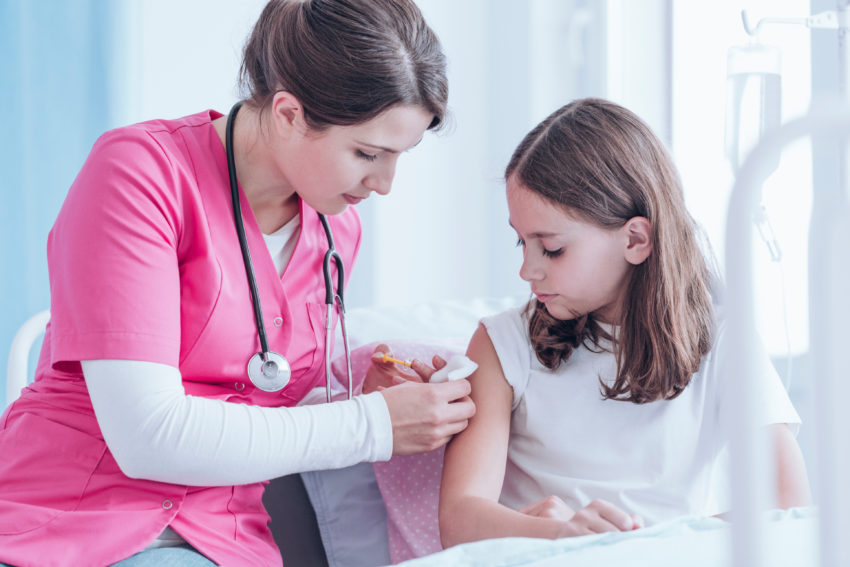
Recent data show communities living under the U.S. poverty line are more aware of the human papillomavirus (HPV) vaccine and vaccination rates in some of these communities is higher than in more affluent ones, The Guardian reports. However, not all patients are completing the entire vaccine series. For the article The Guardian interviewed Dr. Daisy Morales-Campos, a research instructor at the Latino Research Initiative at The University of Texas at Austin (formerly with Institute for Health Promotion Research at UT Health San Antonio). Dr. Morales-Campos directs Entre Familia, an HPV campaign aimed at people in South Texas. There are still a lot of challenges to access, according to Morales-Campos. “People there [in Hidalgo County] often do not have the transportation ...
What does a healthy school look like? Most people would agree that a healthy school would include learning well, eating well, and having time for breaks that include physical activity. Unfortunately, many kids are losing out on recess to increase activity in schools. Studies suggest that children are less likely to meet the recommendations for daily physical activity and are more likely to engage in sedentary behaviors. So how can we ensure all kids, including Latinos, eat and play well for a healthier life? Schools are where kids spend most of their time and consume half of their daily calories. Follow #SaludTues to tweet with us on Jan. 19, 2016, as we unveil the results of a new study that explores the impacts of unhealthy foods and unhealthy school environments that ...
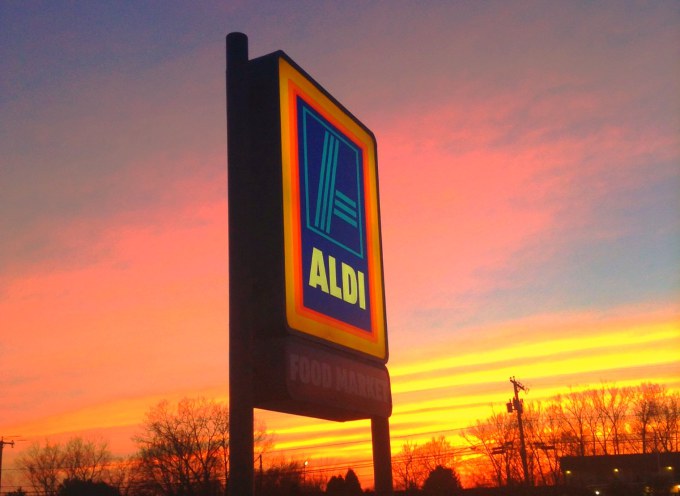
ALDI has pledged to become the first United States supermarket chain to remove junk food from all checkout areas. On January 12, 2016, the discount retail grocer announced that all checkout lanes will offer healthier items reduced in calories, fat, sugars and sodium. The checkout lanes across ALDI's 1,500 locations are to be stocked by the end of 2016 with items like single serve nuts, trail mixes, dried fruits and various low sugar granola bars. The first stores that will see the promised changes include St. Louis, Los Angeles, Dallas, Houston, Chicago and Minneapolis. The Center for Science in the Public Interest has reported that temptations of junk food, especially placed at kid's eye level are hard to resist for shoppers and children, who's willpower is fatigued after hours ...
Schools often have physical activity facilities, but many are not open to the public. Shared use agreements—contracts between a school and a city, county, or sports league that outlines rules for sharing existing facilities—can help neighborhoods have more access to active spaces and help kids stay active and healthy, according to our new infographic on shared use agreements. The infographic is part of Salud America!’s Active Spaces and Kids research package, which tackles the latest issues on the physical activity environment and offers recommendations. Share this infographic today! Salud America! is a Robert Wood Johnson Foundation-funded national childhood obesity prevention and communication ...
The east side neighborhood of San Antonio struggles with socioeconomic hardships, health issues, and a lack of access to quality healthcare. In the past few years, the nonprofit Eastside Promise Neighborhood (EPN) has sought ways to improve conditions for residents in the city’s east side. To solve the gap in the availability of healthcare options in the area and fight health issues, the EPN partnered with a provider, CommuniCare Health Partners, to open a new health clinic in the area.
Health improvement needed in San Antonio
San Antonio’s historic east side neighborhood is home to 17,955 residents (mostly Latino), more than 200 private businesses, and six schools on 3.5 square miles bounded by Interstate 37 to the west, Fort Sam Houston to the north, AT&T Center Parkway ...
Many kids lack access to active spaces and safe streets where they can be physically active. These streets are often plagued with speeding cars and lack of sidewalks. Research shows that when communities adopt a “Complete Streets” policy and organize events such as “Open Streets,” more kids and their families become physically active, according to our new infographic on safe streets. The infographic is part of Salud America!’s Active Spaces and Kids research package, which tackles the latest issues on the physical activity environment and offers recommendations. Share this infographic today! Salud America! is a Robert Wood Johnson Foundation-funded national childhood obesity prevention and communication ...
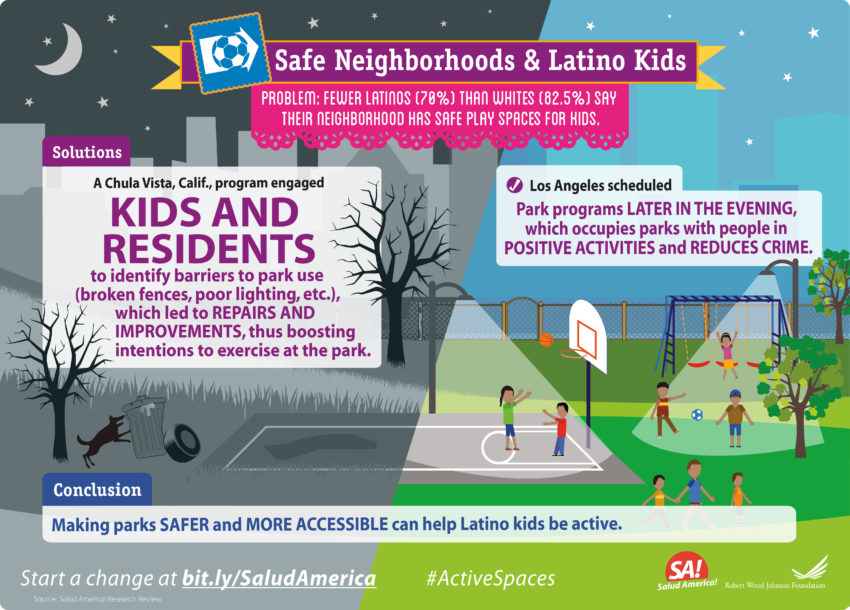
Only 70% of Latinos say their neighborhood has safe, active spaces for kids. Research shows that when communities address challenges to park use such as broken fences, poor lightening and sidewalks, more people visit community parks, according to our new infographic on safe neighborhoods. The infographic is part of Salud America!’s Active Spaces and Kids research package, which tackles the latest issues on the physical activity environment and offers recommendations. Share this infographic today! Salud America! is a Robert Wood Johnson Foundation-funded national childhood obesity prevention and communication ...