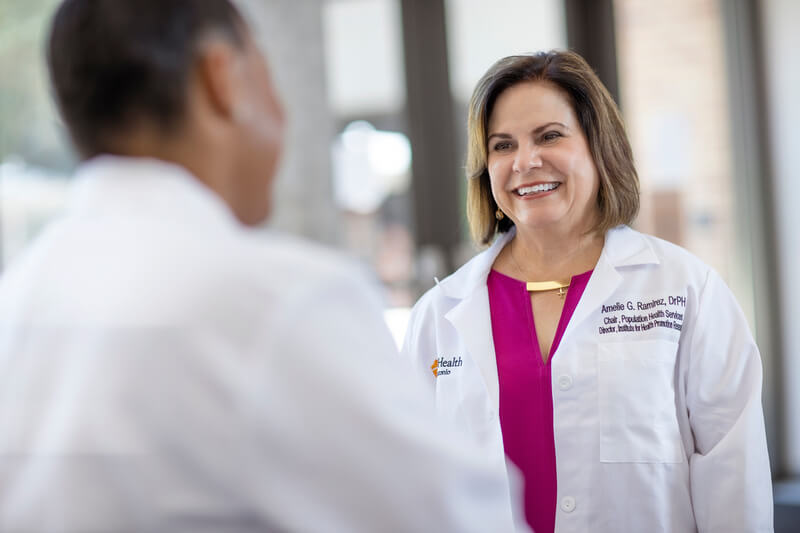
Dr. Amelie G. Ramirez, leader of Salud America! and cancer health researcher at the Mays Cancer Center at UT Health San Antonio, will receive the 2025 Sedgwick Memorial Medal for Distinguished Service in Public Health from the American Public Health Association (APHA). The award recognizes Ramirez's work in public health, which spans more than 30 years, and is a powerful testament to the legacy of the late Dr. Sedgwick. Ramirez and other APHA awards will be honored Monday, Nov. 3, 2026, during APHA’s 2025 Annual Meeting and Expo. "We celebrate the accomplishments and commitment of [Dr. Ramirez and] these outstanding public health leaders," said Dr. Georges Benjamin, APHA leader, in a statement. "Their contributions have helped strengthen the field and provide inspiration as we ...
The month of October is Health Literacy Month, making it a great time to explore equitable health resources for Latinos and all people. Health Literacy Month was founded by Helen Osborne, M.Ed, OTR/L in 1999. Today, Helen works to helps professionals communicate health information in ways that patients and the public can understand. “By collectively working to improve health literacy, we’ll create a more equitable world where everyone can access high-quality care and achieve positive health outcomes,” according to the Institute for Healthcare Advancement (IHA). Let’s dig deeper into the importance of Health Literacy Month and how you can take action for health literacy.
What is Health Literacy?
Health literacy can be defined in two ways, personal and organizational ...
For seniors and other immunocompromised individuals, the best way to protect against severe effects from COVID-19 is to stay up-to-date with the CDC's vaccine recommendations and available treatments. But antivirals are underused. That's why our friends at CVEEP have resources to help protect against infectious respiratory diseases across the lifespan. CVEEP recently featured Dr. Amelie G. Ramirez, leader of Salud America! and cancer health researcher at the Mays Cancer Center at the University of Texas at San Antonio Health Science Center, in a radio campaign for early treatment. The campaign, in English and Spanish, aired on 899 stations and generated 45.2 million impressions. "Please don't wait. Early treatment [of respiratory illnesses] makes a big difference," ...
Gluten is a protein found in wheat, barley, rye, and related grains. It gives dough its stretch and helps baked goods rise. Many common foods contain gluten, including bread, beer, pasta, and cereal. So, why is “gluten-free” become so popular these days? For millions of people, gluten is a medical issue. Celiac disease, gluten sensitivity, and wheat allergies require strict gluten-free diets. “When people with celiac disease eat gluten (a protein found in wheat, rye, and barley), their body mounts an immune response that attacks the small intestine,” according to the Celiac Disease Foundation. In addition, gluten sensitivity causes symptoms when gluten is eaten. However, it doesn’t cause the antibodies and intestinal damage seen in celiac disease. Additionally, ...
Since their introduction in the early 1900s, vaccines have helped eradicate diseases. For this reason, vaccines play a pivotal role in public health, especially for children, the elderly, and the immunocompromised. However, with the invention of the internet and social media, incorrect information is quickly spread and disseminated, sowing seeds of mistrust in vaccine recommendations. This leads to questions over vaccine research, production, and administration. What's more, the widespread misinformation about vaccines has caused outbreaks of previously eradicated diseases such as measles, making vaccine uncertainty a serious threat to public health. In fact, in a recent survey conducted by KFF in collaboration with the Washington Post, 1 in 6 US parents have ...
To celebrate Hispanic Heritage Month, the Prevent Cancer Foundation hosted an Instagram Live on prevention and cancer screening featuring Dr. Derek Rodriguez of the Institute for Health Promotion Research at UT Health San Antonio. On behalf of the Salud America! program, Dr. Rodriguez chatted with Kyra Meister, Prevent Cancer Foundation’s Senior Communications Manager, about the importance of preventative measures like screening and cancer survivorship. Watch on Instagram Live as the two talk about preventative health measures to better understand and detect cancer, health gaps that impact care, and cancer survivorship. Watch Now! WHAT: An Instagram live video focusing on cancer screening and survivorship WHERE: Available on the Instagram accounts of the Prevent Cancer ...
There’s a lot of good that’s come out of the digital age, including telehealth, which allows physicians to meet with their patients from a distance. However, the digital age can also pose health risks, especially for young children. Excessive screen time in children is linked to a higher risk for heart-related complications, including heart disease, according to a new study by the American Heart Association. Let’s go over the study’s key findings and find ways to determine what’s a healthy amount of screen time for your loved ones.
Key Study Findings: Screen Time and Heart Disease Risk
The study examined excessive screen use using data from a group of 10-year-olds in 2010 and a group of 18-year-olds in 2000, according to the study news release. To ...
Families are often busy with work, school, extra-curricular activities, and everyday life. With this in mind, it’s important for families to come together and spend time with one another. One way many families do this is after a long day of work and school is gathering at the dinner table and enjoying a meal together. In fact, the National Research Center on Hispanic Children and Families (NRCHCF) highlights research that finds that half of all Hispanic children eat at least one meal a day with their family, which has many health, emotional, and academic benefits. Additionally, 63% of preschool-aged children (birth to age 5) are the most likely to have daily family meals, while teenagers are the least likely. Let’s dig deeper into this research and why it’s important ...
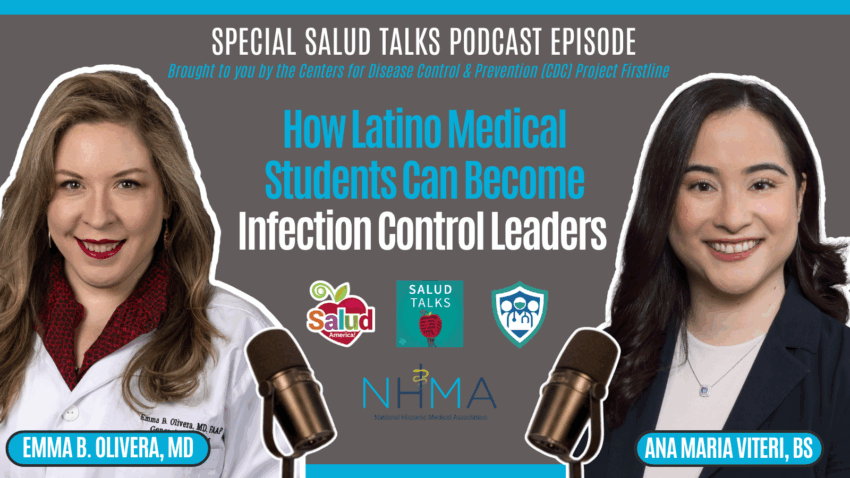
Easy-to-use, informative, bilingual tools on infection control practices in the healthcare setting are essential for all healthcare workers. With this in mind, the U.S. Centers for Disease Control and Prevention (CDC) launched Project Firstline, a training and education collaborative that ensures all healthcare workers, no matter their role or educational background, have the infection control knowledge and understanding they need and deserve to protect themselves, patients, and coworkers. As part of Project Firstline, Salud America! and the National Hispanic Medical Association (NHMA) are bringing you a Salud Talks Podcast series to explore infection control in healthcare. Episode 45 of the Salud Talks Podcast covers the need to bring infection control education to medical ...