Schools often have physical activity facilities, but many are not open to the public. Shared use agreements—contracts between a school and a city, county, or sports league that outlines rules for sharing existing facilities—can help neighborhoods have more access to active spaces and help kids stay active and healthy, according to our new infographic on shared use agreements. The infographic is part of Salud America!’s Active Spaces and Kids research package, which tackles the latest issues on the physical activity environment and offers recommendations. Share this infographic today! Salud America! is a Robert Wood Johnson Foundation-funded national childhood obesity prevention and communication ...
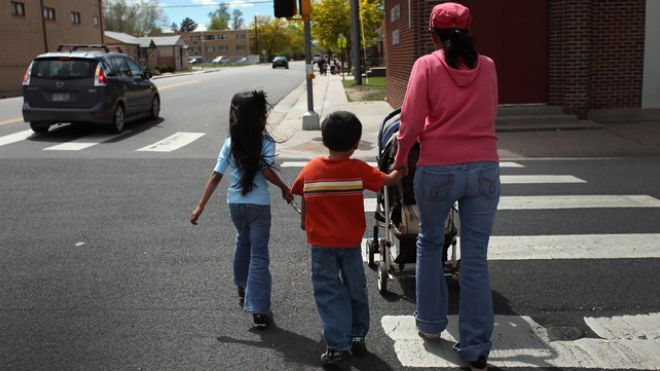
Many kids lack access to active spaces and safe streets where they can be physically active. These streets are often plagued with speeding cars and lack of sidewalks. Research shows that when communities adopt a “Complete Streets” policy and organize events such as “Open Streets,” more kids and their families become physically active, according to our new infographic on safe streets. The infographic is part of Salud America!’s Active Spaces and Kids research package, which tackles the latest issues on the physical activity environment and offers recommendations. Share this infographic today! Salud America! is a Robert Wood Johnson Foundation-funded national childhood obesity prevention and communication ...
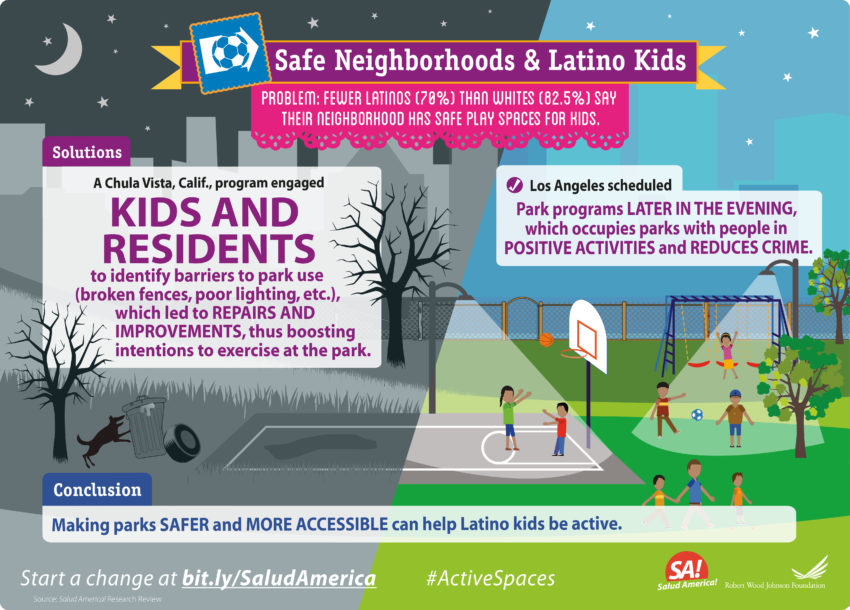
Only 70% of Latinos say their neighborhood has safe, active spaces for kids. Research shows that when communities address challenges to park use such as broken fences, poor lightening and sidewalks, more people visit community parks, according to our new infographic on safe neighborhoods. The infographic is part of Salud America!’s Active Spaces and Kids research package, which tackles the latest issues on the physical activity environment and offers recommendations. Share this infographic today! Salud America! is a Robert Wood Johnson Foundation-funded national childhood obesity prevention and communication ...
Did you know that 81% of Latino neighborhoods don’t have a safe recreational facility? That means many kids lack places to play and be active, which contributes to higher rates of physical inactivity and obesity, according to a new package of research from Salud America!, a national network for childhood obesity prevention and communication funded by the Robert Wood Johnson Foundation. Salud America!’s Active Spaces and Kids research package tackles the latest issues on the physical activity environment and offers recommendations. Solutions are emerging to improve access to and safe use of active spaces: Shared use agreements are formal contracts between a school and a city, county, or sports league that outline terms for sharing existing physical activity facilities. They ...
Many kids and families have limited spaces to be physically active. What are the best ways to improve access to “active spaces” like gyms, athletic fields, parks, and playgrounds for all families, including Latinos? Many schools do not provide public access to physical activity facilities. Shared use agreements set up rules for public use of schoolyards after class. Repairing sidewalks, installing street lights, and improving parks can stimulate more physical activity. Creating safer streets can people to walk or cycle to schools, parks, and other family destinations. Also, using marketing and technology to change kids’ physical activity patterns. See the Full Research Review with references (PDF)
Read the Issue Brief in English (PDF)
Read the Issue Brief in Spanish ...
Physical activity is scientifically proven to improve health outcomes. But some kids have less safe physical activity opportunities, including fewer parks and places to walk and bike in their neighborhoods and less time for recess and P.E. in their schools. Join #SaludTues on December 15, 2015, at 1:00 PM EST to tweet about how we can use new research and stories to redefine physical activity for lifelong health, and how parents, schools, cities, nonprofits, and parks can collaborate and ensure access to #ActiveSpaces for all kids. WHAT: #SaludTues Tweetchat: “How to Increase Active Spaces for Kids”
TIME/DATE: 1-2 p.m. EST Tuesday, January 12, 2016
WHERE: On Twitter with hashtag #SaludTues
HOST: @SaludAmerica
CO-HOSTS: @AL_Research @kaboom @americawalks ...
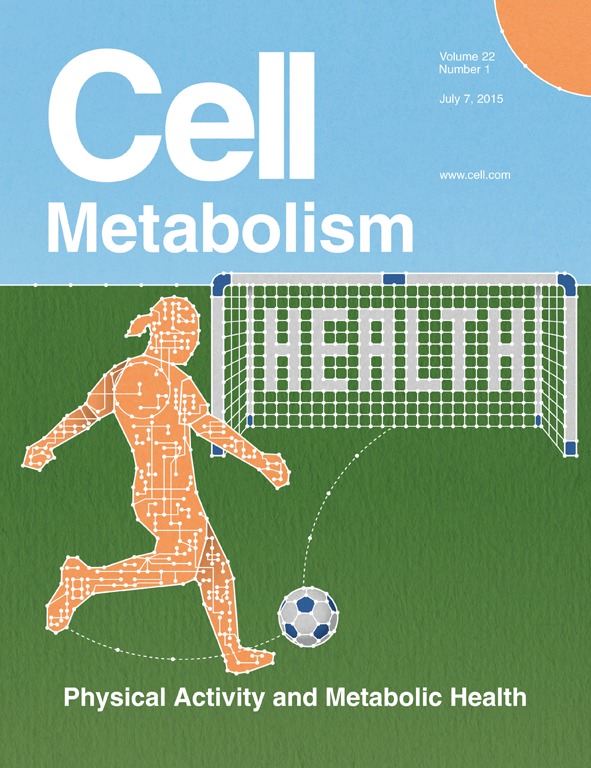
Although maintaining a healthy weight is critical for health promotion and disease prevention, the complex cellular and molecular mechanisms of physical activity are not fully understood. In October, 2014, the National Institute for Health (NIH) convened a workshop entitled ‘‘Understanding the Cellular and Molecular Mechanisms of Physical Activity-Induced Health Benefits’’ to identify gaps in current knowledge, obstacles to obtaining that knowledge, and possible solutions that would advance the field. Working groups addressed physiological mechanisms by which acute and adaptive responses to physical activity benefits multiple tissues and organ systems and how these systems are altered by age, body composition, fitness level, and exposure to exercise. In response to ...
Research over the past two decades has shown numerous health benefits associated with moderate intensity physical activity. This is why the U.S. Department of Health and Human Services (HHS) developed the 2008 Physical Activity Guidelines for Americans (PAG), recommending 150 minutes of moderate physical activity per week for adults and 60 minutes of moderate physical activity per day for kids, to include muscle-strengthening activities, for important health benefits and even more physical activity for greater health benefits. Join #SaludTues on December 15, 2015, to tweet about how we can use evidence and anecdote to redefine physical activity for lifelong health, and how we can stay motivated to move more and sit less throughout the day. WHAT: #SaludTues Tweetchat: ...
Decades of conflicting health, fitness, and weight-loss messages has lead to major confusion about what Latinos and all Americans need to do to be healthy. Every Body Walk! is clarifying health messages by redefining physical activity. "We could be raising the first generation in modern society to end up with statistically shorter life expectancies than their parents," said Mark Fenton, adjunct associate professor at Tufts University. "And it won't be because of some infectious disease. It will be the diseases of sedentary living, like diabetes."
Walking or Running
Which sounds more doable on a daily basis: walking or running? Walking! Regardless of fitness level or weight status, complex biological and molecular processes occur within our body when we walk, which ...