by
by 
Share On Social!
Healthcare workers are constantly on the go. But it’s important for them to have access to infection control training and information on issues like whooping cough.
With this in mind, the CDC’s Project Firstline developed Infection Control Micro-Learns – a series of guided discussions on infection control that can be easily incorporated into team meetings facilitated by an experienced team member with infection control expertise.
These short, easy-to-understand learning opportunities can help healthcare workers recognize and minimize infection control risks to protect themselves, coworkers, and patients from infectious diseases.
Let’s explore the topic of Whooping Cough (Pertussis).
What Does Whooping Cough (Pertussis) Look Like?
Whooping cough, formally known as pertussis, is a very contagious respiratory illness that can lead to severe illness and even death.
Whooping cough is especially dangerous for infants, older individuals, people with respiratory conditions (such as asthma), or those who are immunocompromised.
Pertussis being very contagious, so it’s important for everyone in the healthcare facility to quickly recognize possible pertussis and take action to prevent the spread.
Early symptoms last one to two weeks and may look like a common cold, including a stuffy or runny nose, low-grade fever, and mild cough.
Later symptoms include frequent coughing fits that can cause vomiting, a high-pitched whooping sound when breathing in, and trouble breathing.
Infants and young children may not cough but can have trouble breathing, pauses in breathing, or skin that turns blue.
Reducing the Spread of Pertussis
If a healthcare worker notices symptoms of possible pertussis, they should contact the patient’s care team or their supervisor.
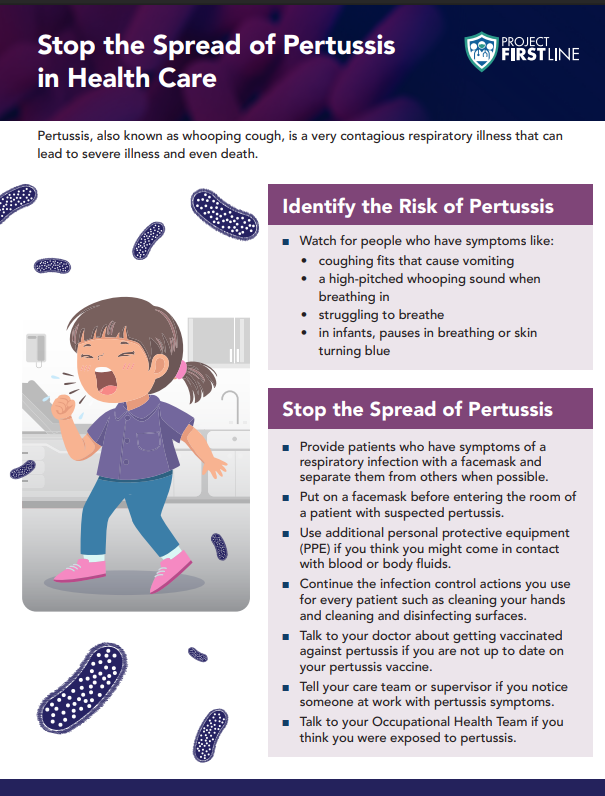
Patients who have symptoms of a respiratory infection should be provided with a facemask and separate them from others when possible.
Additional ways to protect healthcare workers and patients from pertussis include:
- Being up to date on your pertussis vaccine. Healthcare workers should talk to their doctor about getting vaccinated against pertussis if not up to date.
- Wearing a facemask when caring for or entering the room of a patient with suspected pertussis or other respiratory infections.
- Use of additional personal protective equipment (PPE), especially if a healthcare worker thinks they might encounter blood or body fluids, like using eye protection if at risk for sprays from coughing.
- Usual infection control actions like cleaning your hands and cleaning and disinfecting surfaces should also be implemented.
- If a healthcare worker thinks they were exposed to pertussis, they should talk to their Occupational Health Team so they can monitor their health and decide they need antibiotics to prevent infection.
What Can You Do to Promote Infection Control in Your Healthcare Setting?
Help keep yourself, your colleagues, and your patients safe from infectious disease threats by building on your infection control knowledge!
Check out more micro-learns from the CDC’s Project Firstline.
To show your dedication, sign this pledge to complete an infection control training or activity through CDC’s Project Firstline!
Explore More:
Infection ControlBy The Numbers
142
Percent
Expected rise in Latino cancer cases in coming years