Hispanic? Latino? Latinx? People often debate the best term to use when describing the ethnicity of those who trace their heritage from Latin America and Spain, who comprise 18.5% of the U.S. population. “There’s no correct term to use, and appropriateness varies when using Latino, Hispanic, Latinx, or country of origin,” said Dr. Amelie G. Ramirez, director of Salud America! at UT Health San Antonio. Let’s talk about the origins of these terms, who uses them, and what the data says about this population’s own preferences.
The Origin of “Latino”
The term we use at Salud America! to describe this group is “Latino.” “Latino,” or the feminine “Latina,” is used to describe people with ancestry from Latin American countries. Unlike “Hispanic,” the ...
Hispanic Heritage Month is here! This annual U.S. observance, from Sept. 15 to Oct. 15, celebrates the histories, cultures, and contributions of Americans whose ancestors came from Spain, Mexico, the Caribbean and Central and South America. We at Salud America! invite you to celebrate Hispanic Heritage Month in these awesome ways.
1. Learn How Hispanic Heritage Month Started
U.S. Congressmen Edward R. Roybal of Los Angeles and Henry B. Gonzales were among those who introduced legislation on the topic in 1968. President Lyndon Johnson implemented the observance as Hispanic Heritage Week that year. U.S. Rep. Esteban E. Torres of Pico Rivera proposed the observance be expanded to cover its current 30-day period. President Ronald Reagan implemented the expansion to Hispanic ...
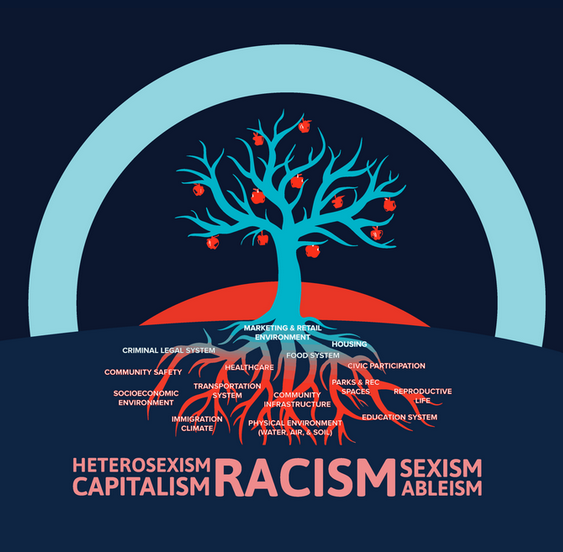
Where we live and the conditions that we live in impact our health and life outcomes. This concept is widely called the Social Determinants of Health (SDOH). Unfortunately, when people live in and experience negative conditions, it can lead to poor health outcomes and disparities, particularly among Latinos and other marginalized communities. In their new SDOH framework, the Praxis Project highlights the root systems of oppression that have led to health disparities for communities of color. “Many traditional SDOH frameworks lack the explicit naming of systems of oppression that cause disparities in health determinants. In an effort to incorporate these systems of oppression and to highlight the root causes of these determinants from a justice and community power ...
Amid the ongoing racial justice movement in the wake of police brutality and the death of George Floyd and others, a rising number of U.S. local leaders are creating resolutions to declare racism a public health crisis. Update 4/5/22: San Antonio, L.A., New York, and Chicago are among 246 cities, counties, and other governmental leaders that have declared racism a public health crisis, as of April 5, 2022, according to Michigan cartographer Alex B. Hill on Twitter. "It's a little thing to declare racism to be a public health crisis, but it's a stake in the sand," said former American Public Health Association (APHA) President Camara Phyllis Jones, Bloomberg reports.
Where Are Resolutions on Racism as a Public Health Crisis Happening?
Over 200 entities, including 19 states, have ...
Latinos and other people of color are increasingly the targets of criminals who use the internet, phone, and text scams to steal money and damage wellbeing. In fact, 40% of Black and Latino adults have been targeted by online scams and fraud, according to a new survey by the American Association of Retired Persons (AARP). “Latino adults are most targeted by government impostor scams, utility scams and grandparent scams. For both utility and grandparent scams, Latino adults far outrank other racial groups,” according to Matthew Petrie of the independent market research group BVA BDRC of AARP.
Latinos and A Struggle with Scammers
Sadly, scammers are common in the United States. The rise of financial fraud in the form of scams is “undeniable,” writes Petrie of ...
Older Latinos who live in neighborhoods where little English is spoken are at a higher risk of poor health and early death, according to a new study from the University of Georgia. “If you are linguistically isolated, you’re very likely to be isolated socially, and we know social isolation contributes to mortality,” said Kerstin Emerson, a co-author of the study. The study has implications for how language barriers and social cohesion in a community can affect health, particularly among elderly Latinos.
What Does the Study Say about Language Isolation?
Researchers at the University of Georgia’s College of Public Health conducted the study to determine if neighborhoods that are linguistically isolated impact health. The study analyzed data from a survey of over 1,100 ...
Latinos are the largest racial/ethnic minority at 18.5% of the U.S. population. Yet they face considerable health inequities — from discrimination to a lack of access to health care, transportation, affordable housing, healthy food, and more. This contributes to a high burden of diabetes, obesity, and disease for Latinos. In response, we need more understanding of the root causes of health inequities, diversity in the health and research fields, better education, and greater societal presence for Latinos, according to a new article in the Journal of the American Medical Association (JAMA) by Dr. Amelie G. Ramirez, director of Salud America! at UT Health San Antonio, and Drs. Rita Lepe and Francisco Ciagarroa of the Transplant Center at UT Health San Antonio. "The changing ...
Healthcare spending is disproportionately skewed toward white people, with less money spent on Latino patients, according to new research from the University of Washington’s Institute for Health Metrics and Evaluation and others. “This study found statistically significant differences in estimated healthcare spending across six race/ethnicity groups, with differences present for total spending, age-standardized spending, spending by type of care, and health-condition-specific spending per notified case,” according to the study. The disparity has significant implications for policies needed for equity in healthcare spending. “Despite making up 18.5% of the U.S. population, only 11% of healthcare spending goes toward Latinos. We can address this disparity by examining the ...
Hispanic Heritage Month is a time where we can honor the history, culture, and diversity of the Latino community. Unfortunately, many Latinos in the U.S. still face many health inequities, including limited access to healthcare, poor nutrition and physical activity, low COVID-19 vaccination rates, and more. Let’s use #SaludTues on Tuesday, September 7, 2021, to discuss how we can improve health equity for Latinos while celebrating Hispanic Heritage Month. WHAT: #SaludTues Tweetchat: How to Improve Health Equity for Hispanic Heritage Month TIME/DATE: 1-2 p.m. ET (Noon-1 p.m. CT), Tuesday, September 7, 2021
WHERE: On Twitter with hashtag #SaludTues
HOST: @SaludAmerica
CO-HOSTS: Public Health Maps (@PublicHealthMap); Latinx Voces en Salud Campaign (@VocesenSalud); ...