by
by Share On Social!
The blare of firetruck sirens, the glow of buildings ablaze, and the thick smell of smoke are all too familiar for Neil Meade. As a seasoned firefighter in San Antonio, he’s faced many dangers and helped others through life-threatening situations.
But nothing could prepare him for a cancer diagnosis.
Meade, a devoted family man and veteran of countless emergency calls, suddenly found himself battling a personal, silent, unpredictable opponent — thyroid cancer.
A Passion for Serving People
Meade, a native of Chicago, moved to San Antonio with his parents, returned to Chicago, but eventually returned to San Antonio and lives here now.
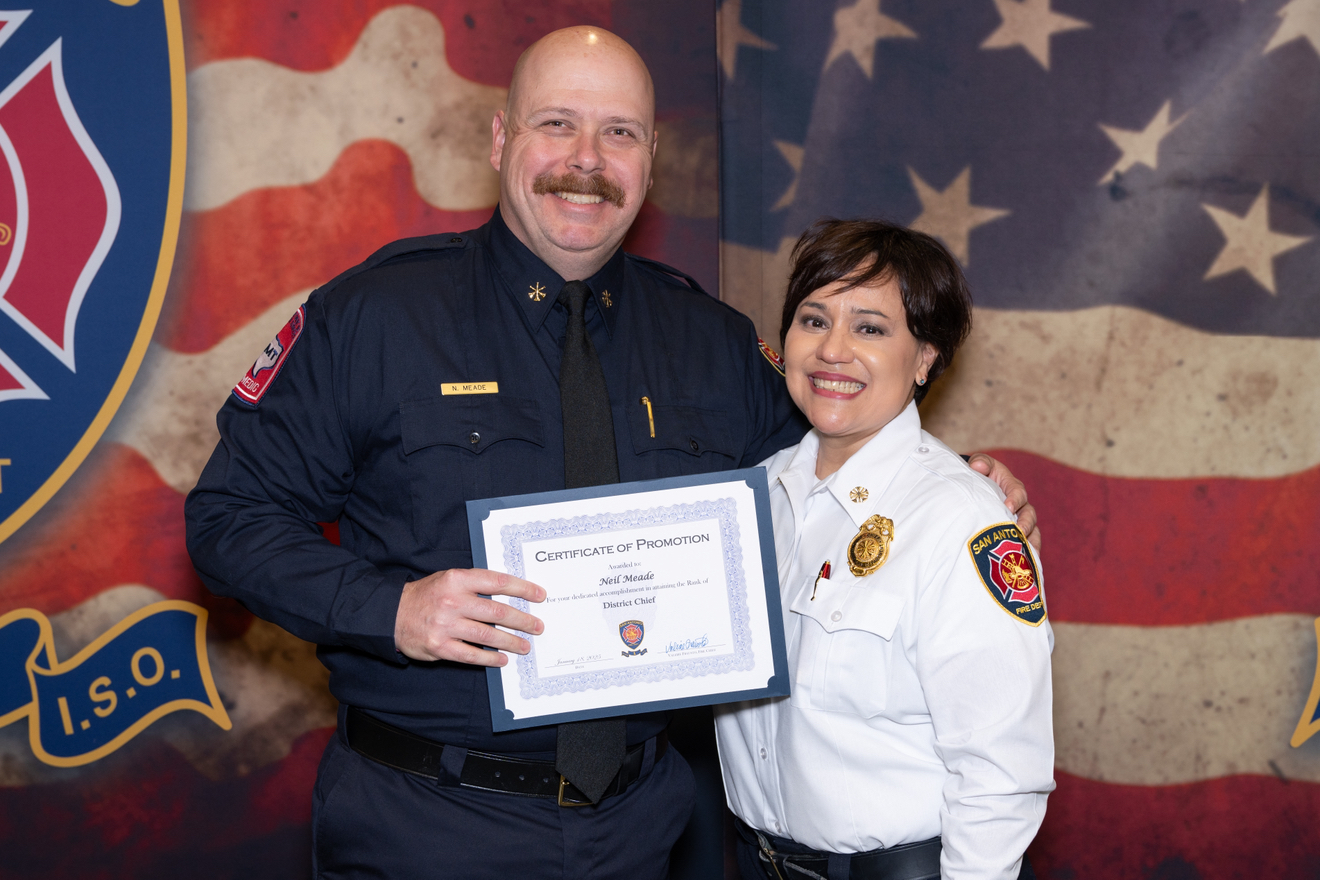
He started his service career in the Air Force.
“I spent eight years on active duty in the Air Force, and when I got out … I tested with the [San Antonio] Fire Department (SAFD), and I spent the last 24 years doing this,” Meade said.
Meade started as a probationary firefighter with the SAFD in February 2001.
Through the years, he has remained dedicated to serving the community as a firefighter, EMT, hazardous material technician, arson investigator, paramedic, fire engineer, instructor, company officer, and chief officer.
Today, Meade serves as the Operations Executive Officer for SAFD.
“I’ve done six or seven different things that would have been six or seven different jobs, and I’m so blessed that I got to stay in one department,” Meade said.
A Different Kind of Fight
For Meade, things were relatively normal as he continued to work as a firefighter, spend time with his family, and cheer on his Chicago Blackhawks.
Then, early in Fall 2014, his visit to his primary care doctor uncovered something unusual.
“We do labs all the time and [my doctor] mentioned my thyroid labs. He was like, ‘Hey, your thyroid labs are off’,” Meade said.
Meade was still recovering from back surgery and had two small children, so for him, being tired and fatigued was normal.
“I hadn’t worked out in a couple months because of my back restrictions. I’ve got little kids, so yeah, I’m tired. But, I mean, who isn’t,” Meade said.
Following that primary care visit, Meade would get additional labs done and confirm that his thyroid labs were abnormal.
“The thyroid stimulating hormone, which comes from the pituitary gland, was high because my body was trying to compensate,” he said.
By November 2014, Meade would get a biopsy of the thyroid.
“They stick a needle into your thyroid, which is a really pleasant experience, only kidding, and those results came back inconclusive,” he said.
Meade had to choose between another biopsy or get surgery to remove part of his thyroid.
He chose surgery.
“I felt like if there was a chance it was cancer. The clock is ticking, and I don’t know how bad this is looking,” Meade said.
Navigating the process wasn’t easy, as Meade scheduled an appointment with an ear, nose and throat doctor and waited.
At the same time, Meade also revisited his primary care doctor.
“[Meade’s primary care doctor] directed me to a different doctor that he knew personally, and he actually called on his cell phone while I was in the office, Meade said. “That really put me in a better place.”
On Dec. 23, 2014, Meade had surgery.
Four days later, as Meade was about to sit and watch “Unbroken” with his family at the movie theater, he would receive a call from his ENT, Dr. Nathan Hales.
“He’s like, ‘Hey, we got cancer and the right side of your thyroid. We’re going to take out the left side,’” Meade said.
“I sat down, my wife looked at me, and she’s says, ‘What?’ and I’m like, ‘I got cancer,’” Meade recalled.
As the couple contemplated leaving, Meade began to think.
“We’re sitting in this movie, and it’s all about resilience and being stronger and getting through these things, and these things are going to beat you down, but they’re not going to kill you,” he said. “It was one of those things where, you know, God has a way of timing.”
Meade’s family would stay and watch the movie.
On Dec. 31, 2014, he would go into surgery and have the second half of his thyroid removed.
A Better Future for Others
In January 2015, Meade revisited his doctor after the second surgery and got the good news that he was clear of thyroid cancer.
“[Dr. Hales] said that the first half, when they sent it off to pathology, that the procedure that was going to be done previously by the other doctor might have missed [the cancer], because it was still stage one,” Meade said.
While Meade was cancer-free, he would still visit his endocrinologist every 6 months to make sure that his labs remained clear.
“At the 10-year mark, which was just last year, [Meade’s endocrinologist] finally was said, ‘Okay, if you’re ready to, we could just do this once a year now,’” he said.
Though he was in the clear, Meade said the thought of cancer is always in the back of his mind, describing it like a “monkey on my back.”
“To this day, I’d call, ‘Hey, I need labs, I’m going to come in and get an ultrasound.’ I need to have this peace of mind. It definitely paints a different picture in your brain on how life is and little things that you probably take for granted,” he said.
Additionally, this made Meade think about the risk that firefighters face.
Meade spoke on how today, plastics and petroleum-based products are common in households and many electronics and other items are made with plastics and foam. These products burn differently put off chemicals and can pose a risk to firefighters.
Studies have shown that firefighters face a 9% higher risk of being diagnosed with cancer and a 14% higher risk of dying from cancer compared to the general U.S. population.
Within SAFD, more than 70 firefighters have been diagnosed with cancer in the past 10 years, including leukemia to multiple myeloma and cancers of the brain, thyroid, colon, prostate, and testicles. Many cases also go unreported.
“There’s just so many things that we run into in this job. And even if you’re safe, even if you’re careful, you’re still being exposed to things that most folks are not,” Meade said.
Cancer Prevention and SAFD
Meade said SAPD mindfully works to take precautions with better ventilation and routinely cleaning gear and equipment, as everyone is well aware that firefighting is classified as a known human carcinogen by the International Agency for Research on Cancer.
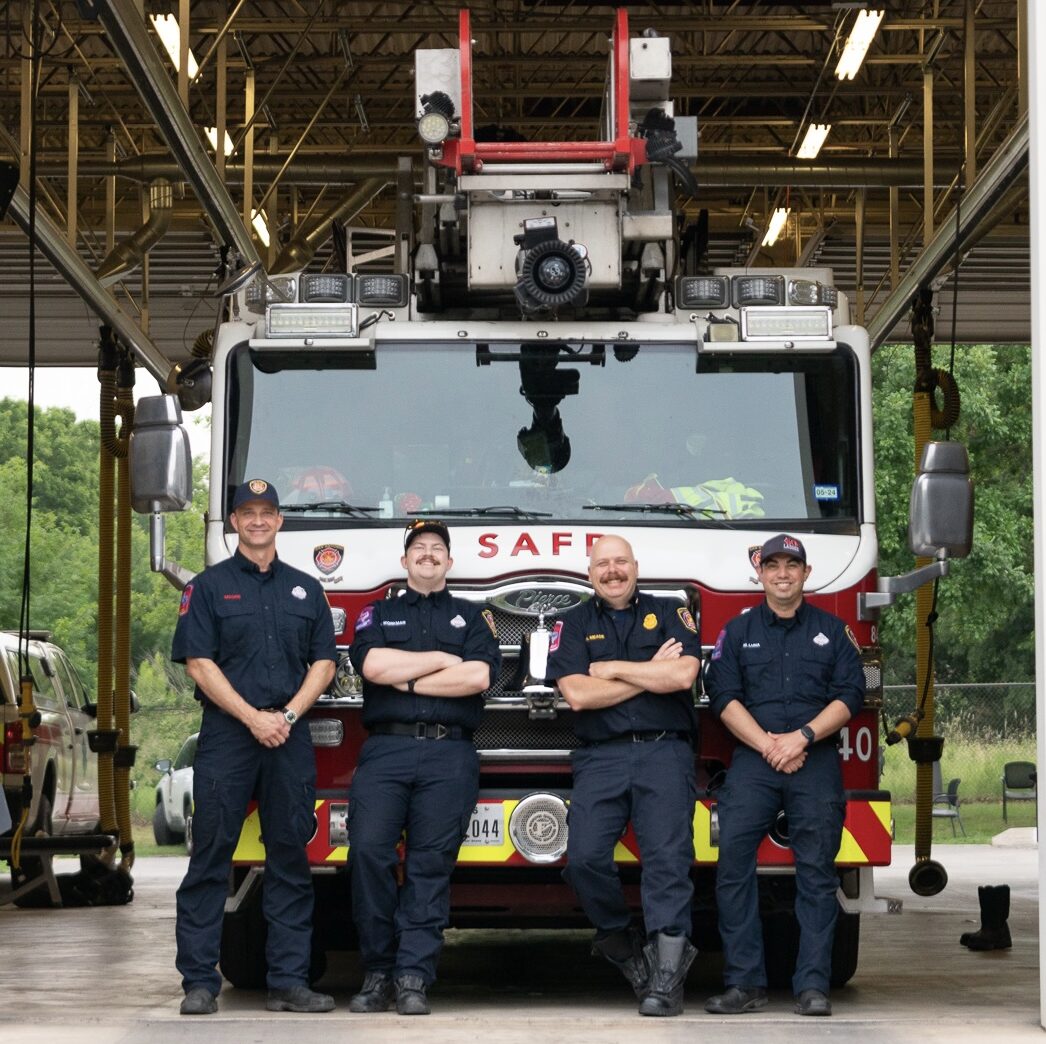
“[Keeping firefighters safe is] really a 180 to where we are, as from when I came into firefighting,” Meade said.
In addition, SAFD, UT Health San Antonio, and Sylvester’s Firefighter Cancer Initiative at the University of Miami have partnered to launch the San Antonio Firefighters Cancer Prevention Program. The program aims to better understand and reduce the burden of cancer among local first responders.
While preventative care and going in for cancer screenings seem like a chore, it’s crucial and can save lives, Meade said.
“I’ve said it a million times, it’s inconvenient to do those things, but it’s really inconvenient to tell your family you got cancer,” he said.
Clinical research is also helpful when it comes to disease like cancer.
Clinical trials are studies that help researchers learn more to help slow, manage, and treat Alzheimer’s and cancer for current and future family members. But without volunteers for clinical trials, the benefits may miss certain groups, such as firefighters.
Visit our clinical trials page to find a clinical trial, read about hero volunteers, and more!
“Volunteers in clinical trials are not only helping themselves, but they’re also contributing to a future with potentially better treatments that can help their families in the future,” said Dr. Amelie Ramirez, director of the Institute for Health Promotion Research at UT Health San Antonio.
Learn More about CLINICAL TRIALs!
Explore More:
CancerBy The Numbers
142
Percent
Expected rise in Latino cancer cases in coming years
This success story was produced by Salud America! with support from the Robert Wood Johnson Foundation.
The stories are intended for educational and informative purposes. References to specific policymakers, individuals, schools, policies, or companies have been included solely to advance these purposes and do not constitute an endorsement, sponsorship, or recommendation. Stories are based on and told by real community members and are the opinions and views of the individuals whose stories are told. Organization and activities described were not supported by Salud America! or the Robert Wood Johnson Foundation and do not necessarily represent the views of Salud America! or the Robert Wood Johnson Foundation.