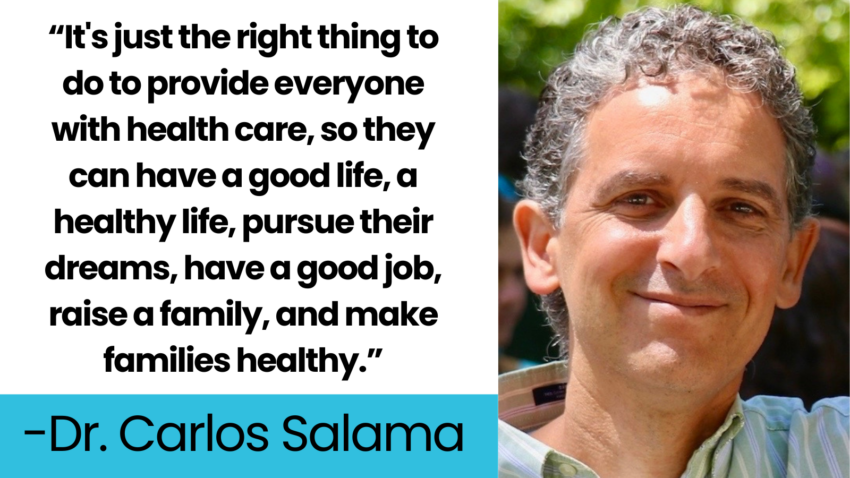
Carlos Salama’s father helped people every day as a physician. Inspired by what he saw, Salama knew at an early age that he, too, wanted to help others the way his father did. “People were just very, very grateful for what he provided them. I thought, ‘I want to do this,’” Salama said. Salama was born in Brooklyn, New York, to Argentinian parents. Salama’s mother and father first came to the United States in the mid-1960s for his father’s residency after he completed medical school at the University of Buenos Aires. Salama recalls helping his parents and two siblings in the doctor’s office. “I used to go with my father to the office, sometimes on the weekends, and help them. My mother was the office assistant, but I would do it sometimes, and I just ...
Researchers at Texas Tech University are interested in learning more about you and your family caregiver's experience with advanced cancer. The research team is seeking participation from people who are 18 or older, speak English, identify as Latino or non-Hispanic White, and have been diagnosed with advanced cancer (stages 3b-4). Caregivers who want to participate must be 18 years or older, speak English, and identify as Latino or non-Hispanic White. If you or your loved one meets these qualifications, you may be eligible to take part in this study, which consists of three different surveys. These surveys will be spaced out and take 30 to 45 minutes to complete, and can be done online, by mail, or over the phone with the help of a research assistant. The ...
The White House recently issued a presidential proclamation declaring April as National Cancer Prevention and Early Detection Month. “During National Cancer Prevention and Early Detection Month, we honor the enormous courage and strength of the millions of Americans facing the disease today and of the many millions of survivors, whose resilience inspires us all,” said President Joe Biden. This observance was led by the Prevent Cancer Foundation, along with the support of 84 additional organizations, to raise awareness and reduce the impact of cancer on individuals, families, and communities. “We hope it serves an important reminder to the public that they have the power to take charge of their health with lifestyle changes and routine screenings, because early detection ...
Do you how cancer impacts your local population? How can you help? Find new strategies to address the local cancer burden at UT Health San Antonio’s webinar, “How to Identify and Equitably Respond to Local Cancer Needs,” recorded live at 10 a.m. Central on Thursday, April 25, 2024. This webinar featured experts from the Mays Cancer Center at UT Health San Antonio, Moffitt Cancer Center in Florida, Genentech, as well as a patient advocate, who together explored local cancer issues. Panelists shared how to strategically listen, engage, and respond to local cancer needs to guide cancer research, care, and outreach tailored to address the needs of local communities. This is a part of a webinar series, “Let’s Address Health Equity Together.” The series is a ...
Marielle Santos McLeod thought she knew a lot about cancer care. Years as a health professional had given her time to learn about cancer care and gain a closer look at the barriers Latinos face in getting equitable treatment. That’s why, when the mother of four was diagnosed with colon cancer at age 36, she was shocked by just how little she really knew. However, it was enduring the disease as a young Latina that guided her toward her life's purpose – serving as a patient advocate to uplift the voice of Latino cancer survivors. “I love advocacy .... It's like one of the things that I'm convinced that I was put on this earth to do. I just had to get cancer to get to it first,” Santos McLeod said.
Spanish-Language Influence
Santos McLeod doesn’t believe ...
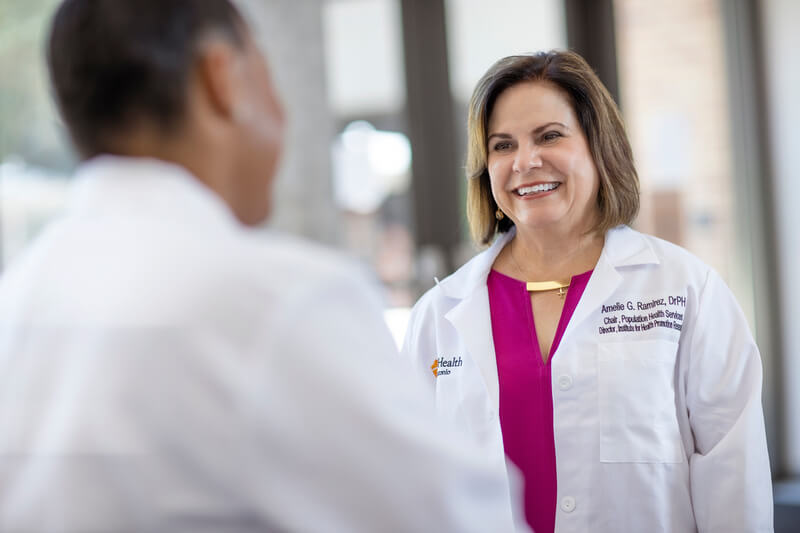
Dr. Amelie G. Ramirez, leader of Salud America! at UT Health San Antonio, recently shared the need to help Latino cancer survivors on "Science & Medicine," an audio collaboration of Texas Public Radio and UT Health San Antonio. Bonnie Petrie, TPR's bioscience and medicine reporter, hosted the segment. Ramirez spoke to Petrie about her project to improve care and life for Latino cancer, called “Avanzando Caminos (Leading Pathways): The Hispanic/Latino Cancer Survivorship Study.” "Our big goal is to really have more equitable care for everyone, not only in South Texas, but nationwide, and that their outcomes for survival are also improved,” Ramirez said during the segment. Listen to the full audio here.
About the Avanzando Caminos Research Project
Avanzando Caminos ...
Dr. Rebecca Jones of UT Health San Antonio has been approved for a 2-year, $250,000 funding award through the Eugene Washington PCORI Engagement Awards (Engagement Awards) program, an initiative of the Patient-Centered Outcomes Research Institute (PCORI). The funds will support the creation of the Creando Conexiones: Cancer Health Equity Research Agenda, which will outline research priorities identified by South Texas cancer survivors, caregivers, and community members. Join the Creando Conexiones coalition! "We know that research has the most impact when guided by voices of cancer survivors and community members," said Jones, assistant director of the Institute for Health Promotion Research and part of the Mays Cancer Center at UT Health San Antonio. "With their input, we ...
Some big changes in 2022 and 2023 have set up the healthcare sector to advance screening for non-medical social needs in 2024 and beyond. This is great news as we work to address social determinants of health (SDoH), improve health outcomes, and reduce health disparities. But one key social need – transportation – isn’t getting the attention it deserves. Transportation is a foundational social need and often co-occurs with other needs and/or acts as a barrier to resolving other needs. Yet transportation is often poorly conceptualized, thus is poorly operationalized in social need screening tools and related justifications. In this post, we review the following big changes as they relate to transportation as a SDOH: Big Change 1: In 2022, the Centers for Medicare ...
For the last few years, the National Institutes of Health’s All of Us Research Program has mounted an unprecedented effort to collect health data from 1 million people of all ages and ethnicities across the country for use in impactful scientific research.
In fact, the data has led researchers to a shocking discovery — 275 million previously unknown genetic variants, according to a recent news release.
Nearly 4 million of the variants are in areas that may be connected to risk for disease.
The variants, uncovered using data shared by nearly 250,000 All of Us participants, put researchers in a position to better understand genetic influences on health and disease, especially in diverse communities often left out of research.
NIH reported that half the genomic data came from Latino, ...