UT San Antonio is shining a light on Alzheimer’s disease with a new research center to study an aging Latino population, the university announced in UT San Antonio Today. Funding for the center, called the San Antonio Center for Alzheimer’s Disease and Related Dementias (AD/ADRD) Population Aging and Social Studies (CAPAS), was made available through a grant program from the National Institute on Aging. CAPAS seeks to bridge the gap in Alzheimer’s research by aligning experts in demography, neuropsychology, biology, economics and public health across UT San Antonio’s campuses, including its Health Science Center. UT San Antonio experts will be working alongside experts from other institutes, such as the Biggs Institute for Alzheimer’s and Neurodegenerative ...
Veteran's Day is on Nov. 11, 2025. We at Salud America! are excited to honor all U.S. military personnel, including the Latinos, who have served our country.
Latinos in the Military: History
Latinos have a “proud and indeed enviable” record of military service that dates back to the Civil War, according to a U.S. Army historical website. About 20,000 Latino serviceman and women participated in Operation Desert Shield/Storm in 1990-1991, 80,000 in the Vietnam War in 1959-1973, and more than 400,000 in World War II in 1939-1945. Latinos have received more than 40 Medals of Honor, according to the Department of Defense. “Whether their heritage can be traced to Spain, Cuba, Puerto Rico, Mexico, or one of dozens of other Spanish-speaking countries or cultures, they’ve ...
Latinos continue to be one of the fastest growing groups in the U.S., rising to 20% of the population for the first time this past year, according to the U.S. Census. In addition, Pew Research Center shared these facts: Latinos have played a major role in U.S. population growth.
The sources of Latino population growth have changed in recent years.
S. Latinos trace their roots to many countries.
California and Texas have the nation’s largest Latino populations.
The share of U.S. Latinos with college experience is rising.
The religious affiliation of U.S. Latinos is changing. Let’s dig deeper into these facts and how they can impact others.
Latino Population Growth in the U.S.
The U.S. was home to 340,110,988 people in 2024. Of those, 195 million are ...
For the last few years, Hispanic/Latinos living in South Texas have been sharing their cancer stories with the Avanzando Caminos Hispanic/Latino Cancer Survivorship Cohort study team at UT Health San Antonio. But up until now those stories were limited to survivors of prostate, colorectal, lung, stomach, liver, endometrial, breast, cervical, and kidney cancers. Now it’s time for the bladder, melanoma, ovarian, thyroid, and lymphoma cancer survivors to share their journeys, too. The Avanzando Caminos study is now enrolling participants who have completed their primary cancer treatments for one of the designated cancer types within the last 10 years. share your story with avanzando caminos!
What is the Avanzando Caminos Study?
The Avanzando Caminos Hispanic/Latino ...
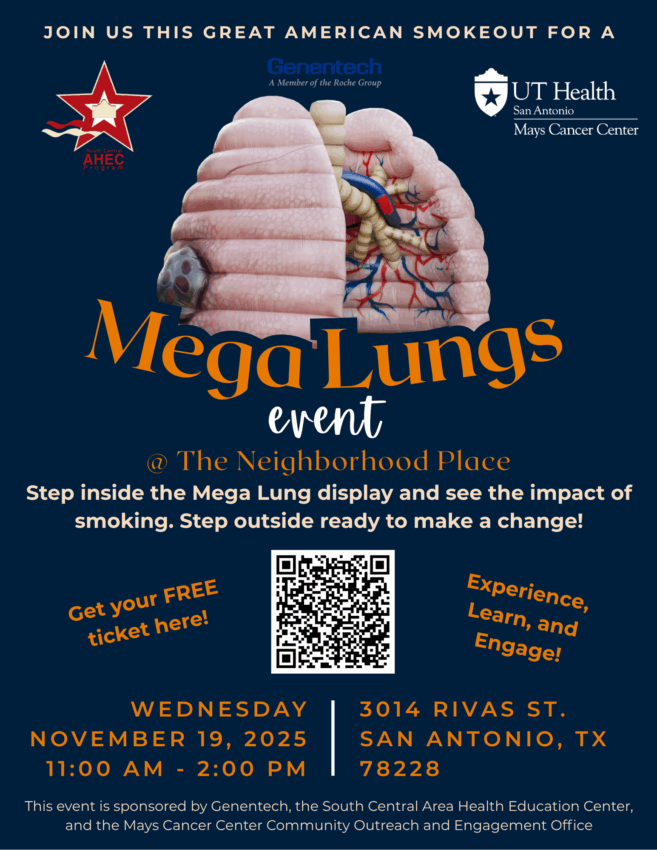
Do you smoke cigarettes and want to quit? On Thursday, Nov. 20, 2025, you can join thousands of people who will begin their smoke-free journey with the Great American Smokeout, an annual quitting event. To get help, enroll in Quitxt, a free English or Spanish texting service that turns your phone into a personal “quit smoking” coach from UT Health San Antonio. To join Quitxt, text “iquit” (for English) or “lodejo” (for Spanish) to 844-332-2058. And, if you’re in the San Antonio area, visit the “Mega Lung,” a giant model of a human lung that shows the importance of the respiratory system’s most vital organ.
Step Inside the Mega Lung
The MEGA Lung is open 11 a.m. to 2 p.m. on Wednesday, Nov. 19, 2025, at the Neighborhood Place cafeteria, 3014 Rivas Street, San ...
Dr. Amelie G. Ramirez, leader of Salud America! and cancer health researcher at the Mays Cancer Center at UT Health San Antonio, will receive the 2025 Sedgwick Memorial Medal for Distinguished Service in Public Health from the American Public Health Association (APHA). The award recognizes Ramirez's work in public health, which spans more than 30 years, and is a powerful testament to the legacy of the late Dr. Sedgwick. Ramirez and other APHA awards will be honored Monday, Nov. 3, 2026, during APHA’s 2025 Annual Meeting and Expo. "We celebrate the accomplishments and commitment of [Dr. Ramirez and] these outstanding public health leaders," said Dr. Georges Benjamin, APHA leader, in a statement. "Their contributions have helped strengthen the field and provide inspiration as we ...
For Dr. Derek Rodriguez, helping survivors is more than part of the job. It’s a calling that began when he was diagnosed with Rhabdomyosarcoma, a rare form of childhood cancer, when he was 8 years old. Now, Rodriguez is helping others share their survivorship stories through his work with the Avanzando Caminos study, which aims to improve the Latino cancer survivorship journey. Rodriguez currently serves as the program manager for the study, which is based at the Institute for Health Promotion Research at UT Health San Antonio. He is living out his dreams of being a research scientist and helping improve the lives of other survivors in his community. “I am now serving my community as well as those that are cancer survivors, so it’s pretty much a full ...
For seniors and other immunocompromised individuals, the best way to protect against severe effects from COVID-19 is to stay up-to-date with the CDC's vaccine recommendations and available treatments. But antivirals are underused. That's why our friends at CVEEP have resources to help protect against infectious respiratory diseases across the lifespan. CVEEP recently featured Dr. Amelie G. Ramirez, leader of Salud America! and cancer health researcher at the Mays Cancer Center at the University of Texas at San Antonio Health Science Center, in a radio campaign for early treatment. The campaign, in English and Spanish, aired on 899 stations and generated 45.2 million impressions. "Please don't wait. Early treatment [of respiratory illnesses] makes a big difference," ...
Today, the Mays Cancer Center at The University of Texas San Antonio Health Science Center, along with 61 National Cancer Institute (NCI)-Designated Cancer Centers with leading national organizations and the University of Puerto Rico Comprehensive Cancer Center have endorsed a joint statement urging the nation’s health care systems, physicians and other health care providers and professionals, parents, and caregivers, and the public to promote and choose human papillomavirus (HPV) vaccination for cancer prevention. HPV vaccination is safe and works to prevent six types of cancer (oropharyngeal, cervical, anal, vaginal, vulvar, and penile). Recently released National Immunization Survey (NIS)-Teen data show no gains in HPV vaccination over the last few years indicating urgent ...