by
by 
Share On Social!
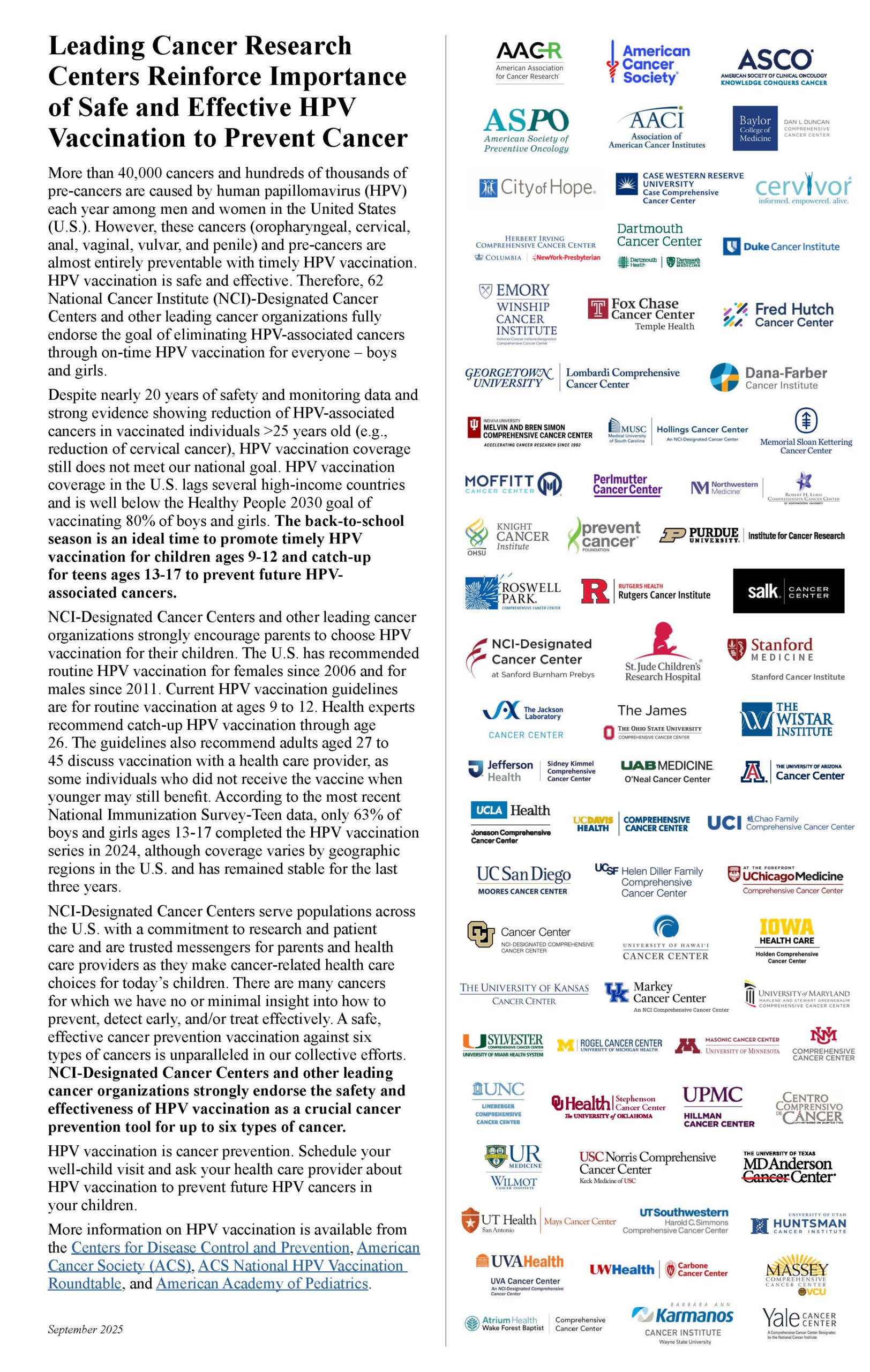
Today, the Mays Cancer Center at The University of Texas San Antonio Health Science Center, along with 61 National Cancer Institute (NCI)-Designated Cancer Centers with leading national organizations and the University of Puerto Rico Comprehensive Cancer Center have endorsed a joint statement urging the nation’s health care systems, physicians and other health care providers and professionals, parents, and caregivers, and the public to promote and choose human papillomavirus (HPV) vaccination for cancer prevention.
HPV vaccination is safe and works to prevent six types of cancer (oropharyngeal, cervical, anal, vaginal, vulvar, and penile).
Recently released National Immunization Survey (NIS)-Teen data show no gains in HPV vaccination over the last few years indicating urgent action to ensure children today are protected against HPV-related cancers they may develop in adulthood.
“At the Mays Cancer Center, our mission is not only to treat the disease but to prevent it,” said Lei Zheng, MD, PhD, executive director of the Mays Cancer Center at UT Health San Antonio. “By increasing vaccination rates today, we have the power to dramatically reduce the burden of HPV-related cancers tomorrow.”
HPV Vaccination is Cancer Prevention
90% of HPV-related cancers preventable through on-time HPV vaccination by the 13th birthday.
In the United States (U.S.), the Centers for Disease Control and Prevention (CDC) Advisory Committee on Immunization Practices recommends routine HPV vaccination for females since 2006 and for males since 2011.
 Current HPV vaccination guidelines are for routine vaccination at ages 9 to 12. Catch-up HPV vaccination is recommended through age 26. Adults aged 27 through 45 should talk with their health care providers about HPV vaccination because some people who have not been vaccinated might benefit. The HPV vaccine series consists of two doses for children who get the first dose at ages 9–14, three doses for immunocompromised people, and three doses for those who start the series at age 15 or older.
“Every parent and caregiver in our community has the power to help protect children from future cancers,” said Amelie Ramirez, DrPH, MPH, director of the Institute for Health Promotion Research at UT San Antonio Health Science Center. “When families stay on track with vaccination, we not only safeguard individual children but also strengthen the health of our entire community.”
According to the most recent NIS-Teen data, only 63% of boys and girls ages 13-17 and only 59% of boys and girls ages 13-15 completed the HPV vaccination series in 2024, with great variability by geographic region and locale with lower coverage among children in rural areas.
Nationally, HPV vaccination coverage has stagnated for the last three years and falls short of the national Healthy People 2030 goal of 80% of children aged 13-15-years-old who are vaccinated.
HPV is a Rising Threat to Health
Nearly 80 million Americans – one out of every 4 people – are infected with HPV, a virus that causes six types of cancers.
Of those millions, more than 40,000 will be diagnosed with HPV-related cancers this year and hundreds of thousands more with pre-cancers caused by HPV.
Despite those staggering figures and the availability of a vaccine to prevent HPV infections, HPV vaccination coverage remains significantly lower than other recommended vaccines for this same age group in the U.S.
It is not yet known in whom HPV infection will lead to cancer, but HPV vaccination is known to protect those who are vaccinated.
HPV vaccine is safe.
Vaccines, like any medicine, can have side effects. Many people who get the HPV vaccine have no side effects at all. The most common side effects are usually mild, like a sore arm from the shot. Findings from many vaccine safety monitoring systems and more than 160 studies show HPV vaccines have a favorable safety profile. Currently available scientific evidence overwhelmingly supports the safety of the HPV vaccine.
In the U.S., where HPV vaccination coverage remains suboptimal, gains have been observed but full population benefit not yet realized.
From 2008-2022, cervical pre-cancer incidence decreased 79% and higher-grade pre-cancer incidence decreased 80% among women aged 20–24 years screened for cervical cancer, the age group most likely to have been vaccinated, according to a recent article in Morbidity and Mortality Weekly Report.
National Call to Action for HPV Vaccination
To ensure protection against HPV-related cancers and move closer to elimination of HPV cancers starting with cervical cancer as a public health concern in the U.S., urgent action is needed to prevent HPV-related cancers.
 HPV vaccination is the best tool in the toolbox to prevent HPV-related cancers.
The joint statement and its call to action comes during the back-to-school period, a time during which most children aged 9-12-years-old are vaccinated against HPV and also during Gynecologic Cancer Awareness Month, which is a time to raise awareness about gynecologic cancers such as cervical, vaginal, and vulvar caused by HPV. The organizations collectively urge the following actions:
- Health care systems’ staff and providers should immediately identify and contact parents and caregivers of age-eligible children who are due for HPV vaccination and encourage them to complete vaccinations.
- Parents and caregivers should have their age-eligible children vaccinated as soon as possible. A list of recommended vaccines is available on the CDC website and American Academy of Pediatrics (AAP) website.
- Talk with family members and friends about HPV vaccination. Share the facts about HPV vaccination as cancer prevention.
- Learn more about HPV vaccination from the CDC, American Cancer Society (ACS), ACS National HPV Vaccination Roundtable, and AAP
Sixty-two NCI-Designated Cancer Centers with leading national organizations and the University of Puerto Rico Comprehensive Cancer Center endorse this statement and share the goal of sending a powerful message about the importance of HPV vaccination for the prevention of HPV-related cancers. HPV vaccination is safe, effective, and provides long-lasting protection against HPV-related cancers and other conditions associated with HPV.
List of NCI-Designated Cancer Centers Endorsing Statement on HPV Vaccination
Here are the 62 NCI-Designated Cancer Centers that endorse the new joint statement:
- Atrium Health Wake Forest Baptist Comprehensive Cancer Center
- Barbara Ann Karmanos Cancer Institute
- Case Western Reserve University Case Comprehensive Cancer Center
- City of Hope Comprehensive Cancer Center
- Dan L. Duncan Cancer Center
- Dana-Farber Cancer Institute
- Dartmouth Cancer Center
- Duke Cancer Institute
- Fox Chase Cancer Center
- Fred Hutch/University of Washington/Seattle Children’s Cancer Consortium
- Georgetown University Lombardi Comprehensive Cancer Center
- Herbert Irving Comprehensive Cancer Center
- Indiana University Melvin and Bren Simon Cancer Center
- Jefferson Health Sidney Kimmel Comprehensive Cancer Center
- Masonic Cancer Center
- Mays Cancer Center at The University of Texas San Antonio Health Science Center
- Memorial Sloan Kettering Cancer Center
- Moffitt Cancer Center
- MUSC Hollings Cancer Center
- NYU Langone’s Laura and Isaac Perlmutter Cancer Center
- O’Neal Comprehensive Cancer Center
- OHSU Knight Cancer Institute Purdue Institute for Cancer Research
- Robert H. Lurie Comprehensive Cancer Center of Northwestern University
- Roswell Park Comprehensive Cancer Center
- Rutgers Cancer Institute Salk Cancer Center
- Sanford Burnham Prebys Medical Discovery Institute
- St. Jude Children’s Research Hospital Stanford Cancer Institute Stephenson Cancer Center
- The Jackson Laboratory Cancer Center The James Cancer Hospital and Solove Research Institute
- The University of Chicago Comprehensive Cancer Center
- The University of Texas MD Anderson Cancer Center
- The Wistar Institute Cancer Center
- UC Irvine Chao Family Comprehensive Cancer Center
- UC San Diego Moores Cancer Center
- UCLA Health Jonsson Comprehensive Cancer Center
- UCSF Helen Diller Family Comprehensive Cancer Center
- UK Markey Cancer Center
- UM Greenebaum Comprehensive Cancer Center
- UNC Lineberger Comprehensive Cancer Center
- University of Arizona Cancer Center
- University of California Davis Comprehensive Cancer Center
- University of Colorado Cancer Center
- University of Hawaii Cancer Center
- University of Iowa Holden Comprehensive Cancer Center
- University of Kansas Cancer Center
- University of Miami Sylvester Comprehensive Cancer Center
- University of Michigan Rogel Cancer Center
- University of Utah Huntsman Cancer Institute
- UNM Comprehensive Cancer Center
- UPMC Hillman Cancer Center
- USC Norris Comprehensive Cancer Center
- UT Southwestern Harold C. Simmons Comprehensive Cancer Center
- UVA Comprehensive Cancer Center
- UW Carbone Cancer Center
- VCU Massey Comprehensive Cancer Center
- Wilmot Cancer Institute
- Winship Cancer Institute of Emory University
- Yale Cancer Center
List of National Health Organizations Endorsing Statement on HPV Vaccination
Here are seven additional health organizations that endorse the new joint statement:
- American Association for Cancer Research
- American Cancer Society
- American Society of Clinical Oncology
- American Society of Preventive Oncology
- Association of American Cancer Institutes
- Cervivor
- Prevent Cancer Foundation
In addition, the University of Puerto Rico Comprehensive Cancer Center has endorsed this statement.
Editor’s Note: This story was original posted here.
Explore More:
CancerBy The Numbers
142
Percent
Expected rise in Latino cancer cases in coming years