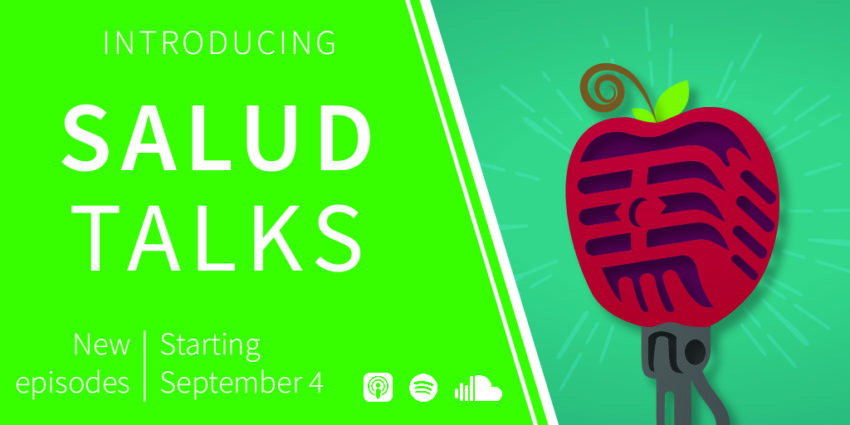
Podcasts are huge — there are over 750,000 shows on the market — but few focus on health equity. That's why Salud America! is lanching the Salud Talks podcast. The project will feature discussions on Latino health equity with guests who are working in the issues, both at the national and grassroots levels. To further that discussion, let’s use #SaludTues on Twitter on Tuesday, Sept. 3, 2019, to discuss podcasts and how they can be one of the best tools to disseminate public health information! WHAT: #SaludTues Tweetchat: “Podcasts and Health Equity”
TIME/DATE: 1-2 p.m. ET (Noon-1 p.m. CT), Tuesday, Sept. 3, 2019
WHERE: On Twitter with hashtag #SaludTues
HOST: @SaludAmerica
CO-HOSTS: @DrCHHuntley, @DoctoraEdith, @latinxtherapy, Dr. Erlanger "Earl" ...
Continuing its work to promote action for Latino health equity, Salud America! is launching a new project: The Salud Talks podcast. This production, which will go live on Wed., Sept. 4, expands on previously covered topic areas of Latino health and life — approaching each discussion with a holistic mindset. Episodes will be available every Wednesday morning on Apple Podcasts, Spotify, and SoundCloud. "The Salud Talks podcast is yet another extension of Salud America!'s wide and impactful reach," said Dr. Amelie Ramirez, director of Salud America! "The podcast will give listeners insight into many of the health disparities impacting Latinos and all Americans. Furthermore, it will raise awareness of emerging solutions to those disparities."
What to Expect
The podcast's first ...
The development of e-cigarette and vaping products has been on the rise among youth smokers. Young adults between ages 18 to 21 are most at risk to become habitual smokers. Longer duration of smoking is associated with increased risk for lung cancer, lung cancer death, and coronary heart disease. Worse, smoking is an addictive, tough opponent to beat. How can we promote quitting and smoke-free environments? Let’s #SaludTues on Tuesday, July, 23rd, 2019, to tweet about the latest research and beneficial strategies and programs that use the latest technology which helps to quit smoking WHAT: #SaludTues: Using Technology to Quit Smoking
TIME/DATE: 1-2 p.m. EST (Noon-1 p.m. CST), Tuesday, July 23, 2019
WHERE: On Twitter with hashtag #SaludTues
HOST: ...
Latino kids consume more sugary drinks than non-Latino kids at all ages, which contributes to their high obesity rates, among other health issues, research shows. Fortunately, many new policies are emerging to fight sugary drink consumption. Let’s use #SaludTues on Tuesday, July 16, 2019, to tweet about what’s working to fight sugary drink consumption and increase consumption of water for Latino and all kids! WHAT: #SaludTues Tweetchat: “How to Win the Fight Against Sugary Drinks”
TIME/DATE: 1-2 p.m. ET (Noon-1 p.m. CT), Tuesday, July 16, 2019
WHERE: On Twitter with hashtag #SaludTues
HOST: @SaludAmerica
CO-HOST: The American Academy of Pediatrics (@AmerAcadPeds), The Horizon Foundation (@thehorizonfound), Center for Science in the Public Interest (@CSPI), ...
July is Minority Mental Health Month. Mental illness does not discriminate based on race. However, Latinos are far more likely than their peers to have mental health issues, according to a Salud America! Research Review. Additionally, Latinos and blacks are less likely than whites to get the mental health services they need, thus leading to a plethora of problems such as missing work. Join us for #SaludTues on Tuesday, July 2, 2019 for a tweetchat in honor of Minority Mental Health Month. What: #SaludTues Tweetchat – The Importance of Minority Mental Health Month
Time/Date: 1-2 P.M. ET (Noon-1 P.M. CT), Tuesday, July 2, 2019
Where: On Twitter with hashtag #SaludTues
HOST: @SaludAmerica
CO-HOSTS: Stamp Out Stigma (@StampStigma) and The American Foundation ...
June marks Alzheimer's & Brain Awareness Month. This is a time to reflect on the many challenges and inequities facing people of color in the United States when it comes to Alzheimer's Disease and overall brain health. Sadly, U.S. Latinos are 1.5 times more likely to develop Alzheimer’s disease than whites, studies show. Alcohol, sleep deprivation, and diabetes play a role in this gap. Worse, Latino caregivers can experience high levels of stress when supporting their family members with the disease. To understand and address these disparities, people must pay more attention to the role of the social determinants of health. Let’s use #SaludTues on Tuesday, June 25, 2019, to tweet about the latest research and beneficial strategies and programs to prevent and reduce ...
Heart disease and cancer are among the leading causes of death for Latino men. Each year over 40% of men in the U.S., are lost to such chronic diseases, according to the Center for Disease Control and Prevention (CDC). Why do men face higher health risks? Compared to women, men are often less likely to get preventative screenings or checkups. Additionally, certain health behaviors related to diet, physical inactivity, and smoking may lead to increased risks of disease. Certain occupations and exposures may also put men at risk for certain cancers and poor health. Join us this month for #SaludTues at 1 p.m. ET on June 18, 2019, to celebrate and help promote Men’s Health Month! WHAT: #SaludTuesTweetchat: “Let's Celebrate Men's Health ...
Air quality impacts a lot more than what you might think. Noxious gasses and fumes contaminate the atmosphere every day, and the problem is getting worse — especially for Latinos and other minorities. Current government policies are also making the problem worse through roll-back initiatives. This year, the EPA is taking steps to reduce air pollution rules. These regulation reductions would give companies more room to emit higher levels of harmful substances. If enacted, those policies could expose more Americans to harm, causing greater long-term health impacts. Let’s use #SaludTues on Twitter on Tuesday, June 11, 2019, to discuss why our air quality is so important and what everyone can do to make a difference in this issue: WHAT: #SaludTues Tweetchat: “Air ...
Inequities in health arise from social and structural inequities and the policies, laws, and culture that keep them in place. To address inequities that affect health, it is important to make the distinction between individual-level (midstream) interventions to address “social needs,” and community-level (upstream) interventions to address “social determinants.” Individual-level efforts to address social needs are necessary, but not enough. Characterizing these interventions as efforts to address social determinants of health conveys a false sense of progress. "If we, even inadvertently, imply that the social determinants of health can be solved by offering Uber rides to individual patients or by deploying community health navigators, it will be challenging, if not ...