This is part of our Food and Latino Kids: A Research Review »
Conclusions
A large portion of U.S. families lack access to healthy, affordable foods in their neighborhoods. Lack of access is especially prevalent in low-income communities, including Latino communities. In these neighborhoods, convenience stores and fast-food restaurants are widespread, but there is a scarcity of supermarkets and farmers’ markets that can provide fresh and healthy food options. Healthy food financing initiatives are relatively recent, but promising at increasing the availability of healthy foods in low-income neighborhoods. These initiatives involve children and adults and are spread across various localities with different environments, characteristics, and obesity rates. There is still ...
This is part of our Food and Latino Kids: A Research Review »
Introduction
While a nationwide concern, obesity is especially prevalent among Latino children. Nearly 40 percent of U.S. Latino youth ages 2-19 are overweight or obese compared with 28.5 percent of non-Latino white youths.1 Obesity is linked to increased risk of developing type 2 diabetes, cardiovascular disease, asthma, liver disease, and cancer.2 Given that Latinos are one of the fastest-growing U.S. populations, preventing and reducing obesity among Latinos will have an important impact on our nation’s health. Latino children are more likely to live in poverty than others,3,4 causing diet quality to suffer and increasing the risk for developing obesity.5 Limited neighborhood access to affordable, healthy ...
Healthy food is important to health for all people. Yet fast food and corner stores outnumber supermarkets and farmers’ markets in many neighborhoods, including Latino neighborhoods. This results in overconsumption of unhealthy foods, and more risk of obesity. Fortunately, healthy food financing initiatives can boost access to healthy, affordable foods. This happens when supermarkets and farmers’ markets get certain incentives to develop their businesses in certain areas. Groups also can help corner stores to expand their inventory of healthy, affordable foods. Also, more marketing of healthy foods, and less of junk foods, can help spur desirability. See the Full Research Review with references (PDF)
Read the Issue Brief in English (PDF)
Read the Issue Brief in ...
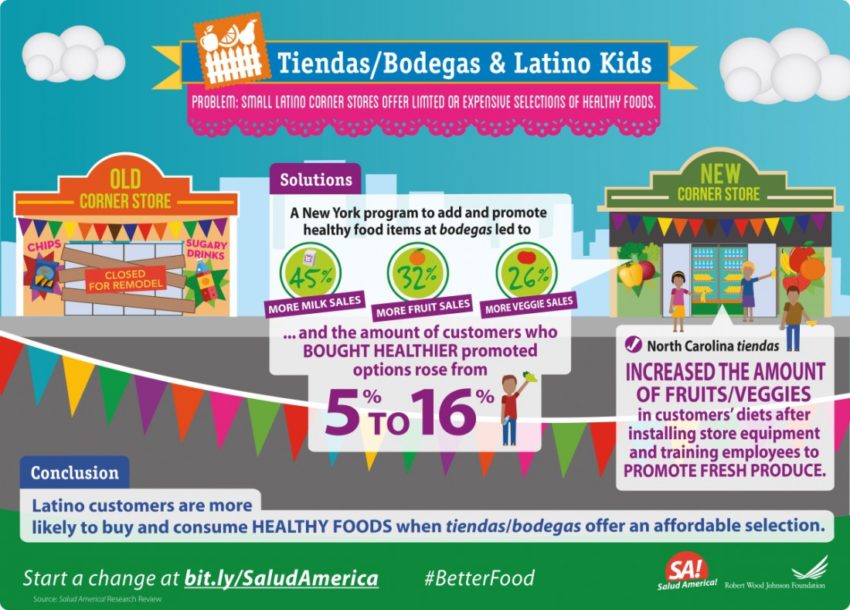
Many people, including Latinos, live in areas with poor access to supermarkets and easy access to corner stores, also called tiendas or bodegas. Research indicates that when corner stores offer a wider selection of healthy foods and promote them, people are more likely to buy them and eat healthier, according to our new infographic on tiendas/bodegas, which is part of the new Salud America! Better Food in the Neighborhood research package on the latest science and recommendations on healthy food options. Share this infographic ...
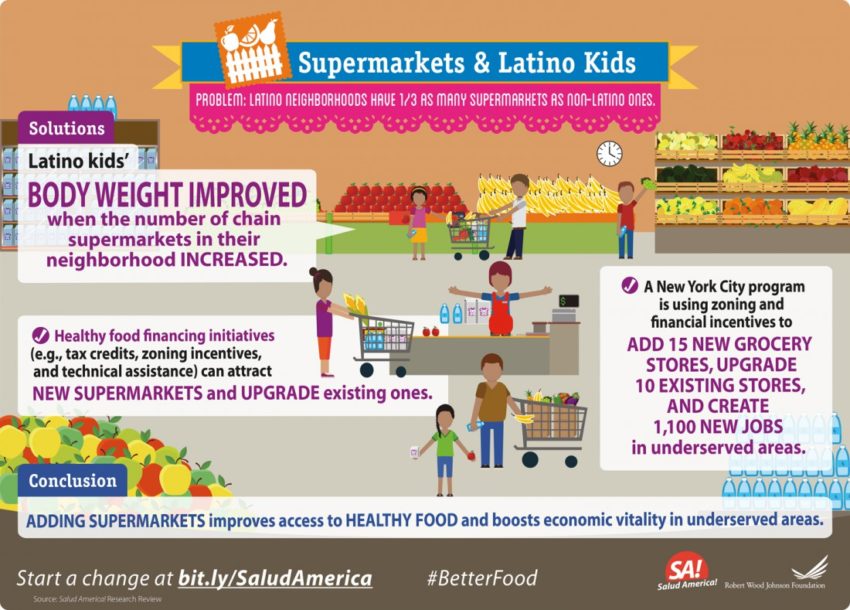
Did you know Latino neighborhoods have one-third as many supermarkets as non-Latino ones? Research indicates that adding supermarkets improves access to healthy food and boosts economic vitality in areas where families experience financial hardships, according to our new infographic on supermarkets, which is part of the new Salud America! Better Food in the Neighborhood research package on the latest science and recommendations on healthy food options for families. Also, kids’ body weight outcomes improved when the number of chain supermarkets in their neighborhood increased. Share this infographic ...
Latinos tend live in neighborhoods with few supermarkets and other sources of healthy, affordable food options, but several promising solutions are emerging, according to a new package of research from Salud America!, a national network for childhood obesity prevention and communication funded by the Robert Wood Johnson Foundation. Salud America!’s Better Food in the Neighborhood research package includes an in-depth review of the latest science on the U.S. food environment and recommendations based on that research. It also includes an issue brief, animated video, and infographics. The research shows that Latino neighborhoods have one-third as many supermarkets as non-Latino ones, corner stores with few healthy options, and more marketing of unhealthy foods. Promising ways to ...
It’s the time of the year when we’re feeling grateful for being healthy, having a loving family and a job, but do you know gratitude can also keep your heart healthy? A study led by Paul Mills, professor of family medicine and public health at the University of California, San Diego School of Medicine recruited 186 men and women who suffered from heart disease “either through years of sustained high blood pressure or as a result of a heart attack or even an infection of the heart itself.” During the study, Mills asked each participant to fill out a questionnaire to rate how grateful they were for the people, places or things in their lives. “We found that more gratitude in these patients was associated with better mood, better sleep, less fatigue and lower levels of ...
A vaccine can't prevent disease unless people use it. In Texas, a largely Latino state, only 39% of girls and 15% of boys ages 13-17 complete the three-dose HPV vaccine for the human papillomavirus (HPV), a common sexually transmitted infection that can cause cervical cancer and other problems. Dr. Deborah Parra-Medina has a plan to change that. Parra-Medina, a health researcher at the Institute for Health Promotion Research at UT Health San Antonio, received a new $1.2 million grant from the Cancer Prevention and Research Institute of Texas to develop an professional education and community outreach program to increase awareness and uptake of the HPV vaccine among children in South Texas. She and her team will train local health care providers to deliver accurate HPV vaccine ...
Obesity is on the rise in the United States, including among Latinos, according to a new CDC study, CBS News reports. The results come as a surprise after a decade of public-awareness campaigns and efforts to get Americans to watch their weight. According to the report by the CDC, the obesity rate of U.S. adults climbed to 38% from 32%, almost a decade ago. "This is a striking finding and suggests that a situation that was thought to be stable is getting worse", Dr. William Dietz, an obesity expert at George Washington University, told CBS News. But some experts warn that the study done by the CDC “may not have been representative of the nation as a whole.” The study was based on surveys conducted in 2013-2014 and found the rate of obesity to be higher among American women ...