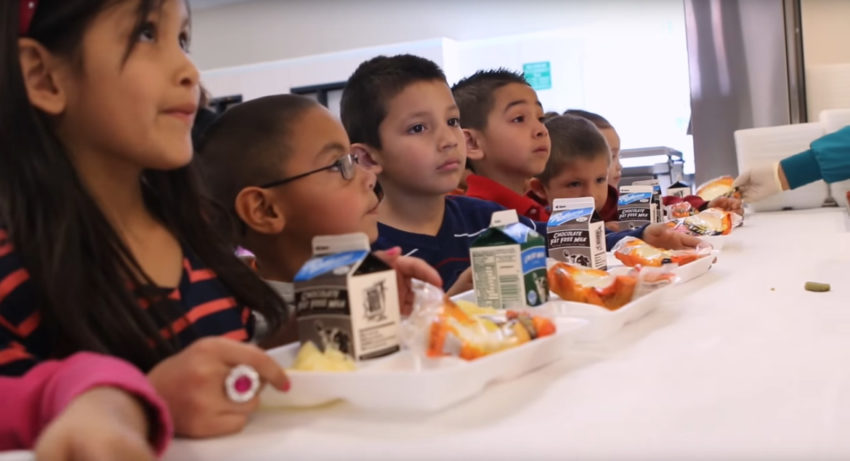
Schools are where kids consume half of their daily calories. But many kids are widely exposed to unhealthy foods at school, and are less likely to engage in physical activity in school, according to a new research review from Salud America!, a national network for childhood obesity prevention and communication funded by the Robert Wood Johnson Foundation. Salud America!’s Healthier Schools and Kids research review shows that Latino-majority schools tend to: have weaker policies on school snacks and drinks than other schools; may be less likely to implement nutritional guidelines; and offer few programs or access to facilities for physical activity. Solutions are emerging to create healthier schools: School policies that reduce access to unhealthy snacks and drinks are likely ...
All kids, including Latinos, need a healthy school environment. How can we healthy schools become then norm? Some students are more exposed to unhealthy food in and out of school. Stronger nutrition standards for snack foods and drinks will help all students access to healthier snacks at school, which can positively influence body mass index (BMI) trends for all populations. In addition, some students also engage in less physical activity in school, and before and after school. Implementing relevant programs that reduce challenges can increase activity opportunities for Latino and all kids. See the Full Research Review with references (PDF)
Read the Issue Brief in English (PDF)
Read the Issue Brief in Spanish (PDF)
Contents
Introduction & Methods. This Salud America! ...
Schools often have physical activity facilities, but many are not open to the public. Shared use agreements—contracts between a school and a city, county, or sports league that outlines rules for sharing existing facilities—can help neighborhoods have more access to active spaces and help kids stay active and healthy, according to our new infographic on shared use agreements. The infographic is part of Salud America!’s Active Spaces and Kids research package, which tackles the latest issues on the physical activity environment and offers recommendations. Share this infographic today! Salud America! is a Robert Wood Johnson Foundation-funded national childhood obesity prevention and communication ...
Many kids lack access to active spaces and safe streets where they can be physically active. These streets are often plagued with speeding cars and lack of sidewalks. Research shows that when communities adopt a “Complete Streets” policy and organize events such as “Open Streets,” more kids and their families become physically active, according to our new infographic on safe streets. The infographic is part of Salud America!’s Active Spaces and Kids research package, which tackles the latest issues on the physical activity environment and offers recommendations. Share this infographic today! Salud America! is a Robert Wood Johnson Foundation-funded national childhood obesity prevention and communication ...
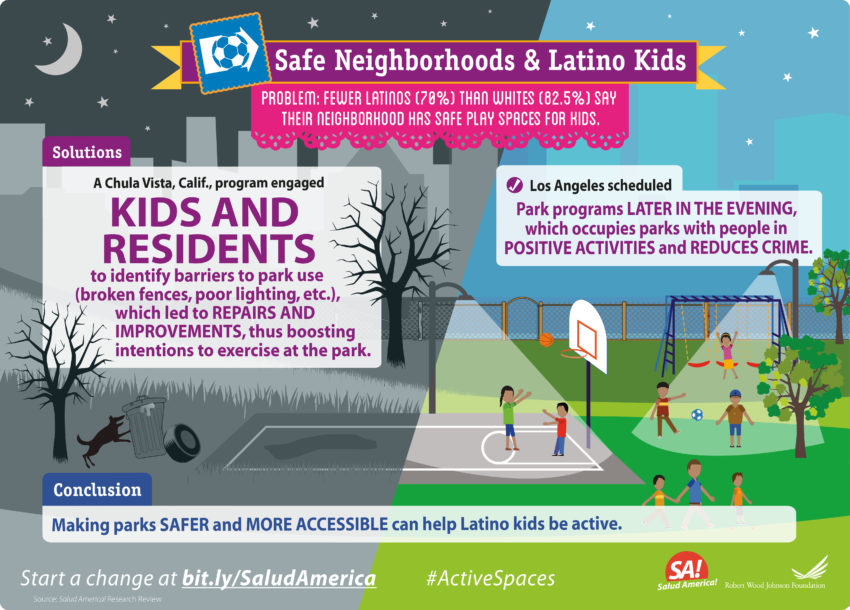
Only 70% of Latinos say their neighborhood has safe, active spaces for kids. Research shows that when communities address challenges to park use such as broken fences, poor lightening and sidewalks, more people visit community parks, according to our new infographic on safe neighborhoods. The infographic is part of Salud America!’s Active Spaces and Kids research package, which tackles the latest issues on the physical activity environment and offers recommendations. Share this infographic today! Salud America! is a Robert Wood Johnson Foundation-funded national childhood obesity prevention and communication ...
Did you know that 81% of Latino neighborhoods don’t have a safe recreational facility? That means many kids lack places to play and be active, which contributes to higher rates of physical inactivity and obesity, according to a new package of research from Salud America!, a national network for childhood obesity prevention and communication funded by the Robert Wood Johnson Foundation. Salud America!’s Active Spaces and Kids research package tackles the latest issues on the physical activity environment and offers recommendations. Solutions are emerging to improve access to and safe use of active spaces: Shared use agreements are formal contracts between a school and a city, county, or sports league that outline terms for sharing existing physical activity facilities. They ...
Many kids and families have limited spaces to be physically active. What are the best ways to improve access to “active spaces” like gyms, athletic fields, parks, and playgrounds for all families, including Latinos? Many schools do not provide public access to physical activity facilities. Shared use agreements set up rules for public use of schoolyards after class. Repairing sidewalks, installing street lights, and improving parks can stimulate more physical activity. Creating safer streets can people to walk or cycle to schools, parks, and other family destinations. Also, using marketing and technology to change kids’ physical activity patterns. See the Full Research Review with references (PDF)
Read the Issue Brief in English (PDF)
Read the Issue Brief in Spanish ...
This is part of our Food and Latino Kids: A Research Review »
Future Research Needs
This review of the evidence indicates that researchers should conduct additional and more rigorously designed studies, such as experimental or quasi-experimental studies with less reliance on self-reported data whenever possible. Future research should examine the degree to which increased access to local healthy foods impacts dietary habits and obesity in communities. Researchers also should: Identify other multilevel factors (for individuals, at homes, in neighborhoods, counties and cities), that contribute to obesity and health outcomes. Such factors include stressors, lack of time or interest in preparing healthy foods, prices for healthy foods that far exceed those for unhealthy ...
This is part of our Food and Latino Kids: A Research Review » Increased access to healthy foods in low-income neighborhoods does not necessarily ensure that it will lead to improvements in residents’ diets.
Some studies some no affect on dietary improvement
Two studies of low-income neighborhoods that have reported findings without sub-analyses have shown that increased access to healthy foods does not affect diet quality in low-income neighborhoods. A national study using longitudinal data observed that proximity to a supermarket was not related to diet quality in low-income young to middle-aged adult populations.27 In addition, the first controlled (one intervention neighborhood and one comparison neighborhood), longitudinal study of a PFFFI-funded project found that exposure ...