A new study hoped to learn more from the data about the health risks, such as smoking, on cancer diagnoses in the Latino community, which in turn, can improve health for all people. More than 16,000 Latinos participated in the study, and 4% reported instances of some type of cancer. Cancer has surpassed heart disease as the leading cause of death in this population, yet researchers still know little about how specific risk factors across ancestry groups. The researchers, part of the Hispanic Community Health Study/Study of Latinos, and including Dr. Amelie G. Ramirez of the Institute for Health Promotion Research at UT Health San Antonio, did not find a significant relationship between smoking and cancer prevalence. However, it is the belief of the researchers that the lack of a ...
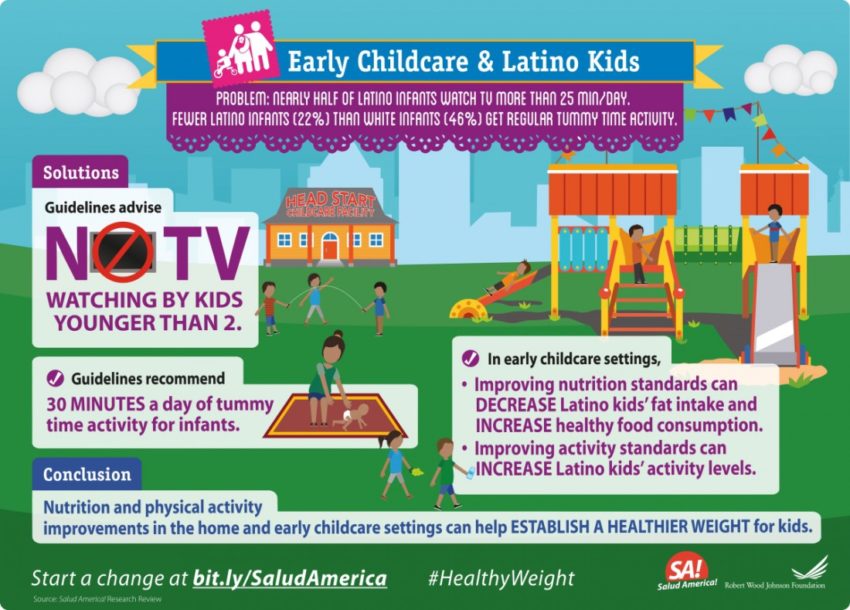
Too many infants watch TV for more than 25 minutes a day and few babies get regular tummy time activity. Guidelines advise no TV watching by kids younger than 2 and 30 minutes a day of tummy time activity for babies, according to our new infographic on early childcare and kids. The infographic is part of the new Salud America! Healthy Weight research package on the latest data and recommendations on how to ensure kids reach a healthy weight by kindergarten. Share this infographic today! Salud America! is a Robert Wood Johnson Foundation-funded national childhood obesity prevention and communication ...
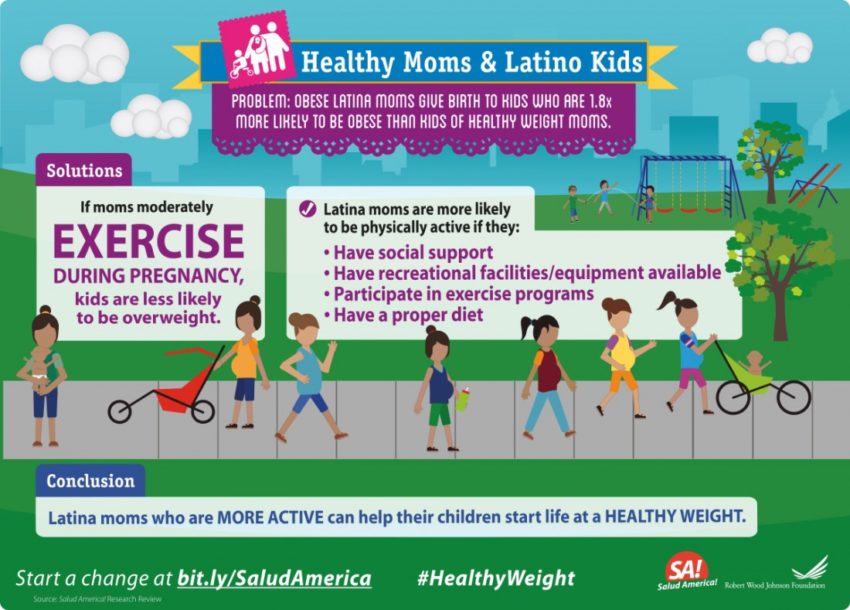
Moms who are obese give birth to kids who are 1.8 times more likely to be obese than kids of healthy weight moms. But, when moms exercise moderately during pregnancy, kids are less likely to be overweight, according to our new infographic on healthy moms and kids. The infographic is part of the new Salud America! Healthy Weight research package on the latest data and recommendations on how to ensure kids reach a healthy weight by kindergarten. Share this infographic today! Salud America! is a Robert Wood Johnson Foundation-funded national childhood obesity prevention and communication ...
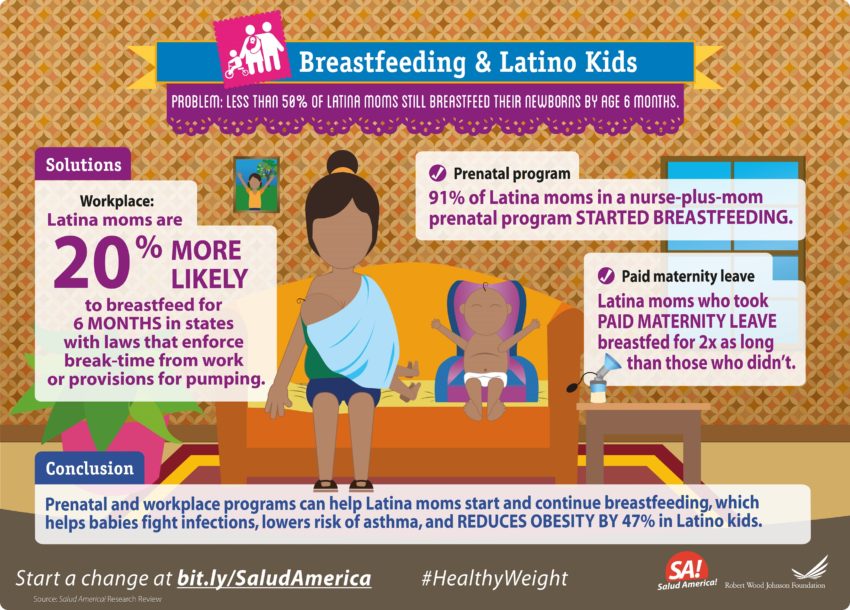
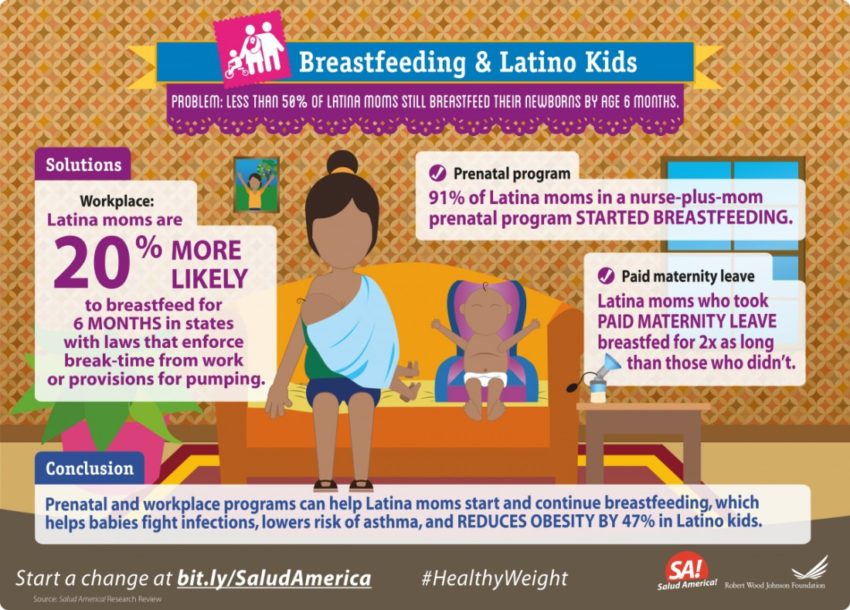
A lot of mothers no longer breastfeed their babies by age 6 months. But when workplaces make it easier for new mothers to breastfeed by providing paid maternity leave, break-time from work or provisions for pumping, mothers are 20% more likely to breastfeed 6 months, according to our new infographic on breastfeeding and kids. The infographic is part of the new Salud America! Healthy Weight research package on the latest data and recommendations on how to ensure kids reach a healthy weight by kindergarten. Share this infographic today! Salud America! is a Robert Wood Johnson Foundation-funded national childhood obesity prevention and communication ...
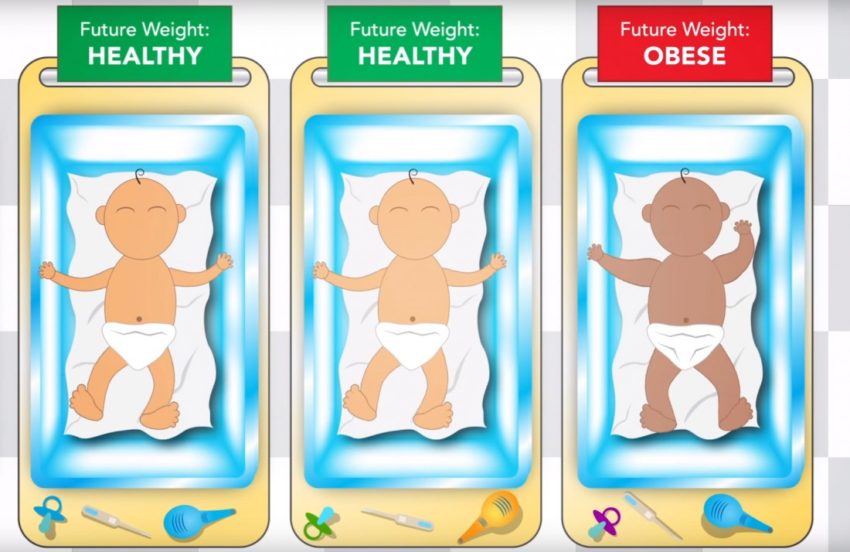
Obesity is rising among our youngest children. That’s because of a mother's obesity, less exclusive breastfeeding, and workplace and childcare issues, according to a new package of research from Salud America!, a national network for childhood obesity prevention and communication funded by the Robert Wood Johnson Foundation. Salud America!’s Healthy Weight by Kindergarten research shows that many women, including many Latinos, are overweight/obese when they get pregnant. Obese moms gave birth to kids who were 1.8 times more likely to be obese than their peers. Breastfeeding can reduce obesity by 47% among kids, but some moms are less likely than white moms to exclusively breastfeed their infants through age 1. Solutions are emerging to improve maternal and child ...
This is part of our Latina Mom and Baby Health: A Research Review »
Benefits of breastfeeding
The benefits of breastfeeding for both mother and baby are well established in the literature, and yet breastfeeding rates in the United States remain below desired levels.38,39 According to recommendations from The American Academy of Pediatrics (AAP) and The American Congress of Obstetricians and Gynecologists (ACOG), mothers should exclusively breastfeed their infants for at least the first 6 months of life, with continuation for 1 year or longer. In addition, breastfeeding infants should not receive supplemental formula unless advised by a health care professional.39,40 As part of the Healthy People 2020 initiative, the U.S. Department of Health and Human Services outlined several ...
One of four U.S. kids, including Latino kids, is already overweight or obese by age 2-5. How can we promote a healthy weight by kindergarten? Mothers’ physical activity and healthy eating habits before and during pregnancy play a big role. Breastfeeding also has many positive effects on children. Interventions or policies aimed at improving breastfeeding rates, while reducing formula marketing, among Latino and all mothers may be critical to promoting healthy weight goals. Healthy eating and physical activity habits established during early childhood care settings also is a stepping stone toward lifelong health. See the Full Research Review with references (PDF)
Read the Issue Brief in English (PDF)
Read the Issue Brief in Spanish (PDF)
Contents
Introduction & ...
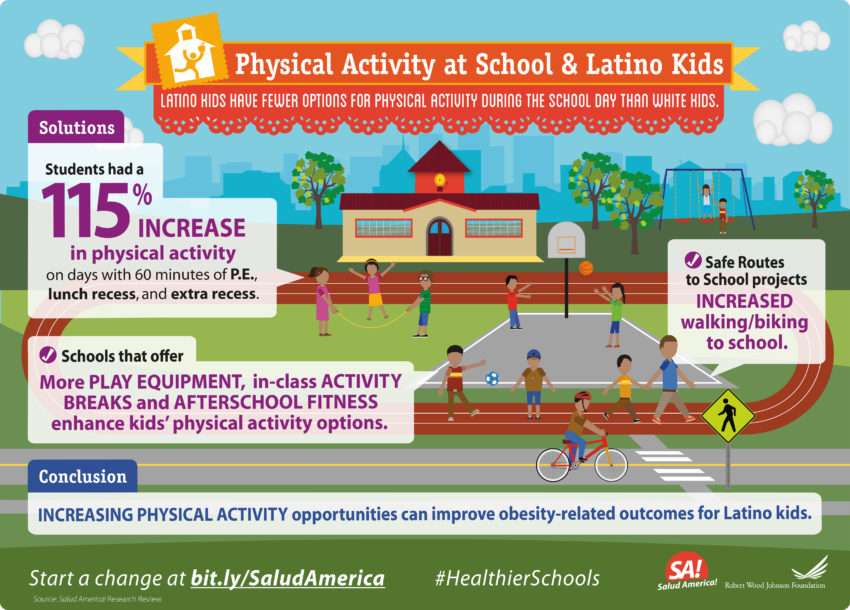
Some kids have fewer options for physical activity during the school day than their peers. When schools offer at least 60 minutes of physical activity, kids' physical activity increases by 150%, according to our new infographic on physical activity at school and kids. The infographic is part of Salud America!’s Healthier Schools and Kids research review, which tackles the latest issues on the school health environment and offers recommendations. Share this infographic today! Salud America! is a Robert Wood Johnson Foundation-funded national childhood obesity prevention and communication ...
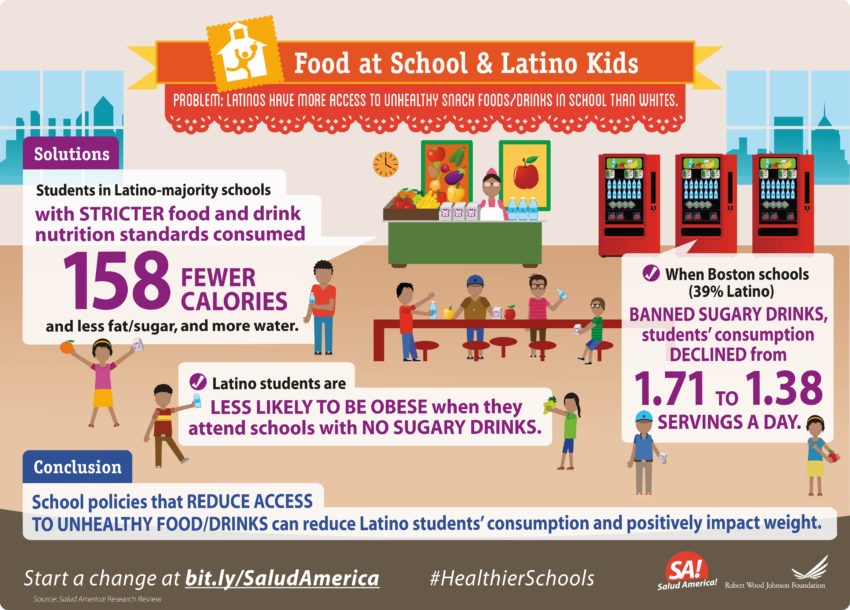
Many kids have access to unhealthy snacks in schools. But when schools take action and set stricter nutrition standards, students consume 158 fewer calories and less fat/sugar, and more water, according to our new infographic on food at school and kids. The infographic is part of Salud America!’s Healthier Schools and Kids research review, which tackles the latest issues on the school health environment and offers recommendations. Share this infographic today! Salud America! is a Robert Wood Johnson Foundation-funded national childhood obesity prevention and communication ...