by
by 
Share On Social!
“Para bailar La Bamba se necesita una poca de gracia.”
There’s a strong chance you’ve heard this song, “La Bamba,” on the radio, on TV, walking through the grocery store, or somewhere else at least once in your life.
While there are several different versions of this song, one of the most well-known was recorded by Ritchie Valens, a rock ‘n’ roll icon who had a short but impactful career.
During Hispanic Heritage Month, Salud America! is celebrating Latino trailblazers, historical figures, and inspirational stories.
This year we are highlighting the career and contributions of Ritchie Valens, a Mexican American singer and songwriter who blazed a trail for rock musicians for decades to come.
Ritchie Valens: Early Life Before Fame
Richard Steven Valenzuela was born on May 13, 1941, in Pacoima, Calif.
He grew up in the San Fernando Valley and developed an interest in music at a young age, picking up the guitar after encouragement from his family.
“Although he was left-handed, he was so eager to learn that he mastered the more readily available right-handed version of the instrument,” according to the California Museum.
At age 16, Valens joined his first band, the Silhouettes.
The young performers would play local gigs, until Valens was discovered by Bob Keane, and eventually sign with the Del-Fi record label.
“He found inspiration from various sources, ranging from traditional Mexican music to popular R&B acts to innovative rock performers like Little Richard,” according to Biography.
Ritchie Valens: Finding Success in Music
Valens would shorten his name from Valenzuela to Valens following Keane’s advice to seem more “radio-friendly.”
He found success with his first single out with Del-Fi, “Come On, Let’s Go.”
The singer had greater triumphs in 1958 with hit songs “Donna,” which would reach number two on the pop charts, and “La Bamba,” a rock ‘n’ roll cover of the traditional Mexican song.
“La Bamba was a revolutionary song that fused elements of a traditional Mexican folk tune with rock and roll,” according to Teach Rock.
As his success grew, Valens appeared on TV’s American Bandstand, the Perry Como TV Show, and a small role in the film, Go, Johnny, Go!
He also joined the Winter Dance Party Tour in January 1959 alongside Buddy Holly, Dion and the Belmonts, and other big names.
Ritchie Valens: The Day the Music Died
The touring group had a concert in Clear Lake, Iowa, on Feb. 2, 1959.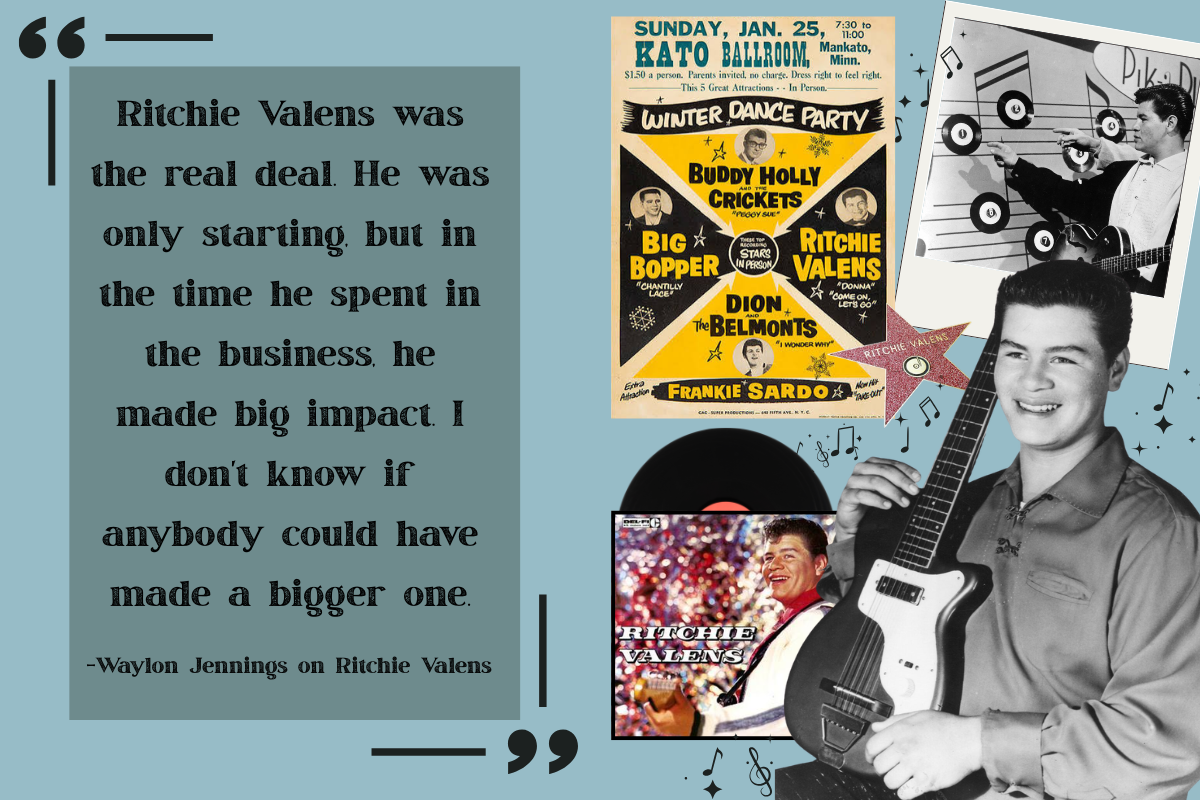
After the show, the performers were to leave for their next stop in Minnesota.
Frustrated with the poor state of their tour buses, which didn’t have operational heaters while traveling through snowy weather, Buddy Holly hired a local plane to take him to nearby Fargo, N.D., where they could gain some more time to rest and recover.
The plane had room for the pilot, Holly, and two others.
“According to some reports, Valens won a seat on the plane in a coin toss with Holly’s guitarist Tommy Allsup. Richardson also traded places with another original passenger, Waylon Jennings,” Biography states.
The plane took off in the snowy, early hours of Feb. 3, 1959, but only make it a few miles.
The plane crashed in a nearby corn field and took the lives of Valens, Holly, J.P. “The Big Bopper” Richardson, and the pilot.
“The pilot was young at 21-years old but had four years of experience. Unfortunately, he was unaware of a weather advisory that had been issued before the plane took off,” according to the official Ritchie Valens website.
The news of the tragedy and loss of so many young talents, including Valens who was only 17 years old, sent shockwaves across the country.
“Valens left behind a few recordings. His first, self-titled album was released shortly after the accident and did well on the charts,” according to Biography.
The tragic event would also be memorialized in the 1971 song American Pie by Don McLean.
Ritchie Valens: Lasting Impact
While he had a short career, Valens’ name and music are still loved and recognized today.
His story and success were immortalized in the 1987 biographical film, La Bamba, starring Lou Diamond Phillips and Esai Morales.
On the surface, La Bamba tells Ritchie’s story.
However, the film also discusses the importance of music, family, and the battles and barriers that Latinos faced in 1950s America.
The movie not only introduced Valens to younger generations but also became a cultural staple for many Latinos.
“In telling Ritchie Valens’s story in a mainstream film, Valdez created a path for other representations of Chicano life to be not only welcome in pop culture but viewed as American culture as well,” according to the Criterion Collection.
Today, many label Valens as a “godfather of Chicano rock.”
In 1990, Valens became the first Latino rock artist to be recognized with a star on the Hollywood Walk of Fame.
In 2001, he would be inducted into the Rock & Roll Hall of Fame.
“Finding success at a time when very few Latinos were heard in mainstream American rock and pop music, he paved the way for musicians such as Los Lobos, Los Lonely Boys, and Carlos Santana,” according to the California Museum.
Explore More:
Increasing RecognitionBy The Numbers
3
Big Excuses
people use to justify discriminatory behavior
This success story was produced by Salud America! with support from the Robert Wood Johnson Foundation.
The stories are intended for educational and informative purposes. References to specific policymakers, individuals, schools, policies, or companies have been included solely to advance these purposes and do not constitute an endorsement, sponsorship, or recommendation. Stories are based on and told by real community members and are the opinions and views of the individuals whose stories are told. Organization and activities described were not supported by Salud America! or the Robert Wood Johnson Foundation and do not necessarily represent the views of Salud America! or the Robert Wood Johnson Foundation.