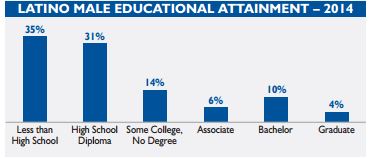
According to a new report, while college enrollment numbers for Latino males continues to rise, they still lag behind female Latinos in terms of college enrollment. This disparity increases as the level of higher education increases. The report, from Excelencia in Education, found that Latino males represent half of the traditional college-aged Americans in total. Other findings from the report were that Latino male high school dropout rates have decreased significantly. In 2014, the high school dropout rate for Latino males was 12% down considerably from 26% in 2005. The graduation rates for Latino males and females have proven to be similar, with Latino males at 49% and females at 51%. Latinos are also the second largest group of college-age males overall. In 2014, Latinos ...
As reported by the Long Beach Press-Telegram, a community-based think tank in Long Beach, Calif. (42% Latino population) detailed in a new report how the city is facing economic troubles along ethnic and geographic lines. According to the report entitled “Long Beach Equity Atlas: Geographical Opportunity” by ReThinking Greater Long Beach, poverty among children and adults is concentrated in communities of ethnic and racial minorities, specifically in the south central and west areas while wealth is concentrated in the areas populated mostly by whites in the north central and east side of Long Beach. “The rate of poverty will increase, and we will reach a point where the reserves of the city will be at such a drain ... we will have to go to bankruptcy,” said Alex J. Norman, a ...
A new report from the U.S. Census Bureau offers a look at the differences in educational attainment for the different races and ethnicities. The study found that 93.3% of non-Hispanic whites over the age of 25 graduated from high school and Asians and non-Hispanic whites were more likely to hold a bachelor’s degree than Hispanics/Latinos. For Latinos, there has been a positive trend in terms of education. In 1988, 10% of Latino adults (25 years or older) had obtained a bachelor’s degree or higher. In 2015, the rate rose to 15%. However, compared to non-Hispanic whites (36% in 2015), Latinos still lag far behind. Latinos were the only group where the percentage of the native population with a bachelor’s degree or higher was higher than the percentage of the foreign-born ...
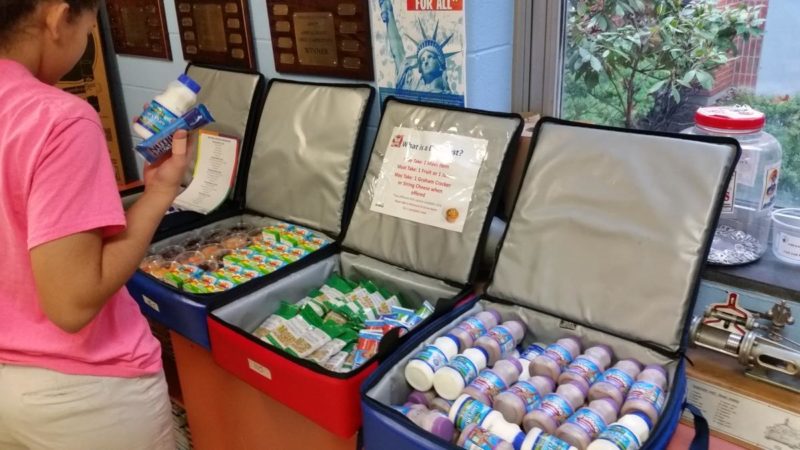
The Springfield City Council has voted to authorize seven million dollars to help support a growing meals program for the state's second largest public school system. The money will help purchase and renovate a warehouse dedicated to help save taxpayers money and provide healthier school meals for the city's 30,000 impoverished kids, by housing all food-related operations for the district into one place. The school's department of finance chief Patrick Roach explained that the warehouse will help save the program over half a million dollars a year, and help create a culinary and nutrition center that will allow for more scratch cooking and less processed foods. The warehouse will also allow high school students learning opportunities and provide 40 additional full-time jobs to ...
A vaccine can't prevent disease unless people use it. In Texas, a largely Latino state, only 39% of girls and 15% of boys ages 13-17 complete the three-dose HPV vaccine for the human papillomavirus (HPV), a common sexually transmitted infection that can cause cervical cancer and other problems. Dr. Deborah Parra-Medina has a plan to change that. Parra-Medina, a health researcher at the Institute for Health Promotion Research at UT Health San Antonio, received a new $1.2 million grant from the Cancer Prevention and Research Institute of Texas to develop an professional education and community outreach program to increase awareness and uptake of the HPV vaccine among children in South Texas. She and her team will train local health care providers to deliver accurate HPV vaccine ...
Camp Cauliflower is a cooking camp in Novato, Calif., where young students are learning what healthy cooking looks like for one week. Created by 17-year-old high school senior, Elena Dennis, the camp encourages young students to create healthy meals from the garden to the kitchen. Students harvest, cut, chop and cook alongside their older peers throughout the classes, all while learning what it takes to create a well-balanced meal. Elena, interested in starting this camp to encourage healthier diets for younger classmates, wanted to use her passion for cooking and nutrition in her school. She set out to make her dream of Camp Cauliflower become a reality in 2014 by asking food and nutrition director of Novato School District, Miguel Villarreal, to help her start her ...
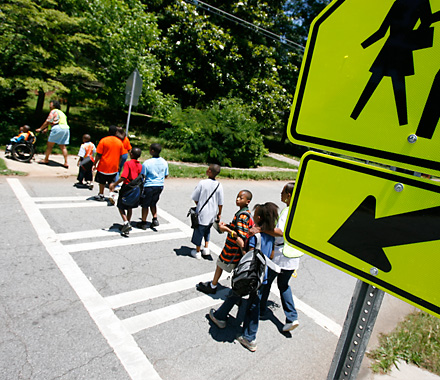
According to a recent research review, the Safe Routes to School program has been successful in increasing the proportion of students that walk and bike to school. The Safe Routes to Schools (SRTS) program provides education, encouragement and road improvements to create safe conditions to increase rates of walking and biking. This is particularly important for low-income populations who tend to experience greater rates of obesity and pedestrian injury and tend to live in areas with poor walking conditions. Participating schools were more likely to be in high-density areas. These areas found fewer rates of child pedestrian injuries and increased rates of walking and biking compared to areas that did not participate in SRTS. Additionally, rates of walking and biking increased over ...
The Michael & Susan Dell Center for Healthy Living have multiple programs and projects that promote healthy living. Active-Play Active Learning (APAL) is just one of the many healthy programs that encourages healthy changes for kids. APAL is a school-based initiative that allows kids to become more active in recess and school time. APAL is incorporated through three main approaches: Classroom Brain Breaks- brief activity breaks that support academic learning and contribute active class transitions.
School Playground Markings- beautified playground areas with locomotor markings that encourage learning and activity during recess and class time.
Peer-Led Games- five to ten minute student led games. Three times a year teachers are trained with interactive games and ...