 by
Share On Social!
Texas has a big opportunity to eliminate cervical cancer.
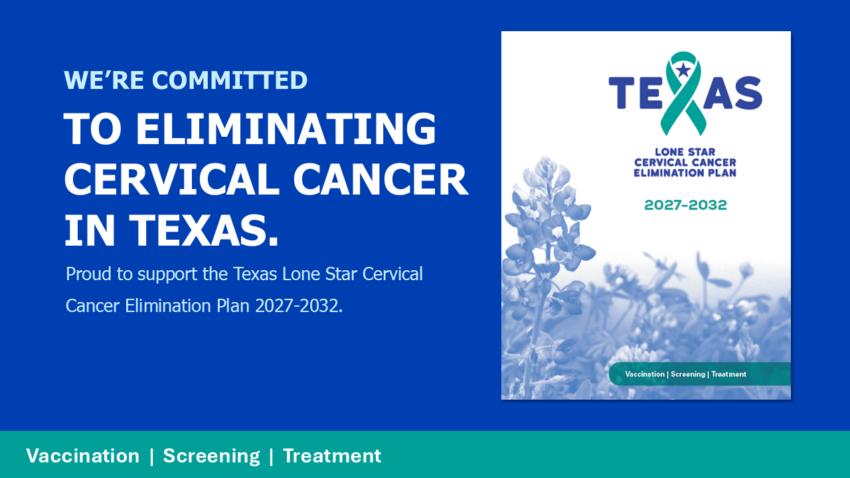
It will take the combined impact of HPV vaccination, routine cervical cancer screening and follow-up, and timely navigation to treatment services, according to the Texas Lone Star Cervical Cancer Elimination Plan 2027-2032.
The plan’s three big actions are recommended by the Cervical Cancer Elimination Priority Area Workgroup, supported by the Cancer Alliance of Texas (CAT).
The workgroup includes Dr. Rebecca Jones, assistant director of the Institute for Health Promotion Research at UT Health San Antonio.
“Texas has the tools to prevent nearly all cervical cancers, but elimination will require coordinated statewide action, sustained partnerships, and tailored and targeted strategies,” according to the plan.
Let’s explore cervical cancer in Texas and three big opportunities for action.
Why Cervical Cancer and Texas?
Cervical cancer is a preventable, but persistent, health problem.
In fact, Texas has the 8th highest rates of cervical cancer and the 6th highest rate of deaths from cervical cancer among U.S. states.
This is largely due to the state’s large geographic size, a population with many different backgrounds, border and rural communities, and high uninsured rates.
Other issues are cross-border healthcare utilization, fragmented continuity of care that can delay screening and follow-up, and incomplete health records across healthcare systems that can make it hard to track vaccination status, screening history, and follow-up care.
Yet Texas also has some big opportunities.
“Texas has unique strengths … including strong academic, clinical, public health, and community partners; collaborative efforts across sectors, coalesced through a strong Cancer Alliance of Texas; and a robust prevention infrastructure supported by the Cancer Prevention and Research Institute of Texas,” according to the plan.
1. Boost HPV Vaccination Rates
The plan’s first big opportunity is HPV vaccination.
The plan aims to increase the percentage of Texas boys and girls up to date on human papillomavirus (HPV) vaccination by age 15 from 50.5% to 80%.
Key strategies to meet this goal include implementing clinical interventions, supporting community outreach and education, and offering the HPV vaccine in additional settings.
“No Texan should suffer from or lose their life to cervical cancer if we could prevent it. Early detection, screening, and vaccination can prevent unnecessary suffering and save lives,” said Ludivina Hernández, community outreach coordinator and cervical cancer survivor.
2. Elevate Cervical Cancer Screening
The plan’s second big opportunity is increasing cervical cancer screening.
That starts with understanding challenges to cervical cancer screening in Texas:
- Lack of health insurance
- Geographic and transportation challenges
- Systemic gaps
- Embarrassment, discomfort, and fear of cancer diagnosis
To overcome these challenges, leaders should focus on adding primary HPV testing and HPV self-collection as screening options for all eligible Texans, even beyond the clinic.
Navigational support for screening participation is also important.
“Reducing barriers to cervical cancer screening includes not only improving access to screening but also ensuring that individuals can successfully complete screening, receive their results in a timely and understandable manner, and access recommended follow-up care,” the plan states.
3. Increase Cervical Cancer Diagnosis and Treatment
The plan’s third big opportunity is timely diagnosis and treatment of cervical precancer and cancer, which can play a major role in eliminating the disease.
The plan sets a goal of ensuring 80% of women receive diagnostic follow-up and treatment when needed through community outreach, patient navigation, provider training and survivorship support.
To meet this goal, the plan highlights the need for the implementation of multilevel, multicomponent interventions, including community outreach and education, patient navigation and provider training and education.
“Multicomponent programs bring together the critical elements needed to overcome these challenges, including community outreach and education, patient navigation, provider training, and strong clinical partnerships,” said Dr. Rose Gowen, faculty associate at Ut Health Houston School of Public Health Brownsville Regional Campus.
Looking Toward the Future
Cervical cancer can be prevented with highly effective, evidence-based interventions.
Future efforts should include:
- Embracing emerging technologies and innovations
- Securing funding
- Strengthening data systems
- Dissemination and evaluation of the plan
“By continuously evaluating outcomes, adapting strategies, and investing in evidence-based innovations, Texas can build a learning health system capable of accelerating progress toward the elimination of cervical cancer as a public health problem,” the plan states.
Go here for the complete 2027-2032 Texas Lone Star Cervical Cancer Elimination Plan.
Improve the Health of Your Community
Do you know what kind of health issues are affecting your community?
Find out by downloading a Salud America! Health Report Card for your town!
Enter your county name and get auto-generated local data with interactive maps and comparative gauges on several health indicators. This can help you visualize and explore local issues in education, housing, transportation, food, health, and more.
See how your county stacks up compared to the rest of your state and nation.
Then email the Report Card to local leaders to raise awareness, include the data in a presentation or grant proposal, or share it on social media to drive healthy changes in your community!
By The Numbers
142
Percent
Expected rise in Latino cancer cases in coming years