Overweight and obesity continue to be big problems in the US, impacting over 100 million Americans or nearly 40% of the US population as of 2023, according to the CDC. The obesity epidemic is, in turn, driving up heart disease, diabetes, and cancer. However, within the last decade, new weight loss injectables have become available to help mitigate obesity and its related risks. These medications – such as Ozempic, Wegovy, Mounjaro, Zepbound – have grown in popularity for their ability to cut down on potential health risks while helping people get back to a healthier weight. But there’s still more providers and researchers are learning about these products and their health applications. Let’s go over 10 things you should know about weight loss ...
Latinos continue to be one of the fastest growing groups in the U.S., rising to 20% of the population for the first time this past year, according to the U.S. Census. In addition, Pew Research Center shared these facts: Latinos have played a major role in U.S. population growth.
The sources of Latino population growth have changed in recent years.
S. Latinos trace their roots to many countries.
California and Texas have the nation’s largest Latino populations.
The share of U.S. Latinos with college experience is rising.
The religious affiliation of U.S. Latinos is changing. Let’s dig deeper into these facts and how they can impact others.
Latino Population Growth in the U.S.
The U.S. was home to 340,110,988 people in 2024. Of those, 195 million are ...
Cancer continues to be a leading cause of death for Latinos and all people in the US. But thanks to modern medicine, which includes cancer screenings, prevention techniques, and treatments, the number of cancer survivors is on the rise. Researchers are constantly working on new ways to mitigate and manage cancer and symptoms. However, some of these can come from unlikely places. For instance, researchers have found a link between the COVID-19 vaccine and the cancer immune system, according to a new publication in the journal Nature. Let’s go over the findings and what they mean for cancer patients.
Research Findings on COVID-19 Vaccine and Cancer
The discovery was made when researchers were developing mRNA vaccines for brain tumor patients back in ...
Yolanda “Yoli” Barrera Day wasn’t aware she had stomach cancer. Not very many do because from a health standpoint, stomach cancer looks like any other gastrointestinal ailment. But for Yoli, stomach cancer preyed on her advancing age. After months of suffering from symptoms such as extreme fatigue and shortness of breath, Yoli was diagnosed with gastric adenocarcinoma. It was a diagnosis that most may deem a death sentence, but not Yoli. Yoli was determined to make it out the other side and help others do the same by becoming a health leader and supporter for change.
Deceptive Symptoms Hiding Stomach Cancer
It was early 2021 and Yoli was feeling more tired than usual. While the exhaustion was draining, it wasn’t enough to raise ...
Type 2 diabetes has increased at an alarming rate in children, increasing to between 24% and 45% (compared to 1-2% before the mid-1990s), with the average age of diagnosis being around 13 years old, according to research. This can deeply effect young Latinos, as more than 22% of Latino youth and 28.7% of Latino young adults have prediabetes. Many factors contribute to this rise, including childhood obesity, genetics, and diet. Now, researchers from Florida Atlantic University have found that where a child lives can also factor into their risk for type 2 diabetes. Let’s explore this research and see how it impacts children and their communities.
Behind the Research on Diabetes in Children
Researchers for Florida Atlantic University’s ’s Charles E. Schmidt College of ...
Myth: Vaccines are linked to autism. Truth: In 1998 there was a scientific paper that linked the MMR vaccine to autism. These claims were refuted, and the paper was retracted. There have since been several other studies examining the relationship between the vaccine and autism, but no link has been found, according to Johns Hopkins Bloomberg School of Public Health. It’s easy to see how incorrect information is spread, disseminated, and accepted. These falsehoods can be dangerous and, when it comes to public health, deadly. And with social media at the epicenter of the threat of incorrect information, it’s never been more imperative to learn how to be better prepared to recognize and correct it. That’s why mySidewalk, an online data visualization platform, ...
For the last few years, Hispanic/Latinos living in South Texas have been sharing their cancer stories with the Avanzando Caminos Hispanic/Latino Cancer Survivorship Cohort study team at UT Health San Antonio. But up until now those stories were limited to survivors of prostate, colorectal, lung, stomach, liver, endometrial, breast, cervical, and kidney cancers. Now it’s time for the bladder, melanoma, ovarian, thyroid, and lymphoma cancer survivors to share their journeys, too. The Avanzando Caminos study is now enrolling participants who have completed their primary cancer treatments for one of the designated cancer types within the last 10 years. share your story with avanzando caminos!
What is the Avanzando Caminos Study?
The Avanzando Caminos Hispanic/Latino ...
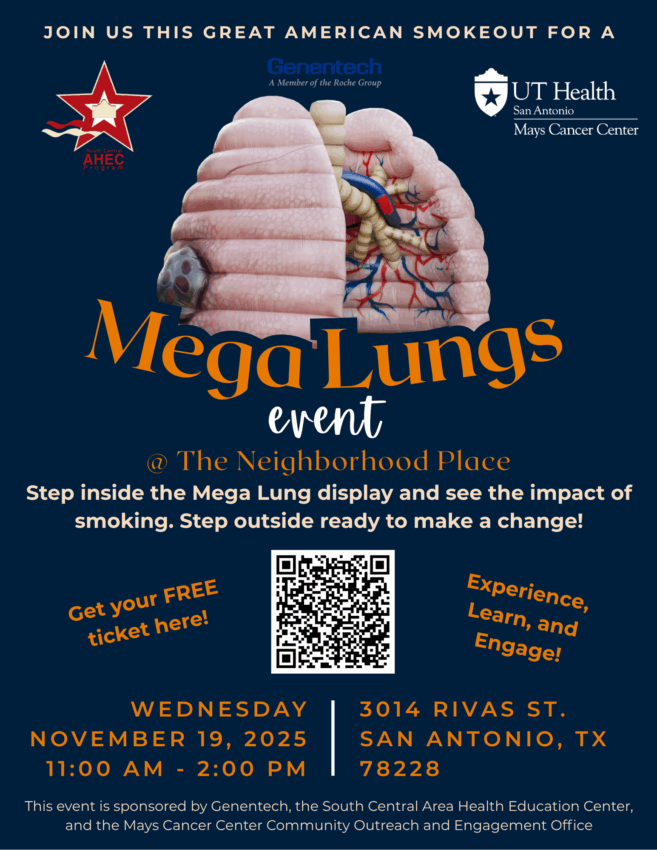
Do you smoke cigarettes and want to quit? On Thursday, Nov. 20, 2025, you can join thousands of people who will begin their smoke-free journey with the Great American Smokeout, an annual quitting event. To get help, enroll in Quitxt, a free English or Spanish texting service that turns your phone into a personal “quit smoking” coach from UT Health San Antonio. To join Quitxt, text “iquit” (for English) or “lodejo” (for Spanish) to 844-332-2058. And, if you’re in the San Antonio area, visit the “Mega Lung,” a giant model of a human lung that shows the importance of the respiratory system’s most vital organ.
Step Inside the Mega Lung
The MEGA Lung is open 11 a.m. to 2 p.m. on Wednesday, Nov. 19, 2025, at the Neighborhood Place cafeteria, 3014 Rivas Street, San ...
We know smokers have an increased risk of dementia. Now new research suggests that quitting smoking, even after later in life, can slow cognitive decline. Researchers from the University College of London collected data from more than 9,000 participants ages 40 and older across 12 countries. “They matched people who had quit smoking with continuing smokers according to their starting cognitive scores and other characteristics, including sex, age, education level and birth country,” according to NPR. Results showed verbal fluency declined at a rate roughly half for those who quit smoking compared to that of their smoking counterparts. For memory, the decline was reduced by 20%. Let’s dive deeper into this study and what this can mean for those who quit smoking.
Why ...