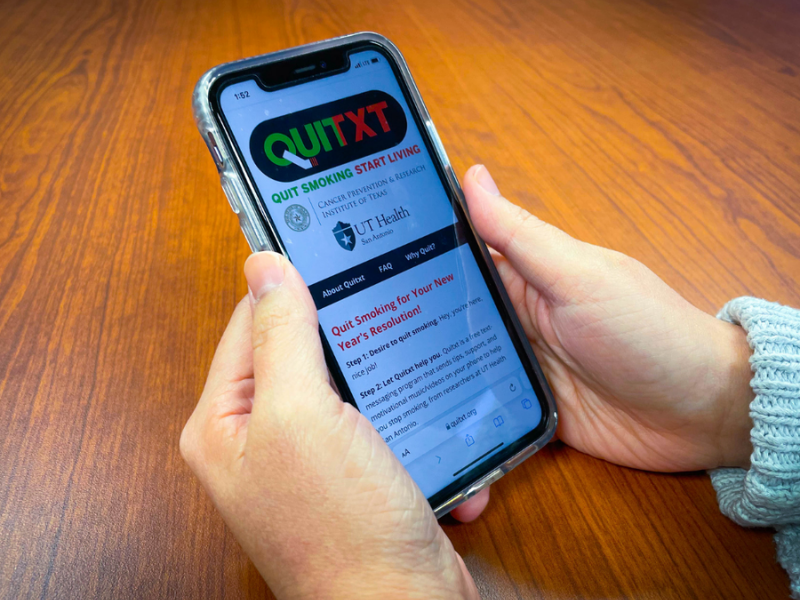
Dr. Patricia Chalela of UT Health San Antonio has received a new five-year, $2 million research grant to test the impact of Quitxt, a bilingual text messaging program that helps Latino young adults in South Texas to quit smoking. The grant is among $90 million for new cancer prevention and research projects from the Cancer Prevention & Research Institute of Texas (CPRIT). For the grant, Dr. Chalela and her team will recruit 1,200 Latino smokers ages 18-29 who agree to try to quit smoking. Half will receive Quitxt, a free texting service with background appropriate visual, video, and audio content fueled with evidence-based techniques to prompt and sustain smoking cessation. The other half will get abbreviated text messages and referral to the "Yes Quit" smoking cessation ...
To help address social needs, or the non-medical challenges to health, more healthcare systems are screening patients for non-medical drivers of health. We at Salud America! at UT Health San Antonio are spotlighting why non-medical drivers of health screenings can be an effective way to improve health outcomes for Latinos and all patients. Today, we are sharing three more non-medical drivers of health screening tools – questionnaires that gather information from patients – that may be helpful to your healthcare facility. Download these screening tools or use them as inspiration to create your own! For more screening tool options, please read our first list of non-medical drivers of health screening tools.
The Accountable Health Communities (AHC) Health-Related Social ...
Latino and Black patients on dialysis have higher rates of staph bloodstream infections, according to a new CDC report. Dialysis is a treatment for people whose kidneys are failing. “More than half of people in the U.S. receiving dialysis [are non-White] —about 1 in every 3 people receiving dialysis is Black and 1 in every 5 is Hispanic,” according to the CDC. Latino dialysis patients alone had a 40% higher risk of staph bloodstream infections than White patients on dialysis between 2017 and 2020. Let’s further explore the health differences that impact dialysis patients.
Risks of Dialysis Treatment
While dialysis treatments are necessary and could ultimately save the life of patients with end-stage kidney disease, it does come with risks. Germs such as staph can ...
Some Latinos fear becoming a guinea pig. Others worry about cost or trust. But clinical trials can provide volunteers potentially life-saving treatments and help researchers learn how to manage and treat different diseases for their family and communities. UT Health San Antonio held a Zoom webinar — “Busting the Myths and Challenges to Clinical Trials” — at 11 a.m. CT on March 9, 2023. This webinar features health experts and real Latino clinical trial volunteers to help define clinical trials, bust several common myths about clinical trials and share testimonials of trial participation. Panelists will also connect audience members with culturally relevant resources and available opportunities to participate in clinical trials at the Mays Cancer Center at UT Health San ...
You’re probably familiar with Valentine’s Day on February 14. Every year, couples dote on each other and exchange candy, roses, and other gifts. But have you heard of Galentine’s Day? On February 13, Galentine’s Day is a time for women to celebrate their friendships with their gal pals, or lady friends. In honor of Galentine’s Day 2023, Salud America! is highlighting the incredible work and friendship of Drs. Amelie Ramirez and Patricia Chalela, two Latina researchers at the Institute for Health Promotion Research (IHPR) at UT Health San Antonio. The duo has a 30-year history working together to mitigate health challenges and differences in the Latino community through public health research. Their contributions to Latino health improvement are immeasurable. Let’s ...
From mental health to education and preparing children for adulthood, moms and dads have a lot to think about with how they parent. In fact, 40% of parents with children younger than 18 say they are extremely or very worried that their children might struggle with anxiety or depression at some point, according to the new Parenting in America Today report from the Pew Research Center. Parents worries stem from the rise of a youth mental health crisis and the compounding stress of the COVID-19 pandemic, which deeply impacted Latinos. Let’s explore the full report on parenting and how it impacts Latinos and all people!
The Top Parental Concern
Mental health is the top concern for parents, according to the Pew report. That worry is felt “more acutely” by Latino ...
Germs are everywhere, including in dirt and dust! When we think of dirt in our daily lives, we usually think of potted plants and gardens. When we think of dust, we think of the kind that we clean in our house and workplaces. But fine dust can also be present at construction and maintenance projects inside a building, like taking out parts of a wall or renovating a room. Also, when construction and maintenance projects that move a lot of dirt and dust around happen in or near a healthcare facility, it can send germs that are in the dirt and dust into the air. These germs can harm certain patients with weakened immune systems.
What Kind of Germs Are in Dirt and Dust?
Dirt and dust contain many germs, including a fungus called Aspergillus. Aspergillus and other fungi ...
Although Anjelica Cazares spends a lot of time talking into a microphone, she doesn’t need it to be heard and make an impact speaking up for fair pay for Latinas. Anjelica – the co-founder, owner, and principal creative director at Big Oak Tree Media and Market Street Consultants, and host of the award-winning podcast, “If Not You, Then Who?” – uplifts the stories of national Latina leaders and actively speaks up for Latina fairness and prosperity. Her most recent accomplishment was organizing and hosting a dinner focused on her main platform – making sure Latinas have fair pay. The dinner was held in Houston, Texas, in December 2022. The dinner brought together a group of Latina leaders to make connections, discuss personal and professional journeys, and strategize ...
About 150,000 Americans are diagnosed with colorectal cancer. For Latinos, colorectal cancer mortality rates remain stagnant due to a number of differences including lack of access to healthy and nutritious food and less access to health insurance and healthcare. While many do experience symptoms when developing colorectal cancer, some may not. Therefore, it is important for Latinos and all people to take measures that can decrease the risk for the disease through making healthy choices, and create healthier environments for healthy lives! Let’s use #SaludTues on March 7, 2023, to dive into the importance of National Colorectal Cancer Awareness Month. WHAT: #SaludTues: National Colorectal Cancer Awareness Month
TIME/DATE: 1-2 p.m. EST (Noon-1 p.m. CST), Tuesday, ...