New Year’s resolutions are a tradition that many people engage in every year. Some resolve to address physical health – to eat better, to lose some weight, to exercise more – and these are all great. However, one aspect of health often gets completely overlooked during this time of year. Mental health affects millions of people across the country, but more often than not goes unaddressed. Latinos – especially young Latinos – are statistically more likely to have mental health issues than their peers and they are far less likely to seek treatment. Lack of access to resources, cultural stigma, and language barriers are all key reasons why Latino mental health often goes untreated. In an effort to reverse this situation, Kaiser Permanente has launched a website entitled ...
Liz Franklin made an important discovery about mental healthcare for the Latino population in her years as school therapist at Washburn Center for Children in Hennepin County (6.9% Latino), Minn. Speaking Spanish is good—but it's not enough to understand Latinos' thoughts and situations. "You won’t get everything right if you just translate things literally," Franklin told the MinnPost. "You have to understand the deeper meanings, and to do that takes time and a lot of communication." That's why Franklin decided to help. She created a consortium of more than 80 Spanish-speaking therapists, doctors, and other mental healthcare providers to share more about the Latino culture and the issues that this population faces.
Latinos and Mental Health
Latinos are less likely ...
Researchers at the University of California, Davis, are investigating the unique, daily challenges and stresses that affect young Latino parents and babies in California, thanks to $2.7 million from the National Institutes of Health. The so-called "California Babies Project" aims to understand how difficult circumstances impact these families. Study leader Leah Hibel and her team will periodically assess stress hormones and chart the emotions of 250 families of Mexican origin in the Sacramento area, according to a news release. "We want to better understand how stress affects daily parent-child interactions," Hibel said, "and how that influences a child’s physical and mental health and school readiness."
The Big Reason for This Study
California is 39% Latino, mostly of ...
Being Latino in America can be stressful. Being a Latino immigrant can be even more stressful, with daily struggles of discrimination, fear of deportation, and cultural identity that can affect your mental health. A new study led by Luz Garcini, postdoctoral fellow at Rice University, looked into the mental health of undocumented immigrants living near the border in California (38.9% Latino). Garcini, just like her research participants, fled violence from her native country Mexico, to come to the United States. Luz learned though that not all immigrants are fortunate. The work that Garcini has done is the first of its kind to prove the prevalence showing extremely high rates of mental illness among undocumented people versus the U.S population.
Study Findings
Garcini and ...
Most people know about cyberbullying these days. Continual cyberbullying online and through social media platforms can cause and/or increase depression, anxiety, low self-esteem among children, and Latinos especially struggle with bullying and discrimination. Texas even has David’s Law to criminalize and prevent cyberbullying. But, sadly, there's a new wave of cyberbullying that's harming teens' mental health: digital self-harm or “self-cyberbullying.”
Cyberbullying’s New Victims
Self-cyberbullying is when kids anonymously post hurtful messages about themselves online and on social media. In a first-ever study of its kind, researchers from Florida Atlantic University’s Cyberbullying Research Center asked 5,600 U.S. high school students from across the country about ...
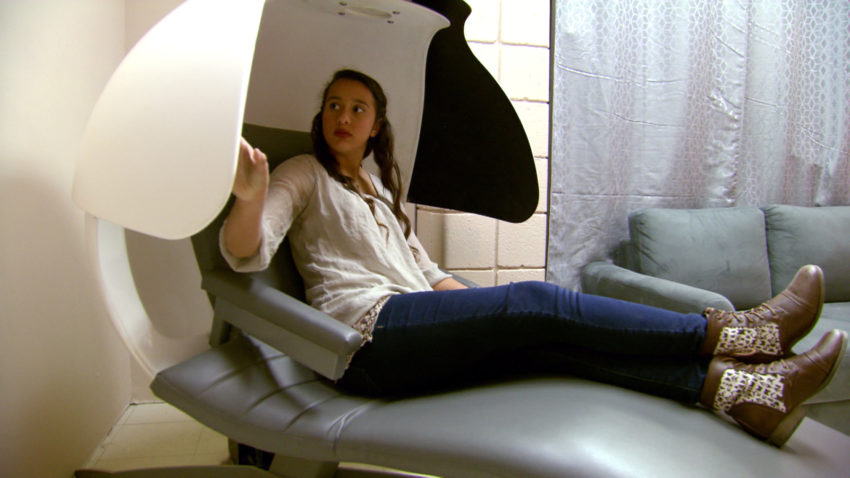
Nap clubs. Quiet rooms. Wellness centers with cozy couches and tea. Schools are trying new ways to give rest to sleepy students, including Latinos who are more sleep-deprived than their peers. That includes high-tech "nap pods" for students in two high schools in Las Cruces (59.6% Latino) and two in Sunland Park (95.2% Latino), N.M. Students sit in the pods, available in the nurse's office, under a sensory-reduction dome that plays relaxing music and soothing lights for 20 minutes before gently vibrating to wake the students.
"[It is] great for kids who weren’t getting enough sleep at night—which teenagers don’t, for a variety of reasons," Sandy Peugh, health services director for the Las Cruces school district, told Las Cruces Sun-News.
"They were coming to school ...
You probably know obesity is bad for a child's health. But did you know obesity takes a toll on children's minds, too? An overweight or obese child has three times the risk for depression in adulthood as a normal-weight child. Risk rises four times for children who are overweight or obese in both childhood and adulthood, according to a new study, CBS News reports. Sadly, Latinos suffer high rates of both obesity and mental health conditions. That is why knowing the facts—and having the resources available can alter the effects of obesity on mental health—can lead child to a healthy lifestyle.
The Facts on Obesity
Childhood obesity is defined as a diagnosis for any child (same sex and age) "with a Body Mass Index at or above the 95th percentile", according to the Center ...
We all remember filing into a school auditorium as first graders and trying to stay awake during a dull, lackluster presentation. Did we learn something? Maybe. Do we remember it today? Probably not. Well, the Vermont Family Network (VFN) discovered a fun way—puppets!—to engage young children in talking about mental health. The Vermont network formed an educational puppet troupe that brings messages of health and inclusion to more than 10,000 children and adults each year in Vermont (2% Latino) and beyond. The troupe, called the Puppets in Education (PiE) program, is celebrating their 36th year of teaching students through puppetry! The PiE program uses 3-and-a-half-foot puppets to empower kids to talk about important, difficult issues. From the stage in schools, ...
Mental health is a rising concern in the United States. For Latina women, the concerns become even more dire. Research has shown that Latinas receive less mental health care than whites, even if they have insurance. They also report more symptoms of depression and anxiety than whites. However, what if there was a better way to reach them? Latina women have a higher than average use of smartphones and the Internet. Technology could be the answer. A recent study from UCLA found that culturally tailored media programming can encourage Latina women to seek help for mental health, as well as decrease their symptoms of anxiety and depression. The researchers developed a digital storytelling series featuring a fictional young Latina woman named "Catalina" that is dealing with ...