More Americans than ever before are stressed, depressed, and coping with anxiety on a regular basis. According to a new study, an estimated 8.3 million adults in the U.S. (close to 3.5%) suffer from serious psychological distress. What’s worse, many are unable to get the help they need to either treat there conditions or even get a diagnosis. In a separate report, the American Psychological Association (APA) found disparities in their recent Stress in America survey, noting that Latinos in particular suffer from the highest levels of stress. “Latinos reported the highest stress across four major sources of stress including money, employment, family responsibilities and health concerns,” the survey said. From the survey, 1 in 5 Latinos report never having engaged in any ...
Nearly 1 in 5 Latinos suffers a mental health problem. But Latinos are less likely than other groups to seek out treatment for mental health conditions. They fear being stigmatized. They lack of health insurance. They face cultural barriers. Or they simply a fail to recognize symptoms. That’s why we at Salud America! are spotlighting heroes who are improving mental health for Latino families!
Irán Barrera: Helping Latinos Answer Mental Health Questions
Dr. Irán Barrera believes there is a difference between mainstream mental health and Latino mental health. Latinos don't use words like anxiety, depression, or post-traumatic stress. This means health professionals need training to address Latinos' mental health needs. That's why Barrera applied for and received ...
Depression is an illness characterized by constant sadness and a loss of interest in activities one normally enjoys and it is also the number one reason for poor health, affecting over 300 million people worldwide, according to the World Health Organization (WHO).
With a growing youth Latino population in America dealing with depressive symptoms, this also brings a concern to higher rates of suicide, anxiety and other mental health issues for this at-risk population.
In fact, research shows the prevalence of depressive symptoms among Latino youth is 22%, a rate higher than any other minority group besides Native American youth and Latina adolescents have the highest rates of suicidal ideation and suicide attempt compared to their peers.
Common mental disorders are increasing ...
Where you live has an incredible amount to do with how healthy and happy you are. Research shows Latinos and low-income families lack access to healthy food options, active spaces, and healthy school environments—which impact an area’s culture of health. So how healthy and happy are heavily Latino states? Gallup recently surveyed 177,000 Americans and ranked every state in terms of its citizens’ “personal contentment” or happiness. Rankings were based on financial stability, physical health, and community involvement. New Mexico, California, Texas, and Arizona—the four most heavily Latino U.S. states—ranked well, at No. 20, 13, 10, and 7, respectively, in terms of happiest, healthiest residents. Hawaii (9.9% Latino) ranked No. 1. Hawaii reported low obesity ...
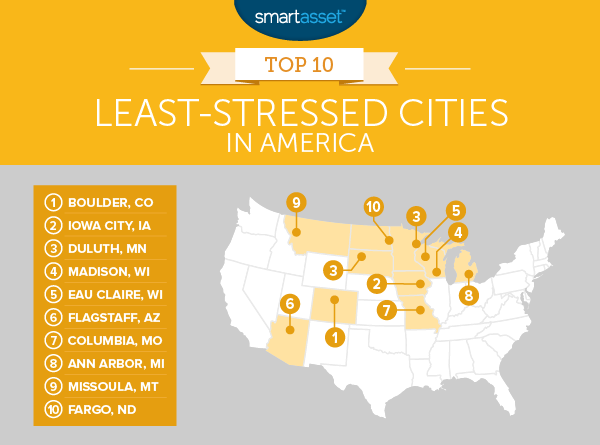
Stress often factors in as a huge burden on the health of many Americans, including much of the Latino population. A survey by the Robert Wood Johnson Foundation found that health concerns – either an existing illness or disease or the financial costs associated with needing medical care – are serious causes of stress for many people. Yes, stress is everywhere. However, some people in some cities experience less stress in the U.S. The financial website SmartAsset recently examined positive and negative factors in 500 cities (with populations of 67,500 or more) in the country to determine the stress level citizens face. Positive factors include the rate of physical activity in the cities and the average hours of sleep; negative factors include hours of work per week and ...
Already the largest and still-growing U.S. racial/ethnic minority, Latinos are a diverse people with distinct differences in origin, language use, and family characteristics. But what are the true Latino family dynamics? New research has confirmed what many already knew about Latino families: they are tightly-knit, resilient, and generally stable, according to a new report by the National Research Center on Hispanic Children & Families. The report, La Familia: Latino Families Strong and Stable, Despite Limited Resources, is among the first to give the complete “breakdown” of Latino households, examining data about mothers, fathers, and children. It indicates, after analyzing data available through 2010, that "Latino families have many of the traits children need to ...
There are often preconceived notions in regards to Latinos and their family dynamics. Already the country’s largest racial/ethnic minority group, which is expected to grow exponentially in the coming years, Latinos represent a diverse group of people with distinct differences depending on where they are from and the language they use. New research has confirmed what many already knew about Latino families: they are tightly-knit, resilient, and generally stable. The National Research Center on Hispanic Children & Families has recently released a new brief series entitled “La Familia: Latino Families Strong and Stable, Despite Limited Resources.” The series is one of the first ever to give the complete “breakdown” of Latino households, examining data about mothers, ...
Did you know this week is National Eating Disorders Awareness week? An increasing amount of Latino and other minority populations deal with "disordered eating"—restrained, compulsive or binge eating and an associated loss of control—in different ways depending on their culture. Let’s use #SaludTues on Feb. 28, 2017, to tweet about #EatingDisorders, their impact on Latinos, and info, resources, and tips how to promote healthy eating patterns for all! WHAT: #SaludTues Tweetchat: “Let’s Talk #EatingDisorders”
DATE/TIME: 1-2 p.m. ET (Noon-1 p.m. CT), Tuesday, Feb. 28, 2017
WHERE: On Twitter with hashtag #SaludTues
HOST: @SaludAmerica
CO-HOSTS: @EDCoalition We’ll open the floor to your stories and experiences as we explore: What are some signs of ...
Researchers from Johns Hopkins University recently identified a “culturally sensitive” set of tools that can be applied by pediatricians to help them screen Latino patients for mental health symptoms. Anxiety, depression, and aggression are some of the mental health issues that plague many Latinos and often go undiagnosed and untreated. The tools, which are freely available, and take less than 10 minutes to use are in Spanish and can help assess a wide range of emotional and behavioral problems among Latino kids. The investigators from Johns Hopkins encourage primary care pediatricians to consider utilizing four mental health screening tools: he Pediatric Symptom Checklist (PSC)-17-question version, the PSC-35-question version, the pictorial PSC-35, and the Strengths and ...