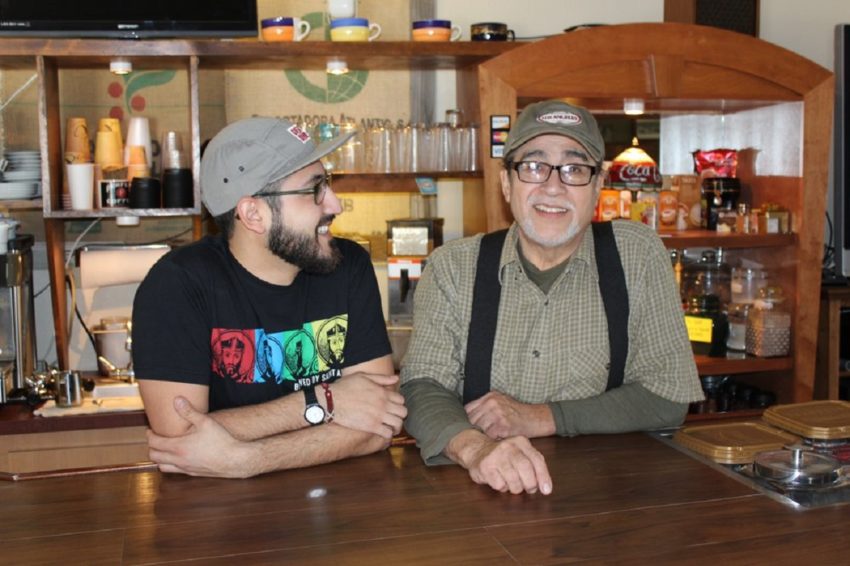
Gilbert de Hoyos opened Barrio Barista because he enjoys serving coffee to West Side residents in San Antonio (67% Latino). He also likes to cook. So de Hoyos added a small menu. And he didn't want it full of unhealthy options, either. De Hoyos is among a growing number of eateries that have joined a city health program, ¡Por Vida!, that unites nutritionists with restaurants to promote healthier menu options. “San Antonio and especially the West Side have a reputation of not having healthy foods and I want to change that by cooking delicious foods that also support a healthy life," de Hoyos said. “It’s my way of giving back to the community." One of those options is his roasted vegetable tacos with remoulade sauce served on a corn tortilla, Kens5 reports. The ...
We know “food swamps” are linked to obesity. We also know Latinos often live in food swamps─where people lack access to healthy foods and have lots of nutrition-poor food options. For example, many Latino neighborhoods lack supermarkets but have abundant fast-food, according to a Salud America! Research Review. Now a recent study shows how Latina mothers deal with life in food swamps.
Latina Moms & Food Swamps
The George Washington University study sought to understand how mothers who lived in Washington, D.C., food swamps feed their children. The mothers were Latina and had been in the Unites States for less than 15 years. Each mother had at least one child younger than 10. Latina mothers valued foods that they considered to be traditional and healthy, ...
To become a productive adult, a child needs more than great academic experiences. Social and emotional learning experiences, for example, can instill responsibility, integrity, and justice in our youngest children. Schools, communities and healthcare professionals play a big role in addressing trauma and stimulating social and emotional development, which requires an understanding of how childhood trauma impacts kids’ brains, bodies, and behavior. We at Salud America! created an Action Pack to help your school take steps to become more trauma-informed/sensitive to reduce absenteeism and misconduct and help students become healthy, productive members of society. Let’s use #SaludTues on June 19, 2018, to see Action Pack and tweet how schools can become trauma-informed to ...
Suicide rates have increased drastically across the United States from 1999-2016, according to a new report released by the CDC. Suicide rates are highest among White and Native American/Alaska Native populations. However, suicide rates for Latinos and African Americans are continually rising, the data shows. There were also significant increases in several states including Massachusetts, Vermont, and New Hampshire. Additionally, more than half the suicides in 2015 were among people with no known mental health conditions, according to an article in the Boston Globe. On the heels of two recent celebrity suicides - Kate Spade and Anthony Bourdain - the “data are disturbing,” Anne Schuchat of the CDC told SCNow. “The widespread nature of the increase, in every state but ...
Omar Gonzalez and many of his neighbors love playing nightly pick-up soccer games on the fields at Harriet Tubman Elementary School in the Columbia Heights neighborhood in Washington, D.C. Gonzalez never expected to get kicked off the field. But that's what happened one night when a local sports league, which had mostly white players in uniforms, showed a permit they had paid to use the fields. They asked the neighbors to stop their game and leave. Gonzalez and his neighbors were confused. No one had ever used a permit to play there on weeknights. So they started a battle to allow open and fair usage of the fields.
Sports and field use across the country
After-school sports are great for building youth leaders and boosting health. However, Latino kids are less likely than ...
In Massachusetts, the opioid overdose rate for Latinos has nearly doubled in three years, reaching twice the rate of whites and African Americans, NPR reports. Massachusetts isn’t alone, either. Latino opioid overdoses are rapidly rising across the nation, according to the CDC. Specifically, the Latino death toll for opioid overdoses rose 52.5% from 2014 to 2016. That’s compared to a 45.8% rise among whites. "What we thought initially, that this was a problem among non-Hispanic whites, is not quite accurate," Robert Anderson, who works at CDC's National Center for Health Statistics, told NPR. "If you go back into the data, you can see the increases over time in all of these groups, but we tended to focus on the non-Hispanic whites because the rates were so much ...
Are you a city or county leader who wants to increase local access to healthy food? You are invited to the Healthy Food Policy Project's new webinar—"Supporting Healthy Food Access: Are There Local Laws For That?"—at 1p.m. EST on Wednesday, June 13, 2018.
About the Food Access Webinar
Food access is an important issues in our nation. For example, fast food and corner stores outnumber supermarkets in many Latino neighborhoods, according to a Salud America! research review. This creates food swamps where obesity rises. Cities and counties are using law and policy to support healthy eating in many ways. Laws can focus on socially disadvantaged groups, like Latinos. They can focus on environmental and economic goals, too. The webinar will shocase the Healthy Food Policy ...
The number of Latino-serving colleges and universities has risen 85% of the past 10 years, from 264 in 2007 to 492 in 2017, according to a new report by Excelencia in Education. A "Hispanic-Serving Institution" (HSI) has 25% or more undergraduate full-time equivalent Latino enrollment. In 2016-17, the U.S. had 492 HSIs. That's 15% of all colleges and universities. Here are other key data: HSIs are present in 21 states and Puerto Rico.
HSIs are very concentrated geographically. 84% were located in 6 states and Puerto Rico. California has the most. Then follows Texas, Puerto Rico, New York, Florida, Illinois, and New Mexico. Most HSIs are urban (85%)
HSIs enroll 65% of all Latino undergraduates in higher education.
HSIs enroll 4.2M total undergraduates.
HSIs ...
Food deserts aren’t the only thing that drag down health in many Latino neighborhoods. “Food swamps” may be a bigger worry. While a food desert is an area more than 2 miles or 15 minutes away from a grocery store, a food swamp includes the food desert AND a high-density of stores and restaurants that offer high-calorie fast food and junk food, relative to healthier food options. Food swamps also are highly linked to obesity, according to new data from the UCONN Rudd Center for Food Policy and Obesity, The Atlantic reports. “Food swamps had about four unhealthy options for each healthy one,” according to The Atlantic. “The relationship between food swamps and obesity was especially strong in areas where people lacked both their own cars and access to public ...