by
by 
Share On Social!
Latinos account for 1 in 5 people in the United States.
Among this group, most Latinos say their heritage is an important part of their identity, according to a recent report from the Pew Research Center.
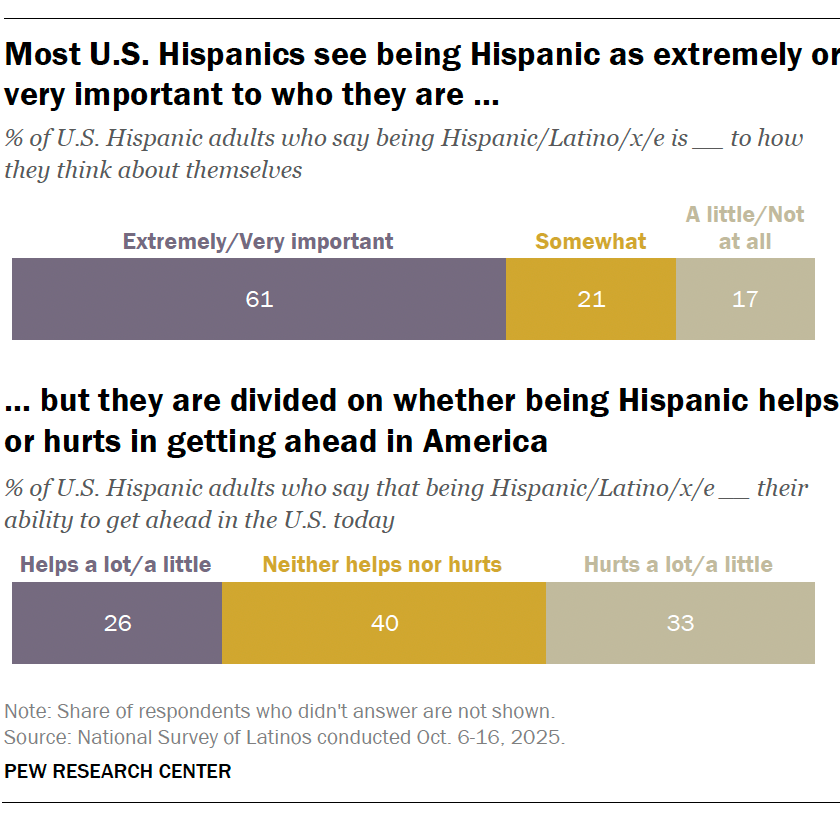
In fact, 61% of Latinos said that “being Hispanic is an extremely or very important part of how they think about themselves,” according to a survey of 4,923 U.S. Latino adults in English and Spanish from October 2025.
Even with this identity, Latinos are divided over whether it helps or hurts them.
So, let’s dive deeper into the new survey and what it means for Latinos in the United States.
Latino Identity: Labels and Names
Among U.S. Latinos, 18% most often describe themselves as “American.”
The remaining Latinos more often use a label that reflects their country of origin or heritage (53% of people, either on its own or combined with American) or a pan-ethnic term like “Hispanic” (27% of people, either alone or combined with American).
Out of the pan-ethnic terms, “Hispanic” and “Latino” are favored.
“The October survey finds a majority of Hispanic adults say they prefer the term Hispanic (54%) over Latino (30%), while very few prefer Latinx (1%) or Latine (1%),” the Pew Research Center states.
Latino Identity: Fairness
While they maintain a strong connection to their heritage, 33% of U.S. Latinos say being Hispanic hurts their ability to get ahead a lot or a little, according to the Pew survey.
“About a third … say they personally experienced discrimination or were treated unfairly in the 12 months before the survey because of their Hispanic background by someone who is not Hispanic,” according to the Pew Research Center.
54% say they have not experienced any of the four discrimination incidents related to being Hispanic asked about in the survey.
34% say that someone expressed support for them because they are Latino.
Latino Identity: Political and Immigration Differences
U.S. Latinos’ view about their identity differ across two factors, political leaning and immigrant generation, according to the Pew survey.
“About three-quarters say Hispanics in the U.S. have many different cultures, while a quarter say they share a common culture,” according to the Pew Research Center.
Politically, survey results found that 57% of Latinos who voted for Donald Trump in the 2024 presidential election say that being Hispanic neither helps nor hurts them get ahead in America, while 27% say it helps a lot or a little and 15% says it hurts a lot or a little.
“By contrast, Hispanic Harris voters are more likely to see being Hispanic as a disadvantage,” the Pew Research Center states.
39% say their identity hurts them, while 38% say it neither helps nor hurts, and 23% say it helps.
“Hispanic Trump and Harris voters also differ in how central Hispanic identity is to how they think about themselves and how connected they feel to other Hispanics,” the research shows.
Survey results show that Latinos that have immigrated are more likely than U.S. born Latinos to say their identity is extremely or very important to how they see themselves.
However, there are differences between generations.
While only 27% of Latino immigrants consider themselves “a typical American,” 60% of second-generation immigrants and 72% of third- or higher-generation say the same.
Go here for the full Pew findings.
Knowing the Health of Your Community
Identity plays a big role in everyday life, just like health.
But what about the health of your community?
Explore and download the Salud America! Health Report Card for your town!
Enter your county name and get auto-generated local data with interactive maps and comparative gauges on several health indicators.
See how your county stacks up compared to the rest of your state and nation.
Then email the Report Card to local leaders to raise awareness, include the data in a presentation or grant proposal, or share it on social media to drive healthy change in your community!
Explore More:
Increasing RecognitionBy The Numbers
3
Big Excuses
people use to justify discriminatory behavior