by
by 
Share On Social!
Commuting is a part of everyday life for many.
In fact, almost 140 million people in the United States routinely commuted to work in 2022, according to the United States Census Bureau.
Many Latino parents with low incomes who commute to work are commuting a long way, with 1 in 10 traveling 60 minutes or more to work, according to a new report by the National Research Center on Hispanic Children and Families (NRCHCF).
Let’s look deeper into data on commutes and how it impacts families and communities.
Commuting by the Numbers
According to the NRCHCF research, people who commute to work outside of the home take an average of 27.8 minutes to travel to work.
For Latino parents with low incomes, the distance increases.
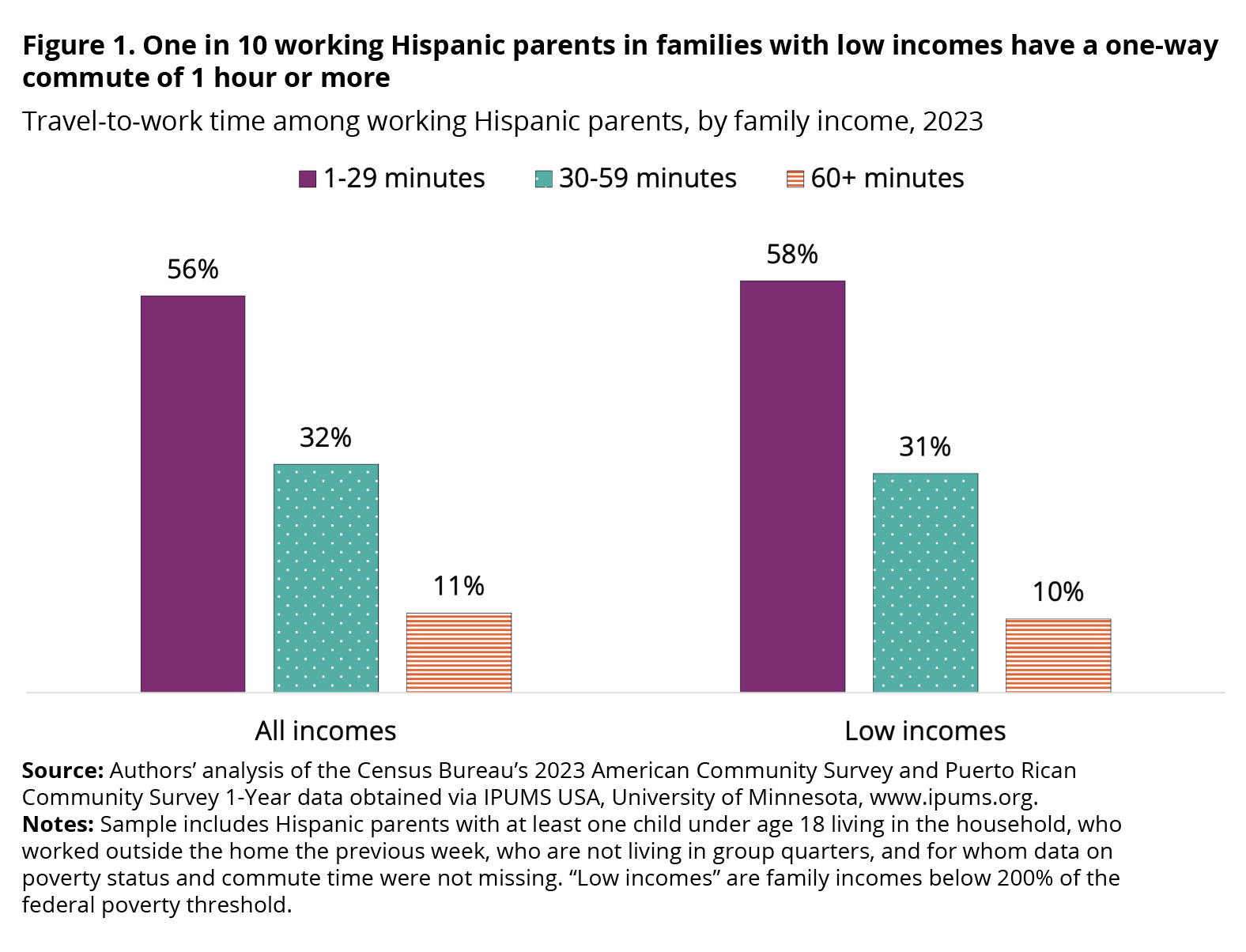
“One in 10 (10%) Hispanic parents with low incomes who commute travel 60 minutes or more,” according to the data analyzed by the NRCHCF.
Additionally, nearly one third (31%) have a commute of 30 to 59 minutes and more than half (58%) have a commute of less than 30 minutes.
“Commute times are nearly identical among all Hispanic parents regardless of their income,” the NRCHCF states.
There are also differences in U.S. and non-U.S. born Latino parents when it comes to commuting percentages.
Latino parents that aren’t U.S.-born who work outside the home face longer commutes than their U.S.-born counterparts.
“12% of working Hispanic parents with low incomes born outside of the United States have a one-way commute of 60 minutes or more, compared to 9% of those born in the United States,” according to the NRCHCF.
The Impact of Long Commutes
Long commute times can limit the amount of time a parent can spend with their families.
“Longer daily commuting time is associated with males spending decreased time with their spouse and children and both males and females spending decreased time with friends,” according to research.
With longer commutes also come increased costs when it comes to transportation.
“Research finds that commuting costs effectively reduce workers’ take-home wages, particularly among workers with lower incomes, and may discourage employment,” according to the NRCHCF.
Data also shows that commute times for working mothers can also be longer due to spending time taking children to childcare or to school.
“This additional time can be quite substantial for families with young children who live in communities with limited access to affordable, high-quality care (i.e., child care deserts), who therefore must travel further to find care,” according to the NRCHCF.
NRCHCF reports that there are some states where human service programs account for families’ commute time.
“States can also use Temporary Assistance for Needy Families funds to help overcome other transportation-related barriers to employment by reimbursing automobile-related costs (e.g., gas, mileage, auto repairs), providing financial assistance to purchase a car, or issuing vouchers for public transit,” according to the NRCHCF.
Knowing the Health of Your Community
Transportation can be an important part of everyday life.
What does transportation look like in your community?
Find out by downloading the Salud America! Health Report Card for your town!
Enter your county name and get auto-generated local data with interactive maps and comparative gauges on several health indicators.
See how your county stacks up compared to the rest of your state and nation.
Then email the Report Card to local leaders to raise awareness, include the data in a presentation or grant proposal, or share it on social media to drive healthy change in your community!
By The Numbers
23.7
percent
of Latino children are living in poverty