by
by 
Share On Social!
In 1998, the U.S. Surgeon General released a landmark report calling for tobacco control interventions for Hispanic and Latino and other populations.
Has this goal been met?
 To find out, Dr. Amelie G. Ramirez of UT Health San Antonio analyzed public health efforts since 1998 and identified a mix of replicable successes and remaining challenges in tobacco control, according to her recent article in JNCI Monographs.
“Although progress has been made in the years since the report’s release, [Latino and other] tobacco users continue to have limited access to cessation medication and support services,” Ramirez wrote. “Cultural barriers and tobacco industry marketing have also complicated cessation efforts.”
“Despite these challenges, some outreach and cessation efforts have shown promising results.”
Let’s explore Ramirez’s new article on tobacco control.
The Current State of Tobacco Use among Latinos
Since the 1998 Surgeon General report, smoking rates are lower among the Latino population.
However, Ramirez’s article points out critical issues that remain in tobacco use by certain characteristics, heritage groups, and type of tobacco used.
 For example, among Latinos who currently use nicotine products, e-cigarettes were more commonly used by Latino youth (ages 12-17) and young adults (18-25), while older Latino adults (age 26 and older) heavily prefer and currently use combustible cigarettes.
Data show that tobacco use still plays an outsized role in smoking-related health conditions.
For example, the death rate for lung cancer among Latino individuals has changed only minimally.
From 1992-1994, the age adjusted death rate for lung cancer was 23.1 per 100,000 for Latino men and 7.7 per 100,000 for Latinas. These rates compare to 22.1 and 11.8 among H/L men and women from 2015-2019.
“Furthermore, lung cancer is still the leading cause of cancer death among Latino men, and the second-leading cause of cancer death among Latina women,” Ramirez wrote.
Challenges Remain in Helping Latino and All Smokers to Quit Tobacco
Based on the research available, challenges include access to cessation services, mental health issues, and cultural barriers, according to Ramirez’s article.
For example:
- Only 42.2% of Latino smokers had access to physician advice, compared to 60.2% of non-Hispanic White smokers and 55.7% of non-Hispanic Black smokers.
- Only 5.1% of Latino smokers using cessation counseling services, compared to 6.9% of non-Hispanic White smokers and 7.6% of non-Hispanic Black smokers.
- Only 16.6% of Latino smokers used tobacco cessation medication, compared to 32.6% of non-Hispanic White and 25.2% of non-Hispanic Black (25.2%) smokers.
“Beyond the general lack of knowledge about smoking cessation treatment options reported by Latino smokers, there is also a perceived lack of cultural sensitivity, even when smoking cessation resources are available in Spanish,” Ramirez wrote.
Successes in Helping Latino and All Smokers to Quit Tobacco
Amid ongoing challenges, several successful strategies are working to promote tobacco cessation in the areas of access, mental health, and cultural relevancy, according to Ramirez’s article.
These efforts include:
- Text- and app-based interventions and Spanish-specific educational campaigns have been uniquely effective in engaging Latino tobacco users.
- Several important educational campaigns are countering the marketing of tobacco by the tobacco industry.
- Policy changes and public health initiatives at the local, state, and federal level have also been helpful. Changes include health warning labels on tobacco products, state anti-tobacco laws, increasing the legal age of tobacco product sales to 21, increasing the price of tobacco products, and more.
“The most effective approaches have common insights, including the importance of community engagement, the value of partnerships with health-care providers, and a culturally and linguistically adapted foundation” Ramirez wrote.
Quit Smoking with Quitxt!
Searching for a convenient, free program that will help you quit smoking?
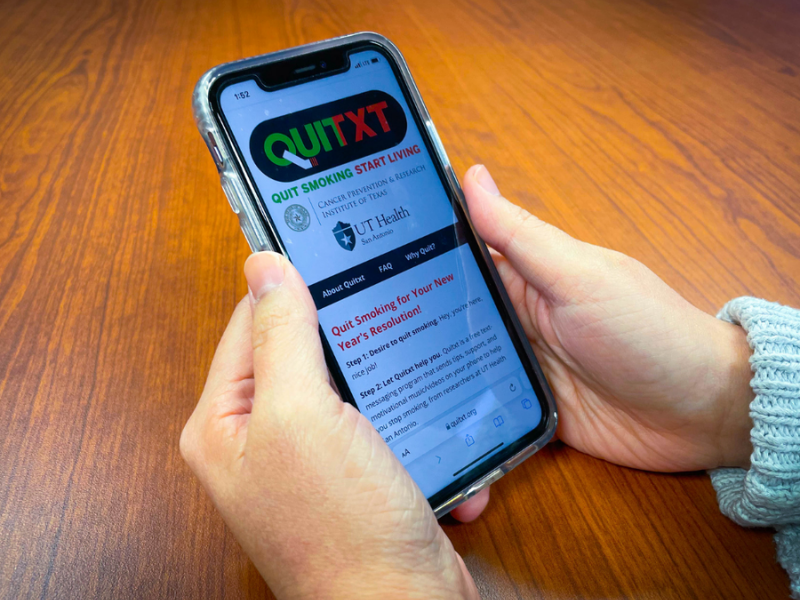 Look no further than Quitxt!
Quitxt is a bilingual service from UT Health San Antonio and the Cancer Prevention and Research Institute of Texas that sends texts messages to smartphones to help South Texas adults quit smoking.
Messages from Quitxt help with motivation to quit, setting a quit date, handling stress, and using nicotine replacement.
To join Quitxt in English, text “iquit” to 844-332-2058.
For Spanish, text “lodejo” to 844-332-2058.
By The Numbers
142
Percent
Expected rise in Latino cancer cases in coming years