by
by 
Share On Social!
Before stepping into the cancer advocacy and support space, the only thing José Adorno knew about cancer was that it killed people and he hated it.
It started when on a vacation.
He had met some family friends, and their daughter had given birth to a baby girl.
“Her sister had given birth to this little baby … and she had cancer when [her baby] was not even two years old,” he recalled. “She passed away a few months after her diagnosis. [The] mom couldn’t even carry [her baby] at times because she was in so much pain, so that’s the picture of cancer that I had in my head … just how ugly it can get.”
José’s perception of cancer changed when he was unexpectedly offered a position to help Spanish-speaking cancer patients find resources they needed to keep up with treatment.
“You talk to people, but you don’t really get to understand what they’re going through because you haven’t experienced it firsthand. You’re just offering the services, and you try to empathize as much as you can,” he said.
Little did the Ohio resident know, he would one day find himself with the firsthand cancer experience he needed to truly make a difference in the lives of the patients he vowed to serve.
José Adorno Gets an Unexpected Offer
José was born and raised in Puerto Rico.

At an early age, José developed a passion for baseball, which he played throughout his school years.
His talent even earned him a scholarship to an Ohio-based college where he studied criminal justice.
It was also the place where he would eventually meet his wife, and the couple would go on to foster three Spanish-speaking children — children they hope to adopt soon — together.
After graduating, José worked as a probation officer for the juvenile court system, helping mentor and rehabilitate youth and encourage them to make positive changes.
It was rewarding in the sense he was helping people and doing what he went to school for, but there was something missing that he couldn’t quite put his finger on.
To support his family and pay back his student loans, José took up a second job working with his father-in-law appraising real estate.
Around the time of the pandemic, José and his father-in-law were on a job site the pair overheard the woman who owned the house having trouble with Google Translate, which she frequently used to translate her e-mail communications from English to Spanish.
The unreliable application was malfunctioning.
Upon hearing her distress, José’s father-in-law suggested a solution.
He said, “I don’t know anything about computers, but my son in law, he knows Spanish. He might be able to help me with the emails.”
But this was no ordinary email.
The email contained sensitive patient health information and wouldn’t be able to translate.
That didn’t mean José couldn’t help in a different way.
Understanding the difficulty in communicating with Spanish-speaking patients, the woman offered him a job opportunity.
“I was like, I have two jobs at this point. I don’t really need a third job, but I will be open to hear her out,” José told Salud America!
When José met with the woman, he learned how impactful it would be to have someone who could speak the patient’s language.
She was able to work with José’s schedule and brought him on board as a part time employee.
José Adorno Joins Pink Ribbon Good
The organization José works with is called Pink Ribbon Good.
Pink Ribbon Good is a cancer nonprofit that serves eight major metropolitan areas across the East and West Coasts.

They specialize in providing support services, such as meals, transportation, peer support and education, along with cleaning essentials to individuals going through breast and gynecological cancers to ensure they stay the course of treatment.
José’s role involves following up with patients, particularly Spanish-speaking patients, who have reached out or been referred by their medical team to receive services.
All day, José keeps up with patients undergoing treatment, hears their stories, and takes in their struggles.
His relationship with the patients he serves is a special one that can’t be replicated.
“It doesn’t feel like a job. I’m just there for people. I’m just showing up along with my team doing the same thing, and I just don’t feel like I’m working. I feel like I’m doing good deeds … I’m meeting people where they are right now,” José explained.
Interacting with patients has changed his entire outlook on life.
“I don’t even have a reason to be mad anymore. If I mess something up at home or my car breaks down. It’s like, ‘How can I be mad at my car breaking down when I just talked to someone who has two months to live?,’” he said.
José Adorno Receives a Cancer Diagnosis
José not only speaks to cancer patients in their language, he also relates to their experience on a personal level — but only very recently.
José remembers the day vividly.
It was August 2024. José was enjoying a relaxing night playing video games with his friends.
“I don’t know why I touched my neck, but I just felt my neck and there was something there,” he recalled.
Usually when José gets sick, his lymph nodes get inflamed, but what he felt was different.
“It didn’t hurt when I touched it, but it was super hard.”
Sensing something amiss, José went to the doctor the very next morning, but his concerns were completely dismissed.
“She said, ‘You’re 25, You are in good shape, You’re good. You don’t have to worry about this. I’ll give you some antibiotics, and just don’t worry about it, it will eventually go away’” he said.
But something in José’s gut was telling him to worry.
Persistent for answers, José took a chance and booked an appointment looking for a second opinion. He was booked with a nurse practitioner in his small town.
His experience was very different and for the first time he felt that his health concerns were valid.
“I was like, ‘Dude, it doesn’t feel right. Like this is just different.’ My stomach is just all over the place, but it has been a few months of straight GI issues, a lot of pain and felt like my body smelled at all times. It’s just something I never experienced before. It was just so weird … it just felt like my body was rotten or something.” José explained.
The health care professional referred him for a biopsy and two months later while at the hospital where his wife was being treated for a rare liver condition, he got the call.
Someone on the other end of the phone said, “Hey, we just got a call from Mayo [Clinic], and this is lymphoma. What they found. Don’t worry about it, though, this is very treatable. You should be all good.”
However, the call left him with more questions than answers.
“You just say I got cancer, and then you’d be all good? Like, what?”
Still in disbelief at the news, José quickly picked up the phone and called back for clarification.
“It was very stressful. I was all over the place mentally. My head was spinning. I was able to meet with the doctor, and he was able to answer a lot of my questions, and although they assured me that we caught this at a very early stage I still worried so much. Thankfully I was able to undergo surgery, and they removed the lymph node, and I did not need any further treatment,” José told Salud America!
José Adorno Starts His Cancer Survivorship Journey
Getting his blood drawn and checked every 6 months was the only reminder José had of his experience with lymphoma.
But it wasn’t just the prevention that took a toll. The $1,400 cost (after insurance) weighs heavily on his pocketbook.

“$1,400 is probably nothing compared to people that have to go through treatment and other testing,” José said. “It’s insane what people have to be put through just to be alive or just to be healthy.”
Even a few years separated from his treatment and diagnosis, José still struggles to come to terms with his experience.
It’s a struggle many survivors face when they receive an early-stage diagnosis where the treatment is less grueling.
Some don’t even consider themselves survivors and minimize their experience because it doesn’t look like a typical cancer experience.
And José was all too familiar with others’ experiences having heard them from those currently in treatment through his work at Pink Ribbon Good.
“Coming back to work and all I had is this little cut in my neck from where they took out one of my lymph nodes. It was weird adjusting and accepting what I had gone through because mentally it took a huge toll [on me] but, it sort of ended with a very easy surgery, and even though I am very gracious to be healthy and not having to go through something as difficult as other’s have was a struggle for me, and to come to terms with the fact that I am also a survivor,” he said.
José went from helping cancer patients to becoming a patient in a short span of time.
However, it was those unique experiences that drove him further into helping speak up for those who can’t speak up for themselves due to language barriers.
“I was able to speak up, look for a second opinion, and advocate for my own health because I am bilingual, something that many people in the United States are not able to do, not only Latinos but anyone that cannot fluently speak English can’t do, he said.”
His community needed his help.
José Adorno Gets an Opportunity to Become a Latino Cancer Patient Advocate
At this point, helping cancer patients was innate for José.
But his recent brush with cancer was telling him that there was more he could be doing to help cancer patients, especially those in his community.
“Being here and seeing all the victory, like the ringing of the bell, just the community,” José explained. “You don’t think about that when you hear cancer, like seeing everybody rejoicing with each other and being there for one another.”
That’s why when his peer recommended he apply for the Latino Cancer Patient Advocate Training Program, he jumped at the chance – even though he didn’t fully understand what an advocate was.
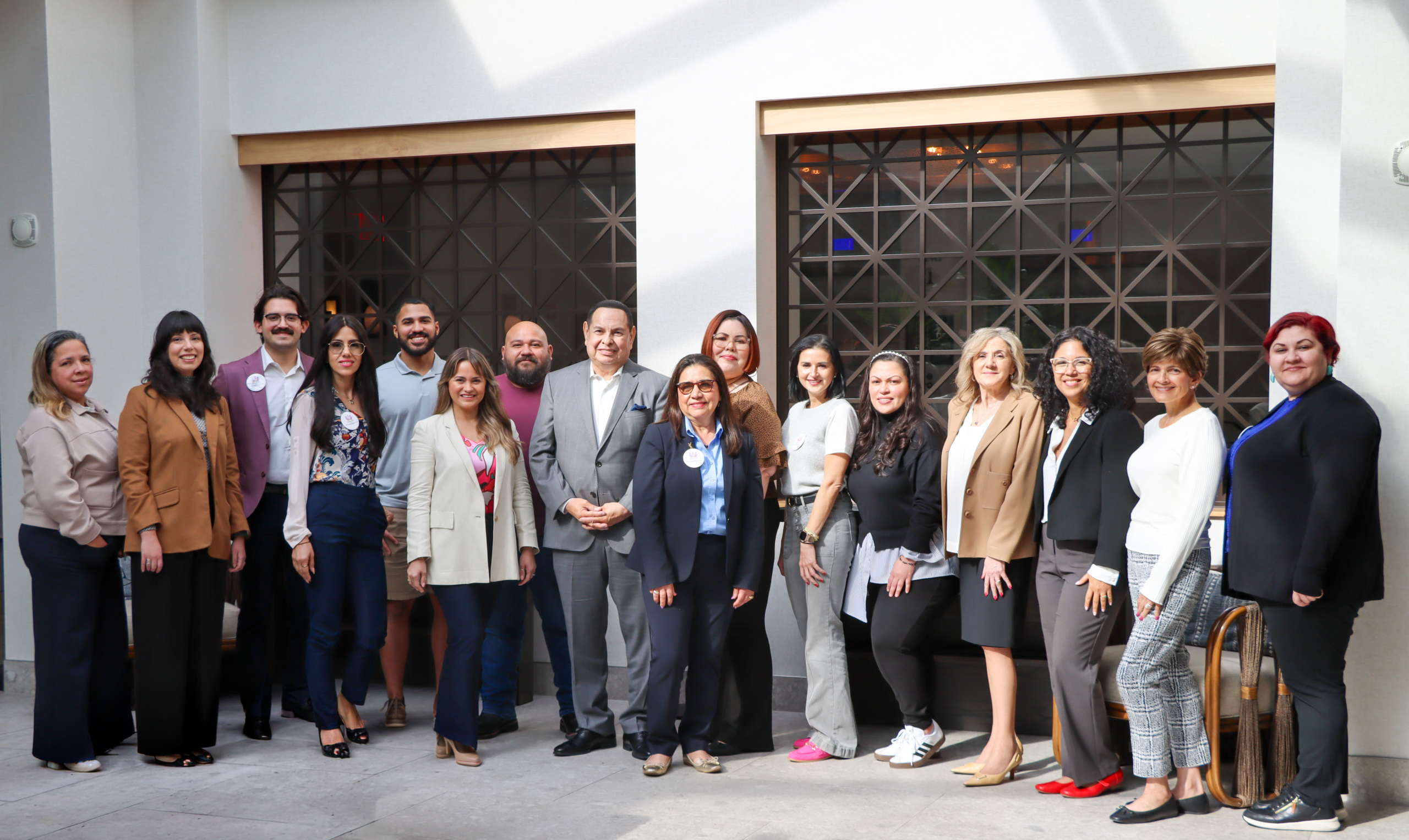
They said, “I feel like this program will not only bring you more knowledge but also give you a [new avenue] where you can help others with advocacy.”
His excitement at the opportunity continued to grow when he started digging into advocacy and all it entailed.
José learned that an advocate could help guide cancer patients, survivors, and caregivers to education and support, help communicate with care teams, and amplify the patient’s voice through research, healthcare, and outreach programs.
The program, led by Dr. Barbara Segarra-Vázquez of the University of Puerto Rico and the late Sandi Stanford of the Alamo Breast Cancer Foundation, offers bilingual Latino cancer survivors a crash course on how to be an advocate.
“You really have to have passion to become a patient advocate,” said Dr. Segarra-Vázquez. “It’s that desire to help others, that desire to speak for those who cannot speak, maybe because they’re not sitting at the table, or maybe because they’re not here anymore. It’s our role to continue the legacy and to have less people or no people at all die from cancer.”
Unfortunately, José didn’t make the initial cut for the 2026 cohort of the Latino Cancer Patient Advocate Training Program.
But just before the training course was about to hold its in-person meeting in February 2026, someone unexpectedly dropped out, and José’s name was the first on the waiting list.
He was ecstatic!
José Adorno Participates in the Latino Cancer Patient Advocate Program
The Latino Cancer Patient Advocate Training Program would challenge everything José thought he knew about cancer and open his eyes to all the ways he could help people.
The in-person training program is held every two years ahead of the Advancing Cancer Research for Latinos and All Populations Conference in San Antonio, Texas.
Prior to arriving in San Antonio for the training and conference in February 2026, most of the program’s participants had already met online and have a good working knowledge of what’s going to occur.
With only two weeks to prepare, José had no idea what he was walking into.

“I didn’t know what to expect. I thought I was gonna be like a fly on the wall because I can be an introvert at times, but I had this feeling that kept telling me I need to be out there. I need to talk to people. I need to meet people. I need to get involved because that is the only way that I learn from this opportunity,” he explained.
But from the moment he sat down with his fellow survivors and advocates that looked and sounded like him and spoke the language he was most familiar with; every worry faded away.
While attending the in-person training program and subsequent conference, José learned from experts in their fields about the science behind cancer, the importance of clinical trials, the ins and outs of drug development, and so much more.
The more he learned, the more it reinforced the need for more programs and services that help bridge the language gaps in cancer care.
“[I became a patient leader] not only to be a voice, but to be there for people who might not be able to say it in their language or to hear things in their language,” José told Salud America!
Even after he left the conference, he kept feeling a renewed sense of purpose and a drive to do more to help his community through his work with Pink Ribbon Good.
Since graduating from the program, José has been working with Pink Ribbon Good to expand services in other parts of the U.S.
There is one thing that hasn’t changed — José still hates cancer.
That hate is what fuels his fire to change the outcome for Latinos and cancer patients everywhere.
“Hating it is not enough to help others,” he said. “You have to get to know cancer, study cancer, ask about cancer, listen about cancer, and spend a lot of time thinking about it to eventually help people going through it.”
“When I was younger and I saw what cancer could do to people, it affected me deeply … now it fuels my desire to ensure everyone going through this horrible disease does not have to battle it alone.”
Explore More:
CancerBy The Numbers
142
Percent
Expected rise in Latino cancer cases in coming years
This success story was produced by Salud America! with support from the Robert Wood Johnson Foundation.
The stories are intended for educational and informative purposes. References to specific policymakers, individuals, schools, policies, or companies have been included solely to advance these purposes and do not constitute an endorsement, sponsorship, or recommendation. Stories are based on and told by real community members and are the opinions and views of the individuals whose stories are told. Organization and activities described were not supported by Salud America! or the Robert Wood Johnson Foundation and do not necessarily represent the views of Salud America! or the Robert Wood Johnson Foundation.