Navigating the public healthcare system is a challenge for anyone. It’s littered with acronyms, complicated medical and legal terms, and the information isn’t always accessible for people with disabilities or non-English-speakers. This leads to people being kicked off healthcare coverage and missed medication, treatments, and appointments, and so much more! To make the situation even more stressful, Medicaid and Medicare coverage, renewal, and eligibility are about to look very different. How do we keep people on their insurance so they get the care they need? Clave Pro Services, a Texas-based private service business, is helping Texans navigate public benefits and support services with a slew of bilingual-friendly resources to address some of the ...
Over the past 20 years, the Institute for Health Promotion Research (IHPR) at UT Health San Antonio has worked to improve health in South Texas and beyond. The IHPR, under the leadership of Dr. Amelie G. Ramirez, built the nation’s first digital health communications program on Latino health, saved lives with culturally relevant patient navigation for women, helped people quit smoking, and more. For its 20th anniversary on Oct. 1, 2026, let’s celebrate some of our biggest milestones! Read our new booklet!
IHPR Creates the Salud America! National Digital Communications Program
Just a year into its existence, the IHPR team created the Salud America! program. The program, funded by a grant from the Robert Wood Johnson Foundation in 2007, became the first national digital ...
The Institute for Integration of Medicine & Science (IIMS) and the UTSA College of Health, Community and Policy announced the winners of the 2026 IIMS Community Engagement Small Project Grants program. Seven community-academic partnerships from South Texas, focused on topics from men’s health to caregiving, each have been awarded a $5,000 grant. The aim is to translate research into public health benefits. Grants are available to newly developed or current partnerships with projects focused on research/assessment, education/training, and/or dissemination/communication of research results, program features, or policy implications.
Dr. Erika Brigmon, Gabrielle Capesius, and Lacy Lichtenhan
“Arts for Justice: The Story of Firearm-related Violence from a Youth ...
Less than half of the 2.25 million adults in the US who live with intellectual and developmental disabilities (I/DD) were part of government programs that helped people receive assistance, such as Medicaid and Medicare. To make sure caregivers and families can connect to much-needed services, join UT Health San Antonio’s webinar, “How to Support Caregivers and Families of Adults with Intellectual and Developmental Disabilities (I/DD),” at 6 p.m. Central on Thursday, Nov. 5, 2026. Webinar host Dr. Amelie Ramirez, leader of Salud America! and the Institute for Health Promotion Research at UT Health San Antonio, will join experts from the National Hispanic Health Foundation (NHHF), a representative from Genentech, and organizations working to improve quality of life for ...
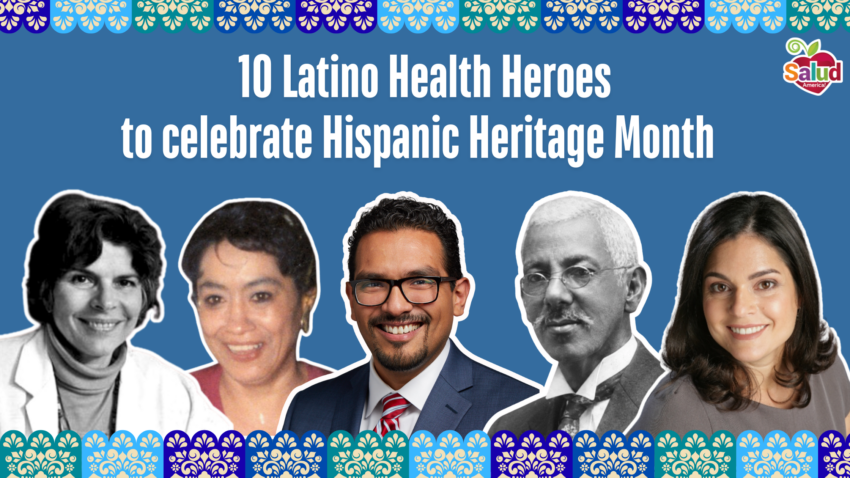
Whether it’s in hospitals and clinics, out in the community, or online, there are many Salud Heroes who have helped improve health for all the people in their communities. During Hispanic Heritage Month, Salud America! recognizes figures both throughout history and today who serve as health role models. Let’s look at 10 Salud Heroes who have championed Latino health.
1. Dr. Jose Celso Barbosa
Dr. José Celso Barbosa Alcalá, also known as José Celso Barbosa, was the first Afro-Latino to obtain a medical degree in the United States. Born in Bayamón, Puerto Rico, Barbosa valued education. He graduated in 1880 from the University of Michigan Medical School as the valedictorian of his class, becoming the first Puerto Rican to earn a medical degree in the continental ...
A lot goes into the decision to get pregnant with a baby. More than being a physical, mental, and emotional decision, it’s also become a larger financial decision that parents must weigh before starting or adding to their families. And the costs don’t stop after you bring the baby home from the hospital. Many parents are burdened by the rising costs of childcare. What’s more, the decision is also heavily influenced by access to prenatal care, postpartum support, affordable healthcare, childcare, and other community resources. A new report by WalletHub ranked the states by how expensive having a child is and health care outcomes based on access to care. Let’s break down the report’s findings, what they mean for child and maternal ...
As the U.S. population continues to age, more Latinos and all people will face memory loss because of Alzheimer’s disease and related dementias. Fortunately, every year, the U.S. Department of Health and Human Services (HHS) updates its National Plan to Address Alzheimer’s Disease to adopt new strategies to support communities impacted by Alzheimer’s and related dementias. This year, HHS is seeking direction from clinicians, researchers, caregivers, and families on what areas to focus on to address dementia through 2035. 170 people submitted a Salud America! model comment to tell HHS to help improve Alzheimer’s health outcomes for Latinos and all populations by supporting clinical trials, programs, and investments that make a ...
This content is from UT Health San Antonio’s book, “Advancing Cancer Research for Latinos and All Populations: 2026 Conference Proceedings,” which highlights results of the same-named conference in February 2026.
Advancing Environmental Change and Cancer Research Through Latinx Expertise
Dr. Leticia M. Nogueira is Director of Health Services Research at the American Cancer Society. Environmental and cancer care Dr. Nogueira’s presentation focused on the connection between environmental change and cancer, and how expertise from the Latinx population is fundamental for advancing solutions that are relevant to everyone. Environmental change alters the behavior of extreme weather events. Extreme weather events can damage medical infrastructure, break transportation links, ...
Amid a sweltering summer heat wave, communities in the U.S. East Coast are struggling to handle the stress on energy demand in homes built to heat rather than cool. In fact, many households across the county experience a lack of air conditioning reliability. This often-overlooked non-medical driver of health impacts overlooked populations, lower income individuals, those who live in rural areas, and families that live in densely populated urban areas that lack shade or in older buildings with no central air. Let’s explore how air conditioning reliability (or unreliability) can affect the health of you and your familia—and how local communities can address this inconsistency.
State of Air Conditioning Reliability
Over 35 million Americans live ...