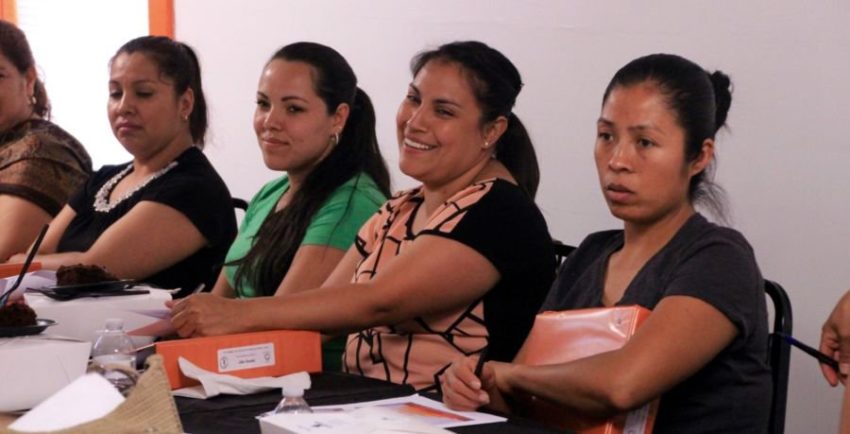
Latinos face many barriers to health care, including language differences; complex and confusing documents and processes; lack of knowledge of available services; unreliable transportation; and fear of using government services. One way to increase health equity among Latinos is to remove these barriers. Rocio Muñoz, community health navigator at Benton County Health Department (BCHD), in partnership with the school district, worked to embed bilingual, bicultural health navigators into elementary schools in Corvallis, Ore. (7.4% Latino), to address these identified barriers. The partnership resulted in a model where health navigators are placed in schools to coordinate with students, parents and teachers regarding students’ health records in order to boost access to health ...
This is part of our Mental Health & Latino Kids: A Research Review »
Community stressors are linked to Latino kids' depression, etc.
Garcia and Lindgren recruited 53 Latino adolescents and caretakers to participate in focus groups in which participants would discuss mental health stressors. There were two focus groups each for boys, girls, mothers, and fathers. The boys’ groups generally focused their discussions on racism and discrimination, particularly racial profiling. One of the boys’ groups consisted of adolescents recruited from a community center with a program for truants. They discussed stressors that were not identified in the non-truant group, including gang activity, violence, and substance use disorder. In the girls’ groups, discrimination and immigration ...
Dr. Amelie G. Ramirez of UT Health San Antonio today received a new $1.3 million grant to expand Quitxt, her bilingual service that sends texts with culturally and regionally tailored support to help South Texan young adults quit smoking. The new grant is from the Cancer Prevention Research Institute of Texas. The new funding will enhance the Quitxt service—currently designed to turns a user’s phone into a personal quit coach by providing texts and links to online support, educational content, music, and videos—with a new social media support component. Quitxt also will extend beyond South Texas to include English and Spanish speakers in rural counties, and Spanish speakers in urban areas of South, West and Central Texas. To quit smoking now, join Quitxt in English or ...
While still on the rise, the annual growth rate of the U.S. Latino population has dropped from 3.7% in 2006 to 2% in 2017, according to new stats from Pew Research Center. U.S. Asians now account for the highest growth rate (3% in 2017). The black population rose slightly (0.9), while whites slightly decreased. Why the leveling off of Latino population growth? "Following a Hispanic population boom in the 1990s that was driven by immigration and high fertility rates, the Hispanic population’s annual growth rate peaked at 4.2% in 2001," according to Pew's Jens Manuel Krogstad. "It then started to decline as fertility rates fell and immigration slowed, a trend that accelerated during the Great Recession." But that doesn't mean the Latino population is in decline. Rather, ...
Where you live matters. There is no escaping how important that housing impacts an individual’s life. Where someone lives affects their income and education levels, their access to opportunities, and their overall health. In many “big cities” in the United States, housing costs force some low-income and Latino families to make difficult financial decisions. Many forgo medical expenses, utilities, and sometimes food in an effort to pay rent or mortgages each month. The city of Austin, Texas (34.5% Latino population), has earned a reputation as one of the most segregated cities in the country. In an effort to combat this unfortunate trend, the Austin City Council approved a resolution to “better spread affordable housing throughout the city,” reports the Austin ...
Even as the unemployment rate continues to drop around the country – which is a clear positive sign for the economy – the situation for many Latino and low-income families is still very bleak. Approximately 1 in 6 households have zero or negative net worth, according to the financial website Prosperity Now. In the state of Nevada (27.53% Latino population), the financial situation for many families mirrors what is happening nationally. Large numbers of Nevada families are struggling with low-wage jobs that do not allow them to save, according to a report from Northern Nevada Business Weekly. Of the households in Nevada, nearly 44% are considered “liquid asset poor.” This means that they have so little funds saved that they could not live at the poverty level for three months ...
Education is one of the key social determinants of health. It has been tied to a person’s overall health, long-term financial well-being, and job attainment. Latinos have made great strides in education in recent years, with high-school dropout rates at an all-time low and enrollment in colleges and universities at all-time highs. However, for many Latino families, one barrier that keeps them from obtaining quality education is simply a lack of knowledge of the overall system. In Memphis, TN (6.69% Latino population), a group of parents banded together to help Latino families in keep up with the city’s fast-changing education landscape. They created Spanish-speaking classes as part of the Memphis Lift’s Public Advocate Fellowship. “Our mission is to make the powerless ...
A simple assignment has the power to sharply increase Latino middle-schoolers' chances of getting to college, researchers have found. The assignment? Write essays about your core values and why they are important to you. For the past few years, Stanford University-led researchers followed 81 Latino, 158 black, and control students in middle schools who wrote these types of essays—which can provide "self-affirmation," reinforce adequacy, and add resilience, John Timmer reports in Ars Tecnica. Researchers then compared these essay writers to other students who wrote on neutral topics, like their afternoon routine. For Latinos, the self-affirmation essay writers cut their risk in half of ending up on the remedial track, and they were more than twice as likely to end up ...
Despite significant gains made under the Affordable Care Act (ACA), Latinos still remain the largest uninsured population in the country. A lack of access to health care has been one of the most persistent causes of health inequity for many Latino families. One of the main barriers to access is often the cost associated with health insurance. A new report has determined that the costs for healthcare may have leveled off, but that is not necessarily a positive. According to a report from PricewaterhouseCoopers' Health Research Institute (HRI), a “new normal” for medical costs has been determined. The HRI expects the medical cost growth to be 6.5% from where it is this year for 2018. “Even with net growth rate expected to hold at 5.5% for next year, [due to likely changes in ...