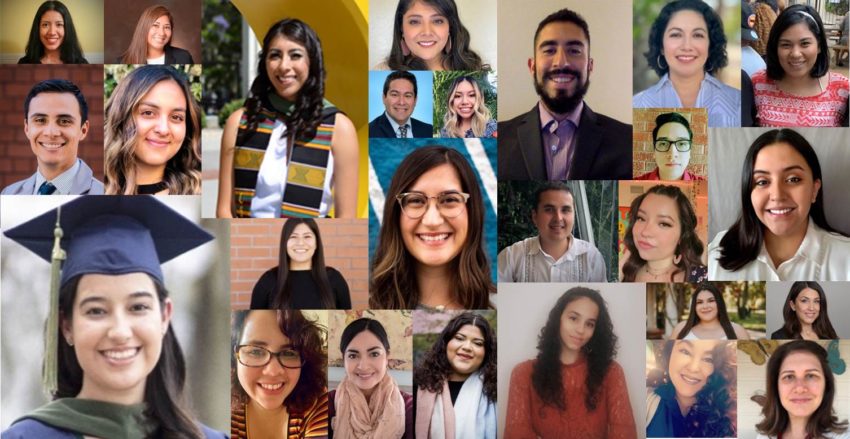
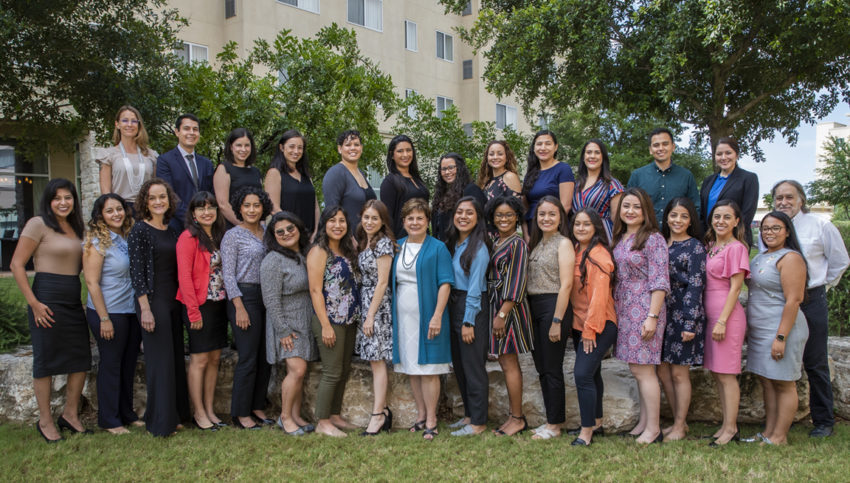
Program leaders have selected 26 aspiring Latino researchers from across the nation to join the 2021 cohort of Éxito! Latino Cancer Research Leadership Training at UT Health San Antonio. Each year, Éxito! recruits U.S. master’s level students and professionals to participate in a five-day, culturally tailored Éxito! summer institute to promote pursuit of a doctoral degree and cancer research. The 26 new participants were selected from a deep pool of applicants. Each participant now will join the Éxito! summer institute on June 7-11, 2021 in San Antonio. They will interact with Latino researchers and doctoral experts to learn about Latino cancer, succeeding in a doctoral program, and the diversity of research careers.
Meet the 2021 Éxito! Ccohort Leslie Aragon, ...
Over the first half of the COVID-19 pandemic last year, gains made in life expectancy dropped — especially among Latinos and other people of color. As a whole, US life expectancy fell by a year, dipping from 78.8 to 77.8 years from 2019 to June 2020, which is the lowest average since 2006, according to CDC research. Latinos, who have experienced some of the harshest COVID-19 impacts, saw a drop in life expectancy of 1.9 years. Latino life expectancy fell from 81.8 to 79.9 years. “It was disturbing to see that gains that have been made for the Black [and Latino communities] and decreasing the gap between life expectancy for African Americans and white Americans over the past six years had come to a halt,” Dr. Leon McDougle, president of the National Medical Association, ...
Exposure to adverse childhood experiences (ACEs), such as poverty or abuse, is a known risk factor involvement in the legal and judicial system. And, involvement in the legal and judicial system may be an indicator of toxic stress. Thus, the legal and judicial system plays an important role in preventing the effects of ACEs and toxic stress. That’s why, in December 2020, Dr. Nadine Burke Harris released her Roadmap for Resilience: The California Surgeon General’s Report on Adverse Childhood Experiences, Toxic Stress, and Health. Salud America! is exploring the report as part of its 11-part series on toxic stress. “Factors that underlie connections between victimization or trauma and later [legal and judicial] involvement provide a window into areas for primary and ...
Through prolonged activation of the toxic stress response, adverse childhood experiences (ACEs), like neglect and poverty, disrupt the development of brain architecture and other organ systems and are strongly associated with some of the most common and serious health conditions facing our society. This means toxic stress is a health condition with clinical implications. The healthcare system can play a central role in preventing, detecting, and mitigating toxic stress. That’s why, in December 2020, Dr. Nadine Burke Harris released her Roadmap for Resilience: The California Surgeon General’s Report on Adverse Childhood Experiences, Toxic Stress, and Health. Salud America! is exploring this as part of its 11-part series on toxic stress. Below are primary, secondary, ...
Alzheimer’s disease is an illness that affects the lives of many, and it impacts some Americans more than others. In fact, studies show that U.S. Latinos are 1.5 times more likely to develop Alzheimer's than their White peers. That number is only going to get worse over time if dedicated action isn't taken. The number of Latinos living with Alzheimer’s is projected to grow from 430,000 in 2014 to 3.2 million in 2060. That is more than an alarming seven-fold increase. Yet Latinos are underrepresented in clinical research across the board. Fortunately, Texas officials and researchers are working on this issue.
How Big a Problem is Alzheimer's Disease in Texas and Among Latinos?
The problem is huge in Texas, according to the experts. "In Texas in 2019 alone, 1650 ...
Apply now for the 2021 Éxito! Latino Cancer Research Leadership Training program and optional $3,250 internships from the Institute for health Promotion Research (IHPR) at UT Health San Antonio! Each year, Éxito! recruits 25 U.S. master’s level students and professionals to participate in a five-day, culturally tailored Éxito! summer institute to promote pursuit of a doctoral degree and cancer research. COVID-19 postponed the 2020 Éxito! program. Now applications for 2021 are open with limited spots available. At the next Éxito! summer institute, set for June 7 -11, 2021, in San Antonio, participants will interact with Latino researchers, mentors, and doctoral experts. They will learn about Latino cancer, succeeding in a doctoral program, and the diversity of careers ...
Many severe side effects of prescription drugs are not reported, according to new findings from JAMA Internal Medicine. Moreover, the researchers who completed the study comment that current FDA regulatory practices need reform, especially the process used to report harm caused by medical devices. “Over the last 4 decades, the approval and regulation processes for pharmaceutical agents have evolved and increased in complexity as special programs have been added and as the use of surrogate measures has been encouraged,” the researchers write. “The FDA funding needed to implement and manage these programs has been addressed by expanding industry-paid user fees. The FDA has increasingly accepted less data and more surrogate measures and has shortened its review times.”
What ...
Apply now for the 2020 Éxito! Latino Cancer Research Leadership Training program and optional $3,250 internships from the Institute for health Promotion Research (IHPR) at UT Health San Antonio! Each year, the Éxito! program recruits 25 U.S. master’s level students and professionals to participate in a five-day, culturally tailored Éxito! summer institute to promote pursuit of a doctoral degree and cancer research. At the next Éxito! summer institute, set for June 1-5, 2020 in San Antonio, participants will interact with Latino researchers, mentors, and doctoral experts to learn about Latino cancer, succeeding in a doctoral program, and the diversity of careers in cancer research. Ten optional internships also are available to program participants. Applications are ...
Minorities who visit an emergency room in the U.S. are less likely to receive prescriptions for certain medications than Whites, according to a new study. Researchers found that Latinos and Blacks specifically face disparities in obtaining analgesics, which include a wide range of pain killers. The study also noted that other minority communities might undergo similar experiences, but further research is needed in the topic. “The reasons for these disparities are likely complex and multifold and may include factors such as implicit bias, language barriers, and cultural differences in the perception and expression of pain and institutional differences in ERs that serve mostly Black and Hispanic patients,” Dr. Andrew Meltzer, senior author of the study and a researcher at George ...