Many Latino families don’t have access to healthy, nutritious foods. To put food on the table, they rely on government food aid programs, such as the Supplemental Nutrition Assistance Program (SNAP) and Special Supplemental Nutrition Program for Women, Infants and Children (WIC). SNAP and WIC can improve diets and help raise people out of poverty. But many people of color don’t participate, even if eligible. Now two congresswomen of color — Reps. Jahana Hayes and Jenniffer González-Colón — introduced the WIC for Kids Act to eliminate barriers to enrollment for millions of pregnant women, mothers, and children, improve child and maternal health, and increase food access. “I introduced the WIC for Kids Act of 2021 to make it less burdensome on families to enroll ...
Extremely harmful toxins, per- and polyfluoroalkyl substances (PFAS), contaminate water supplies, products, food packaging, and other everyday sources. It's why some national legislators want to pass a bill to designate these chemicals as hazardous substances. This designation would then begin action toward federal cleanup standards. This is a critical issue, especially for marginalized communities that face exposure to PFAS, according to Energy and Commerce Chairman Frank Pallone (D-N.J.). “PFAS contamination is a pressing issue for countless communities, and while the EPA under President Biden is working hard to address the issue, it is still playing catch up after four years of inaction,” he said during opening remarks in the committee hearing.
The PFAS Action Act of 2021 ...
Share in E-Newsletters
San Antonio Latino Cancer Survivors, We Need You! Are you a Latino cancer survivor? Volunteer for the Avanzando Caminos study at UT Health San Antonio! Avanzando Caminos aims to enroll 1,500 Latino cancer survivors in South Texas to help unpack the social, cultural, behavioral, mental, biological, and medical influences on post-cancer life. The study, led by Dr. Amelie Ramirez of UT Health San Antonio and Mays Cancer Center, is looking for Latino survivors age 18 or older who have completed primary treatment for breast, colon, kidney, liver, lung, prostate, stomach, cervical, bladder, melanoma, ovarian, thyroid, and lymphoma cancers. Volunteers will participate in seven study visits over five years, each with assessment interviews, and some with blood draws. To ...
Chris David is ready for the pandemic to be over. It’s dramatically hurt his business and taken friends and family away from him. Even though he had heard heard folks say the shots will make your skin shed, damage your DNA, and are part of a secret conspiracy to get people to accept government control, he decided to get his vaccine so that he can keep his family, friends, and customers safe, and so that we can put an end to COVID once and for all. “To me, it's no big deal to get vaccinated. Help the rest of the planet out. Let's do it together,” Chris said. Find COVID-19 vaccine locations near you with Salud.to/findvaccine!
How COVID-19 Hurt His Business
Chris is a Navy combat veteran who is originally from Michigan. He’s lived outside of Austin in a rural area of ...
Latinos suffer from toxic pollution in the air at higher rates than their white peers, and it can lead to many harmful side effects. University of Colorado Boulder researchers just added another side effect to that list: Childhood obesity in those whose mothers were exposed to air pollution during pregnancy. Study authors say their findings reveal air pollution’s disproportionate impact on communities of color — the same communities that suffer a lack of access to healthy food and barriers to safe places for physical activity, which contribute to America’s obesity epidemic. “Higher rates of obesity among certain groups in our society are not simply a byproduct of personal choices like exercise and calories in, calories out. It’s more complicated than that,” said ...
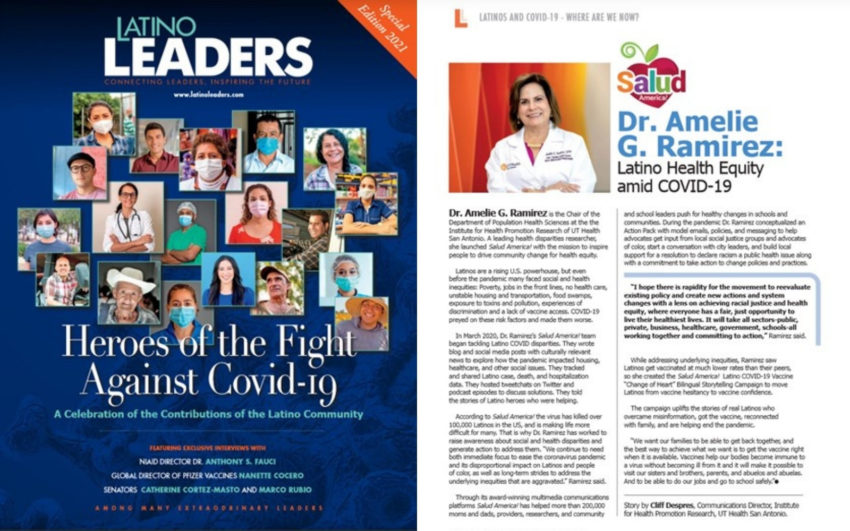
Dr. Amelie Ramirez, leader of Salud America! at UT Health San Antonio, is featured in the latest edition of Leaders, a national magazine that aims to connect and inspire Latino and all leaders. The edition is called "Heroes of the Fight Against COVID-19." Highlights include: Profile stories about health leaders: Dr. Elena Rios, president of the National Hispanic Medical Association; Dr. David E. Hayes-Bautista of UCLA; Joaquin Duato of Johnson & Johnson; Nanette Cocero of Pfizer; Bonnie Castillo of National Nurses United; Dr. Robert Rodriguez of UCSF; Dr. Xiomara Rocha-Cadman of City of Hope; and more
Profile stories about elected leaders: Catherine Cortez-Masto, Arizona, and Marco Rubio, Florida
Data on COVID-19 case and death rates (via Salud America!)
Data on ...
Companies emitting harmful waste and gasses into the Earth’s atmosphere will now have to abide by strict regulation policies recently passed by Colorado’s state legislature. The new law will require these businesses to more closely monitor their emissions standards — more importantly, the data found must be published publicly. Not only will the law ensure transparency, it could also save countless lives, according to Carmen Abrego Vasquez, a member of the Colorado People’s Alliance. “[This bill] an important step to making sure we have transparency and hold corporate polluters accountable, she told the Colorado Sun. “The majority of people who live in my community are Latinos or immigrants and this is a step to improve our lives. We have a right to know what’s in ...
Younger generations of Latinos are more likely than their immigrant parents to talk about issues like racism and discrimination, particularly when it comes to discrimination against Black people. “Most of our societies are fundamentally racist against darker people,” said political science professor Eduardo Gamarra, according to Carmen Sesin and Cora Cervante of NBC Latino. Generation Z, typically defined as those born between 1997 and 2015, may be more willing to confront their immigrant parents about racism because they are more racially diverse than past generations and active in social justice movements. Let’s examine how Latino youth compare to older generations, some characteristics of Generation Z, and the implications for how Latinos can tackle discrimination and ...
Millions of Latinos and other Americans of color suffer from a lack of reliable access to a sufficient quantity of affordable, nutritious food. For years, experts and advocates have described this problem as “food insecurity.” However, as this conversation takes the forefront after a year of food-insecurity problems highlighted by the coronavirus pandemic, nutrition experts are now saying it is time to address food security in a new light: Through “nutrition security.” “You’ve probably heard the phrase ‘food security’ to describe consistent access to food,” Cara Rosenbloom, a registered dietitian and the president of Words to Eat By, wrote in a recent Washington Post perspective. “But many health professionals and policymakers think it’s an inadequate ...