This is part of our Food and Latino Kids: A Research Review »
Efforts rising to boost healthy food in corner stores
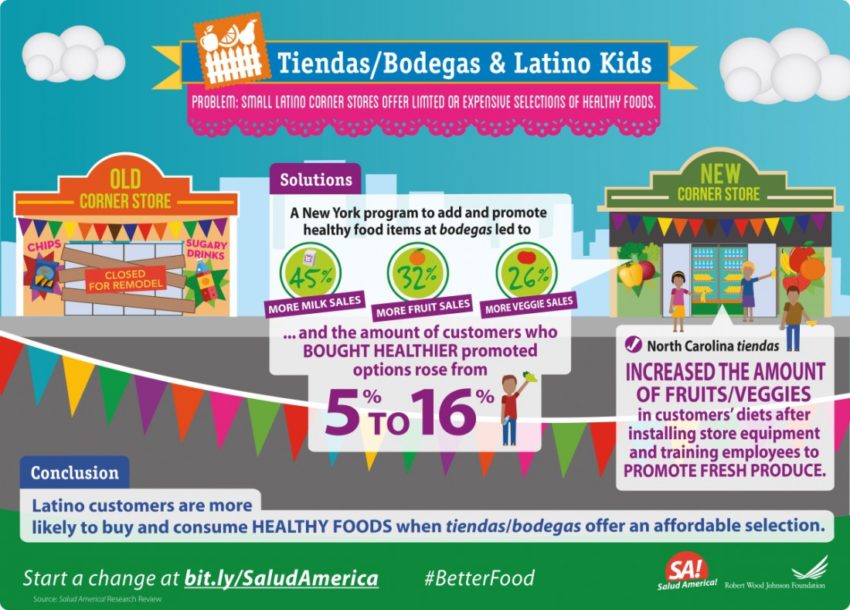
Initial findings on the impact of initiatives aimed at expanding healthy foods in corner stores have been generally favorable, although most studies to date are not large and rigorous in their methods and analyses. Additionally, the majority of studies have not been conducted in areas with significant Latino populations. Two reviews of several studies on corner store initiatives in areas with small numbers of Latinos found that most stores reported that the interventions were linked to increased sales of promoted healthy foods, including fruits and vegetables, low-fat milk, high-fiber cereals, and water.71,72 A small, randomized, controlled study of tiendas in ...
This is part of our Food and Latino Kids: A Research Review »
Introduction
While a nationwide concern, obesity is especially prevalent among Latino children. Nearly 40 percent of U.S. Latino youth ages 2-19 are overweight or obese compared with 28.5 percent of non-Latino white youths.1 Obesity is linked to increased risk of developing type 2 diabetes, cardiovascular disease, asthma, liver disease, and cancer.2 Given that Latinos are one of the fastest-growing U.S. populations, preventing and reducing obesity among Latinos will have an important impact on our nation’s health. Latino children are more likely to live in poverty than others,3,4 causing diet quality to suffer and increasing the risk for developing obesity.5 Limited neighborhood access to affordable, healthy ...
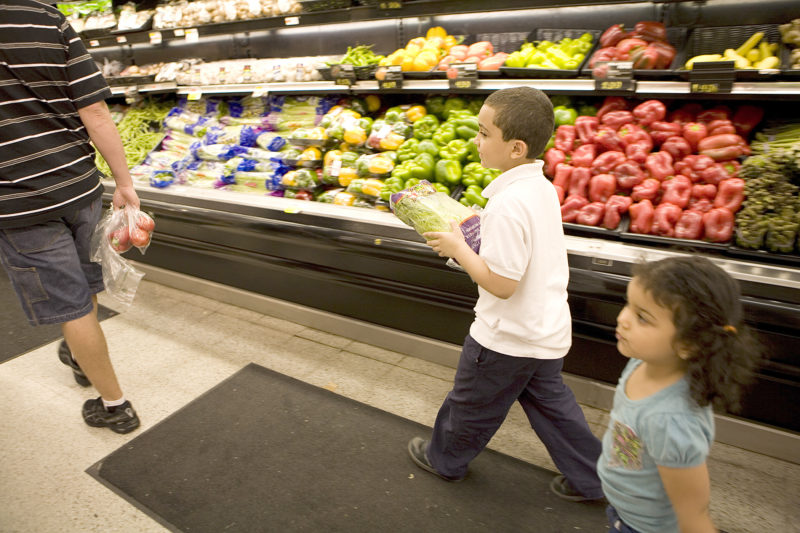
Healthy food is important to health for all people. Yet fast food and corner stores outnumber supermarkets and farmers’ markets in many neighborhoods, including Latino neighborhoods. This results in overconsumption of unhealthy foods, and more risk of obesity. Fortunately, healthy food financing initiatives can boost access to healthy, affordable foods. This happens when supermarkets and farmers’ markets get certain incentives to develop their businesses in certain areas. Groups also can help corner stores to expand their inventory of healthy, affordable foods. Also, more marketing of healthy foods, and less of junk foods, can help spur desirability. See the Full Research Review with references (PDF)
Read the Issue Brief in English (PDF)
Read the Issue Brief in ...
You may have heard the saying: “an apple a day keeps the doctor away,” but what if your doctor actually prescribed fruits and vegetables for what ails you? In Forest Grove, Ore., a health clinic and farmers market teamed up to help prevent obesity and fight disease by providing patients with prescriptions for healthy foods. Fruits and vegetables are what the doctor ordered, as Forest Grove families visit their local healthcare providers to eat their way to healthier futures.
Healthy Food Options in Local Neighborhoods
Awareness: Kaely Summers, nutrition, and market access coordinator of Adelante Mujeres, a nonprofit that organizes a farmers’ market in Forest Grove, Ore. (23.1% Latino), was well aware of the dietary health issues faced by community residents. U.S. Latinos ...
In 2009 Douglas Johnson, the new principal at Mountlake Terrace Elementary School in Mountlake Terrace, Wash., realized the enormity of physical inactivity and obesity in his community. Many kids lack safe, quality opportunities for physical activity, which heightens their risk for obesity and disease. Safe biking opportunities provide one avenue to improve the situation. Johnson and other leaders at Mountlake Terrace started taking advantage of existing opportunities offered by local cycling clubs. Soon, they began creating their opportunities and helped bring new bikes, helmets, and a brand-new bike trail to the school to expand students’ ability to get the physical activity they need to stay healthy.
Kids Aren't Playing Enough
In 2009 Douglas Johnson, the new principal ...
A coalition formed by the New York City Department of Health and Mental Hygiene (DOHMH) resulted in a 40% increases in colorectal screening rates over four years. The program is now being looked at as a possible pilot for other communities to boost their cancer screening rates. A report headed by Dr. Steven Itzkowitz, a professor of medicine/oncological sciences at the Icahn School of Medicine at Mount Sinai (ISMMS), now provides a framework for how communities might learn from a program to increase screening rates and ensure access for all people. “The increased screening rates from 2003 to 2012 translates to an additional 833,000 New Yorkers who have undergone screening colonoscopy and represents an important public health intervention,” said Dr. Itzkowitz. “By making ...
RJ Manchester and Erica Asti, staffers at the Florida Hospital for Children, along with Dr. Angela Fals and her team, spent years working with obese children and families in their Central Florida CCFW clinic. The local childhood overweight and obesity rates ranged from 32% in Orange County (28.7% Latino population) to 64% in Osceola County (48.6% Latino). The team was growing increasingly concerned about younger and younger patients with obesity-related health complications. “We were having some of the youngest patients we’ve ever had in the weight and wellness clinic with pre-diabetes and diabetes,” Asti said. They wanted to step up in a big way.
An Underlying Issue: No P.E. Asti and Manchester and the CCFW team discovered that many parents misidentified their ...
There are numerous mental and physical benefits to walking. However, many Americans live in nonwalkable communities and face challenges to this most basic form of physical activity. Although walking is an individual behavior, walking can be made easier by improvements to community walkability and by programs and policies that provide opportunities and encouragement for walking. In fact, this is exactly what the Surgeon General is calling for in the Call to Action to Promote Walking and Walkable Communities. Multiple sectors of society can contribute to walkability, including transportation, land use, and community design; parks, recreation, and fitness; education; business and industry; volunteer and nonprofit organizations; health care; media; and public health. Check ...
Al rededor del 26 por ciento de los latinos y el 24 por ciento de afro-americanos viven en “pobreza extrema,” el cual significa que tienen dificultades en poder pagar por necesidades básicas, aun así con ayuda de programas gubernamentales, de acuerdo a un nuevo estudio. El reporte del US Department of Health and Human Services , HHS por sus siglas en inglés, define pobreza extrema al nivel de la mitad del nivel de pobreza federal—menos de $6,000 para un adulto o $7,600 para un adulto con dependientes. Según el reporte: Una familia en pobreza extrema gasta $3,000-$6,000 más en necesidades que sus ingresos permiten.
Individuos en pobreza extrema tienden a estar menos saludables que aquellos con ingresos mayores por lo cual requieren de mayor atención ...