Toddlers and preschoolers who grow up amid poverty and racism are at a developmental disadvantage and face lifelong social, health and economic consequences that hinder health equity, according to a new report from the Robert Wood Johnson Foundation (RWJF) and the University of California, San Francisco (UCSF). This includes Latino kids, who are prone to hardships in early childhood. Experiencing poverty and racism in the first five years of life can “set off a vicious cycle of inequities” from obesity, stress, and developmental problems that affect adulthood and future generations. Fortunately, the report explores ways to overcome or prevent these damaging effects. “Reducing child poverty, eliminating structural racism, and providing universal high-quality early care ...
Transportation affects health. Latinos, for example, often face unsafe streets and big transportation hurdles that make it hard, costly, and even deadly to access basic and health needs. They end up suffering higher rates of disease, diabetes, depression, pedestrian injuries and deaths, and more. Yet transportation and public health professionals don’t always get together for solutions. Fortunately, the Transportation Research Board is enabling these connections. The Board created its Health & Transportation Subcommittee in 2011, hosted a topical conference and magazine edition in 2015, and will carve out space in its 2018 annual meeting to explore this topic. “[We aim] to identify, advance and publish research and information to expand and improve current ...
Getting Latinos to go and see a primary care provider is hard enough. Even when they reach a doctor, many families get frustrated with little time to ask questions. In response, two Latina pediatricians started a Spanish-language health podcast for Latino parents! Drs. Edith Brancho Sanchez and Angela Castellanos of Children’s Hospital of Philadelphia started the podcast, "Las Doctoras Recomiendan," in March 2018 to provide reliable, free health information, whyy.org reports. Why and how did they make it happen?
The Issue of Latino Healthcare Access
At least 27% of Latinos report having no usual health care provider, according to a Salud America! research review. Latino parents face barriers to medical care, like lack of insurance, legal status, language, high cost. This ...
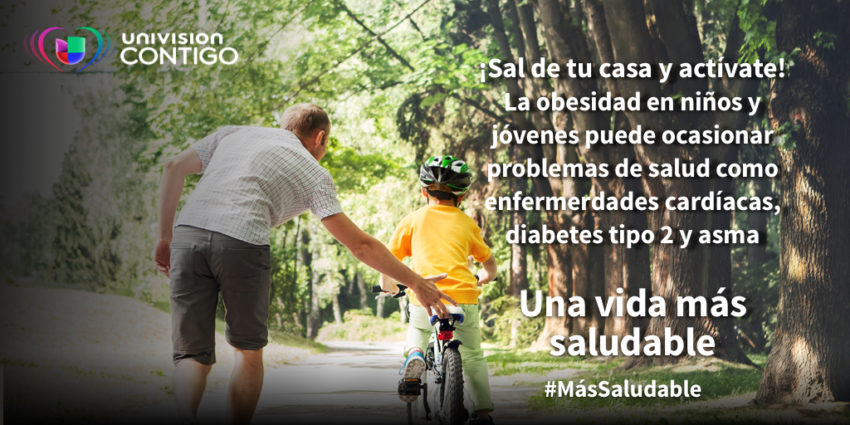
Salud America! is excited to serve as a partner with broadcasting company Univision's new national campaign to promote Latino health this summer. The campaign, Univision Contigo's Una Vida Mas Saludable, aims to inform, entertain and empower our Latino communities to live healthier. The campaign runs from June 18 to July 14. "Univision will cast a spotlight on various health issues impacting the Latino community," according to Univision. "[That includes] being active outdoors, addressing mental health in the Latino community, providing health and wellness tips, and discussing the importance of healthy aging."
How We're Getting Involved
Salud America! is partnering with Univision. We will share Univision Contigo's Una Vida Mas Saludable messages with the hashtag #MasSaludable. ...
When it comes to Latinos and alcohol, there is good news and bad news. Good news: More Latinos have never had even one drink of alcohol (31.8%) than their white peers (15.8%). Bad news: About 1 in 10 Latinos will have alcohol dependence at some point in their lives, according to the National Institute on Alcohol Abuse and Alcoholism. More than 33% of these Latinos will have recurrent or persistent problems compared, a higher rate than their white peers (22.8%). Either way, some Latinos do struggle with alcoholism. That makes it a problem that public health officials should address.
Latinos and Alcohol: Stats
Not all Hispanic groups are equal when it comes to drinking and alcohol-related problems, according to an expert who has been studying the alcohol pattern in Latinos for ...
We at Salud America! are dedicated to helping people drive healthy community change. That’s why we’re excited to announce our efforts have won three Digital Health Awards from the Health Information Resource Center. The Center is a national clearinghouse for professionals who work in consumer health fields. It recognizes the world’s best digital health resources: Spring 2018 Digital Health Awards, Gold, Salud America! Twitter
Spring 2018 Digital Health Awards, Silver, Salud America! Website
Spring 2018 Digital Health Awards, Silver, Salud America! Digital Health Curation “We’re humbled by the recognition of our communication work from groups like the Health Information Resource Center,” said Dr. Amelie Ramirez, director of the Institute for Health Promotion ...
Suicide rates have increased drastically across the United States from 1999-2016, according to a new report released by the CDC. Suicide rates are highest among White and Native American/Alaska Native populations. However, suicide rates for Latinos and African Americans are continually rising, the data shows. There were also significant increases in several states including Massachusetts, Vermont, and New Hampshire. Additionally, more than half the suicides in 2015 were among people with no known mental health conditions, according to an article in the Boston Globe. On the heels of two recent celebrity suicides - Kate Spade and Anthony Bourdain - the “data are disturbing,” Anne Schuchat of the CDC told SCNow. “The widespread nature of the increase, in every state but ...
Are you a city or county leader who wants to increase local access to healthy food? You are invited to the Healthy Food Policy Project's new webinar—"Supporting Healthy Food Access: Are There Local Laws For That?"—at 1p.m. EST on Wednesday, June 13, 2018.
About the Food Access Webinar
Food access is an important issues in our nation. For example, fast food and corner stores outnumber supermarkets in many Latino neighborhoods, according to a Salud America! research review. This creates food swamps where obesity rises. Cities and counties are using law and policy to support healthy eating in many ways. Laws can focus on socially disadvantaged groups, like Latinos. They can focus on environmental and economic goals, too. The webinar will shocase the Healthy Food Policy ...
Why is men’s health so important for Latino and other men of color? Men die at higher rates than women from the top 10 causes of death and are the victims of over 92% of workplace deaths. Women are also more likely to visit the doctor for annual examinations and preventive services than men. Latino men live five years less than Latinas. They face high incidence and mortality rates due to prostate cancer, are more likely to be smokers, and are more likely to have undiagnosed mental health issues. These issues need our attention. So, for National Men’s Health Month in June, let’s use #SaludTues on Tuesday, June 5, 2018, to tweet about the state of men’s health and emerging strategies to improve men’s healthcare! WHAT: #SaludTues Tweetchat─Improving Men’s ...