Diana Centeno knows kids exposed to traumatic events don’t get the support they need at school. Doug Greene knows police come across kids at crime scenes but feel unable to help them cope. So, they teamed up to start a project where patrol officers send a notification to the district if a child was present at a traumatic incident, enabling monitoring and support for the child. Centeno, a student support leader at San Antonio Independent School District (SAISD), is passionate about providing wrap-around, social-emotional services, particularly for children facing adverse childhood experiences (ACEs). Kids exposed to ACEs often act out in class, miss school, and fall behind, increasing their risk of dropping out, getting into criminal activities, and suffering from poor ...
Steve Long knows the mission of the Children's Museum of the East End is to spark imagination, play, and learning for all children in Bridgehampton, N.Y. (21% Latino). But the museum has risen to a new level under Long's leadership as executive director. It has become a Latino community hub. Long and the museum leaders host an afterschool science program for Spanish-speaking students. They partnered to host "safe space" workshops for Latino immigrants. They helped start an eight-week music program to enhance Spanish-speakers' literacy skills. They even added a mini-golf course with science-based facts in English and Spanish. "[The museum] is having a lifelong impact on the development of Latino children and their families through these programs," Long said.
The ...
More than 5.6 millions Americans are drinking water with increasingly high amounts of nitrates known to cause health problems, according to a new study. Latinos are disproportionately exposed to nitrates in public water systems. "Since the lead crisis in Flint, Michigan, there's been a real push to document other types of disparities in drinking water quality in the U.S. and understand the factors that drive them," said Dr. Laurel Schaider, lead author of the study in the Journal of Environmental Health and an environmental chemist at Silent Spring Institute, in a statement. "Because at the end of the day, everyone should have access to clean and safe drinking water regardless of your race or where you live."
The Shocking Study Results
For the study, scientists at the nonprofit ...
Bob Stewart knew that some students were frequently missing class or dropping out of the Gladstone School District in Gladstone, Ore (14.6% Latino). But he didn’t know why. Stewart came to realize his students face trauma─neglect, mental illness, poverty, foster care, divorced or jailed parents, and other adverse childhood experiences─that affect their school attendance and long-term social, emotional, mental, and physical health. He wanted to help. He started mental health services in his district. Stewart wanted to go bigger. Could he achieve his goal of starting a statewide learning collaborative to educate other school districts how to support students who have adverse childhood experiences?
Absenteeism: A Symptom of a Larger Problem
Stewart, who started as ...
More than 200,000 people—including some from Salud America!—submitted public comments on proposed changes to the "public charge" rule that could negatively impact the health of immigrant families. For the past 60 days, the U.S. government sought public comments on the Trump Administration's proposed changes to the public charge rule. Experts say the changes could penalize legal immigrants applying for green cards if they enroll in healthcare or use public benefits, such as food aid and housing. We at Salud America! asked our network to submit comments to protect families. Regulations.gov received a total of 210,889 comments! Here are some key results: Only 17,073 of the comments appear in search results on Regulations.gov, as of Dec. 11, 2018.
About 40 people ...
The rise of the Latino population makes it urgent to tackle disparities in obesity, diabetes, and cancer. But did you know fewer than 5% percent of Latinos participate in federal clinical trials? Researchers thus have less chance to develop new cancer treatments for this population, which suffers a heavy burden of certain cancers, obesity, and mental health issues. That's why we're excited to use #SaludTues on Oct. 16, 2018, to tweet about how to increase Latino participation in clinical trials to prevent health disparities, as Hispanic Heritage Month draws to a close! WHAT: Bilingual Tweetchat: “Hispanic Heritage Month: Latinos and Clinical Trials”
TIME/DATE: 1-2 p.m. ET (Noon-1 p.m. CT), Tuesday, Oct. 16, 2017
WHERE: On Twitter with hashtag #SaludTues
HOST: ...
A few years ago, San Antonio City Council member Rey Saldaña tried his own transportation experiment. He ditched his car and relied on public transit for one month. The good? Saldaña met great people. He read. He explored the city. Parking was no problem. The bad? When buses ran late, he missed connections and showed up late to council meetings. Rain drenched him at bus stops. He had to skip fun activities because of a lack of frequent routes. Saldaña’s eye-opening experiment led him to champion more funding for VIA Metropolitan Transit (VIA), the regional mass transit agency serving San Antonio and Bexar County, which operates with the least amount of funding among all major transit authorities in Texas. His efforts spurred the city to invest millions to improve public ...
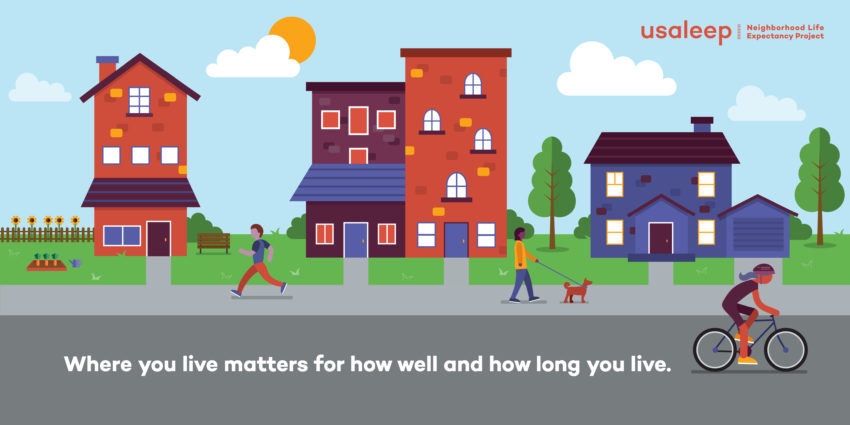
These days, ZIP code isn’t only for your mail. ZIP Code is a bigger predictor of our life expectancy than our genetic code. For the first time in our country’s history, the U.S. is raising a generation of children who may live sicker and shorter lives than their parents, according to the Robert Wood Johnson Foundation. But there’s good news. For the first time ever, a census-tract-level data on life expectancy at birth has been released to help stimulate change. The expectancy estimates—released by The United States Small-Area Life Expectancy Estimates Project (USALEEP), a joint effort of the National Association for Public Health Statistics and Information Systems, the Centers for Disease Control and Prevention’s National Center for Health Statistics, and the ...
Police came to four-year-old Fatimah Muhammad’s house in Newark, N.J. (34% Latino), after an altercation between her parents. They came in with force. They had guns. They aggressively grabbed and body-slammed her father before taking him away, Muhammad said. “I was completely terrified,” she said. “Instead of feeling grateful.” As a kid, Muhammad didn’t have a name for some of the traumas that she and her neighborhood were experiencing, like police aggression, domestic violence, and mass incarceration. But she felt an “us vs. them” sense when it came to police. Years later, amid a wave of unlawful policing in Newark, Muhammad helped seize an opportunity to unite police and community to explore trauma and rebuild trust. Update 6/2/20: Muhammad is ...