by
by 
Share On Social!
This content is from UT Health San Antonio’s book, “Advancing Cancer Research for Latinos and All Populations: 2026 Conference Proceedings,” which highlights results of the same-named conference in February 2026.
The Hidden Costs of Care: Tackling Financial Toxicity in Oncology
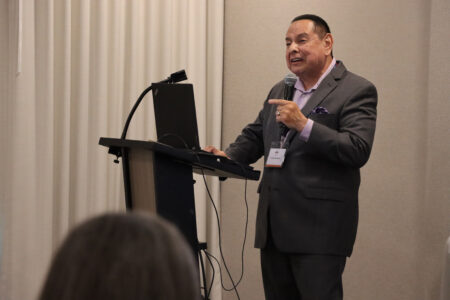
Dr. Jean Edward is Associate Professor and PhD Program Director for the College of Nursing at the Markey Cancer Center and the University of Kentucky.
Financial toxicity and Hispanic cancer survivors

Dr. Edward began by defining financial toxicity as the financial burden and distress associated with the high costs of cancer care. Approximately 30% of cancer survivors experience financial toxicity. Overall, cancer survivors spend about 20% of their income on out-of-pocket expenses, and are 2.65 times more likely to file for bankruptcy.
In 2020, the median annual household income for Hispanic individuals in the U.S. was $55,321, which is only 73% of the median annual income for non-Hispanic White individuals and lower than the overall median of $67,521. Younger Hispanic survivors, age 18 to 64, spend an average of $616 every year in out-of-pocket medical expenses (not including monthly premiums), while Hispanic survivors over the age of 65 spend an average of $1,131 in out-of-pocket medical expenses.
Financial toxicity is rampant among Hispanic cancer survivors, 32% of which report having problems paying medical bills in the past 12 months, compared with only 21% of non-Hispanic White survivors. Approximately 70% worry about paying future medical bills, compared with 51% of non-Hispanic White survivors.
Financial toxicity involves three overlapping domains: psychological response, or the feelings of distress, concern, and anxiety; material conditions, including out-of-pocket expenses, missed work, reduced or lost income, medical debt, and bankruptcy; and coping behaviors, including skipping medications, foregoing treatment, delayed or missed visits, or having to choose between food and treatment.
Some existing screeners that are used to assess financial toxicity include the National Comprehensive Cancer Network’s Distress Thermometer, the Comprehensive Score for Financial Toxicity, and Legal Barriers to Care developed by Dr. Edward and colleagues.
Multidimensional interventions
Interventions for financial toxicity must be multidimensional, with the patient and caregiver at the center of the approach. A financial navigator can make a powerful difference in helping patients and caregivers navigate the cost of care. However, providers must also receive training to enhance skills and deliver quality care effectively. Services should also be integrated into health systems to streamline care delivery and coordination. Community partnerships such as legal resources can support broader efforts to improve access to financial assistance resources. Finally, research outcomes must inform policy reforms to drive systemic healthcare improvements.
Medical-legal partnerships are another important intervention, integrating lawyers within healthcare settings to address health-harming legal needs and training healthcare providers to recognize legal needs. Approximately 52% of low- to moderate-income households in the US have at least one unmet legal need. A lack of access to civil legal aid may be an even stronger predictor of poor health than low income. Medical-legal partnerships are uniquely positioned to assist, advocate for, and empower families with the resources to overcome financial barriers by increasing access to social support that helps mitigate negative non-medical drivers of health.
Training medical teams to engage in effective cost of care conversations is another impactful approach. These conversations address the range of costs patients and families may face, including both direct out-of-pocket expenses and indirect costs, to ensure a clear understanding of the financial burden. Cost of care conversations result in time and resource savings by preventing treatment and testing escalation, additional follow-up visits, and unnecessary hospitalizations. Furthermore, these conversations address a substantial frustration and barrier to care for patients, supporting patient-clinician communication and trust and improving patient care quality and outcomes.
Actionable steps
Dr. Edward ended the presentation by discussing the importance of policy changes and actionable steps that can be taken to alleviate the burden of financial toxicity in cancer survivors. Screening for financial toxicity, engaging in cost of care conversations, and referring patients to financial assistance, navigation, and community outreach programs can all be powerful tools to mitigate financial toxicity. Research is also needed to determine the sustainability of health system interventions, medical-legal partnerships, multilevel interventions, and AI integration. Finally, policy advocacy is needed in light of the 1.4 to 4.0 million Medicaid adults who could soon lose coverage.
Advancing Cancer Survivorship: Challenges and Community-Engaged Solutions
Dr. Betina Yanez is a Professor in the Department of Medical Social Sciences, Program Co-Lead of Cancer Control and Survivorship, and Director of Patient Engagement in the Cancer Survivorship Institute at the Robert H. Lurie Comprehensive Cancer Center and Northwestern University Feinberg School of Medicine.
Financial hardship and cancer

Dr. Yanez’s presentation began by discussing the financial hardship associated with cancer. Approximately half of cancer patients face some economic burden associated with diagnosis and treatment leading to psychosocial distress and lower adherence to cancer treatments. However, a nationwide survey of 738 breast cancer patients revealed that most patients (58%) were not asked about financial stressors. Most patients preferred their providers reach out regarding financial needs and wanted this to take place soon after diagnosis. Black and Hispanic patients were more likely to receive financial assistance, and were more likely to prefer in-person financial education than White patients. Screening for financial toxicity can help identify patients at risk for nonadherence and triage patients to appropriate services.
Health insurance literacy
One contributor to financial hardship is low health insurance literacy, which is the lack of knowledge to understand, choose, and use health insurance. Patients with low health insurance literacy are more likely to experience financial hardship, lower health-related quality of life, lower adherence to medications and healthcare services, delays in care, and greater psychosocial distress.
A recent study by Dr. Yanez and colleagues sought to assess the acceptability and preliminary efficacy of a brief health insurance literacy video. English- or Spanish-speaking adults diagnosed with cancer who had elevated screening for depressive symptoms were enrolled. Race, ethnicity, gender, and age were not found to be associated with health insurance literacy outcomes at study baseline. However, higher levels of education and language were found to be associated with greater health insurance literacy outcomes. Furthermore, the health insurance literacy video demonstrated good usability and acceptability and improved the patients’ ability to define co-insurance and co-pay terms in the short term. There was also marginal improvement in confidence in selecting health insurance one month later.
Psychosocial care for cancer-related distress
Dr. Yanez and colleagues also implemented bilingual psychosocial care for cancer-related distress in a group of 80 Latina breast cancer survivors. The intervention was co-developed with patient advocates and healthcare providers to improve symptom burden self-management and health promotion. Patient-reported outcomes from electronic health records were linked to digital health interventions designed to improve depressive symptoms among bilingual patients. Significant short-term reductions in symptom burden were found alongside significantly improved breast cancer-related well-being over time. The intervention, called My Wellbeing Guide, incorporated interactive features, guided relaxation activities, and symptom management information such as dealing with common cancer symptoms and tips for coping with cancer.
AI-driven digital interventions
Another focus of study for Dr. Yanez and colleagues is Advancing Cancer Control Engagement Research Through Transformative Solutions in Patient Navigation (ACCERT). This is an AI-enhanced patient navigation trial enrolling over 700 participants. In this research, health workers are paired with AI navigation support for preventive care, treatment and survivorship care, financial navigation, and using AI. Priorities include trust and credibility, confidentiality, accuracy, digital literacy, and sustainability. Key outcomes of the study include uptake of cancer-related services, resolution of barriers associated with non-medical drivers of health, and balanced reach and adoption of navigation in community settings.
Dr. Yanez concluded the presentation by emphasizing that digital interventions have the potential to address key concerns among cancer survivors. Engagement and participant satisfaction in these initiatives are strong. One area for additional research involves understanding how to sustain intervention gains. Furthermore, solutions may vary by population and location. Trust, credibility, literacy, and accuracy are key considerations. Implementing digital interventions in healthcare and community settings can expand access to care, but more data are needed to guide effective and balanced implementation.
Avanzando Caminos
Dr. Frank Penedo is Professor of Psychology and Medicine, Director of Cancer Survivorship and Supportive Care, Sylvester Comprehensive Cancer Center Associate Director, Sylvester DCC Living Proof Endowed Chair in Cancer Survivorship, and Director of the Biopsychosocial Mechanisms and Health Outcomes (BMHO) Lab.
Hispanic cancer survivors

Dr. Penedo’s presentation focused on enhancing cancer survivorship among Hispanics in the United States, including unmet needs and targeted interventions. Cancer survivors currently make up 5% of the US population, and approximately 20% of US cancer survivors are of Hispanic origin. Survival comes with many challenges, including financial issues, comorbidities, psychosocial distress, and health system challenges. Unmet needs impact critical outcomes such as treatment adherence and health-related quality of life.
In 2050, the Latino population in the US is projected to be approximately 100 million, accounting for 30% of the overall population. Cancer is currently the second leading cause of death among Latinos, who experience higher rates of certain cancers, particularly those associated with infectious conditions. Latino cancer patients also report greater supportive care needs relative to non-Hispanic patients.
My Wellness Check
My Wellness Check is an integrated electronic health record system that also assesses needs and triages patients. My Wellness Check is embedded in the patient portal and sends the patient brief questionnaires about anxiety, depression, pain, fatigue, and physical function 72 hours prior to an oncology appointment. The questionnaire also assesses nutritional needs and practical needs, including childcare, transportation, financial needs, and food insecurity. This program has been implemented by Dr. Penedo and colleagues in a cancer center serving 42% Hispanic patients.
Although about 40% of patients complete the questionnaire, Hispanic patients are less likely to complete it. Some have reported feeling that if they disclose their needs, they will not receive the same level of care as someone who does not. Engagement and triaging within the system were associated with a lower likelihood of emergency room visits or hospitalizations. Black and Hispanic patients are at significantly greater risk of emergency room visits or hospitalizations. Relative to non-Hispanic white patients, Hispanic participants report significantly lower quality of life and greater supportive care needs, including transportation needs, health insurance issues, housing needs, food insecurity, and limited access to care.
Cognitive behavioral stress management
Dr. Penedo and colleagues developed cognitive behavioral stress management interventions to be delivered to cancer survivors. These interventions are typically group-based, led by 1 or 2 therapists. Significant improvements in quality of life, ability to manage stress, coping benefits, and reframing the experience of cancer have been documented.
This work was also adapted to be more targeted to Hispanic populations, who tend to need more information about cancer. Cancer information was therefore prioritized, alongside specific stressors such as immigration stress, family stressors, financial stressors, loss of control, lack of self-efficacy, and fatalistic attitudes. Assertiveness training was also provided. This intervention resulted in improved quality of life, reduced pain interference, reduced fatigue, and improved sexual function.
Avanzando Caminos
The Avanzando Caminos (Leading Pathways) study is a Latino Cancer Survivorship study that has assessed structural, psychosocial and biobehavioral factors. Dr. Penedo and colleagues set out to characterize the study population in terms of cultural beliefs and behaviors (e.g., diet, family interdependence), biology, psychosocial factors, socioeconomic status, geographic location, country of origin, and migration pattern. Of the 3000 participants, 50% were Mexican American, with the rest being Central and South American, Cuban, Puerto Rican, or Dominican ancestry.
Preliminary findings showed that financial strain, social care needs, being female, being retired, and having fewer family members were associated with poor quality of life. Better physician-patient interaction was associated with better emotional well-being. Much more research is planned involving this well-characterized population in order to assess multilevel determinants of outcomes that are affecting Hispanic cancer survivors. Future research plans also involve incorporating AI-driven analysis of patient records.
By The Numbers
142
Percent
Expected rise in Latino cancer cases in coming years