by
by 
Share On Social!
This content is from UT Health San Antonio’s book, “Advancing Cancer Research for Latinos and All Populations: 2026 Conference Proceedings,” which highlights results of the same-named conference in February 2026.
Clinical Research as a Lifeline: Navigating Relapse and Remission Through Evidence-Based Care
Arnoldo Rodriguez is a cancer survivor and chimeric antigen receptor (CAR)-T cell therapy recipient.
A cancer story
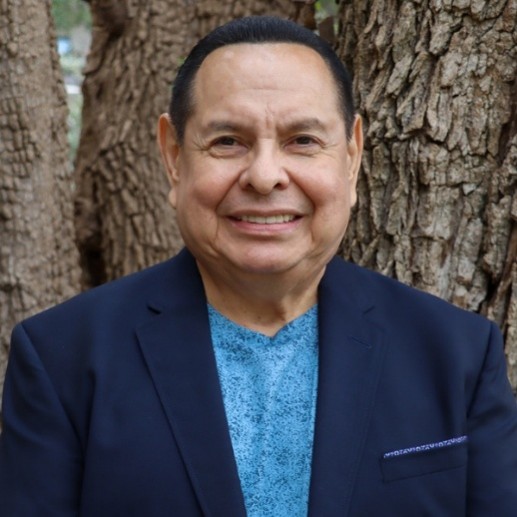
Mr. Rodriguez’s presentation relayed lessons he learned as a cancer survivor. In 2010, he was diagnosed with prostate cancer. Both his primary care doctor and oncologist were unempathetic and terse, leaving him feeling alone in his cancer journey. After conducting his own research, he chose to seek treatment at MD Anderson in Houston because of its reputation for high-quality cancer care and the lack of a specialized cancer hospital near his home in the Rio Grande Valley of South Texas. The physicians at MD Anderson recommended that he undergo a prostatectomy.
Following surgery, Mr. Rodriguez returned to MD Anderson for follow-up care and prostate-specific antigen (PSA) monitoring. Initially, his PSA levels were checked every six months and later on an annual basis. In 2019, while working as a sales representative for an education company, he began to notice unexplained weight loss. He also discovered lumps in his neck and armpits. After seeking medical attention, he was diagnosed with follicular lymphoma. Unfortunately, his wife received the same diagnosis at approximately the same time.
Complications from COVID
During the first week of treatment for follicular lymphoma, while staying in a hotel near MD Anderson, Mr. Rodriguez experienced difficulty breathing. He went to the MD Anderson emergency department and was diagnosed with pneumonia and the corona virus, which had caused a significant fluid buildup in his abdominal cavity. He underwent a paracentesis to remove the fluid.
For several months afterward, daily drainage procedures were performed by his wife, causing him considerable pain. During this period, Mr. Rodriguez also developed diverticulitis, fractured a vertebra, and lost much of his muscle mass. He was beginning to experience what he described as “the new normal” following cancer and its many complications.
Although treatment was initially effective, Mr. Rodriguez experienced a relapse in 2020. The ongoing COVID-19 pandemic created additional challenges and uncertainty for both Mr. and Mrs. Rodriguez, as it did for many cancer patients worldwide. Some follow-up appointments had to be rescheduled or conducted virtually through Zoom. By the end of 2020, Mrs. Rodriguez had achieved remission and has remained in remission to this day. Mr. Rodriguez also entered remission in 2020 after undergoing multiple rounds of chemotherapy.
A clinical trial
When another relapse occurred in 2021, physicians prescribed an oral cancer medication that cost approximately $10,000 per month, making it financially inaccessible for Mr. Rodriguez. Instead, he was determined to be a candidate for a CAR T-cell therapy clinical trial.
Although participation in the clinical trial presented several challenges — including leaving his home in deep South Texas and living in Houston for a couple of months to remain close to the cancer center — he readily agreed to the treatment. Given the evidence supporting the efficacy of CAR T-cell therapy, he viewed the clinical trial as a lifeline to remission.
Mr. Rodriguez achieved remission from lymphoma in January 2022. However, in December 2025, he learned that his prostate cancer had recurred. Fortunately, the University of Texas Rio Grande Valley Health Cancer and Surgery Center had opened in McAllen, Texas, in October 2025. Like MD Anderson, this center is part of the University of Texas System and offers evidence-based care and access to clinical research trials. As a result, Mr. Rodriguez was able to remain at home while receiving a 28 day course of radiation therapy and the accompanying hormone therapy.
Lessons Learned
Mr. Rodriguez concluded his presentation by sharing lessons from his long and difficult cancer journey. The most important lesson, he explained, was the importance of self-advocacy and advocating for others facing a cancer diagnosis, as well as for survivors and caregivers.
He emphasized that clinical research participation should not be viewed as a last resort. For him, CAR T-cell therapy was a lifeline, and it has since become a standard-of-care treatment option for several types of relapsed or refractory non-Hodgkin lymphoma, including the disease that affected him.
Finally, Mr. Rodriguez explained how his cancer experience has shaped his advocacy mission. He hopes to share the lessons he has learned to help cancer patients and survivors develop the skills and confidence necessary to advocate for themselves. Through informed advocacy, patients can make treatment decisions based on evidence-based care and seek treatment at specialized cancer centers or university-affiliated teaching hospitals whenever possible.
An Odyssey to Diagnosis: AML Patient Experience from Treatment to Advocacy
Karen Estrada is a cancer survivor.
A devastating diagnosis

Mrs. Estrada’s presentation was a first-person account of her journey as a cancer survivor. The following is a slightly edited version of her account:
There is a moment in my life I return to often. I was standing in a crowded emergency room waiting area when a doctor told me I had AIDS. I will never forget my husband’s face; the room felt smaller and the future felt uncertain. A few days later, I was admitted to Sylvester Comprehensive Cancer Center, where my care was immediately taken over by a specialized oncology team. Within days, I learned the real diagnosis, acute myeloid leukemia, an aggressive and life-threatening cancer that changed everything in an instant.
I was born in Medellin, Colombia, and now I live in Miami, Florida. I carry both cities with me as a mother, a professional woman, and a leukemia survivor, and everything I do is shaped by my identity as a Latina. At the time of my diagnosis, I was healthy. I was a cross-fitter, raising 2 boys, traveling for work when necessary, and I felt I was in my prime, strong, and unstoppable.
An unexpected week of fever led to isolation in a 10 by 10 hospital room at Sylvester. I was told my life depended on the expertise, research, and coordinated care happening inside that institution. I remember staring at the walls trying to understand how life changed so quickly. I did not even understand what leukemia meant, or how aggressive it was. When I heard the word cancer, my reaction was denial with determination.
I said, “No, let’s do what we have to do. Everything is going to be fine.”
Tenacity through treatment
Chemotherapy began right away. Even as my world collapsed, the doctors and nurses created order in this chaos. When the first round failed, I was told I may have 3 weeks to 3 months to live. I heard the words, but all of me could not accept them. I did not. I told myself I was GI Jane. My doctors did not give up.
After weeks of testing, the team at Sylvester found a clinical trial. My first reaction was fear. I told them, “I don’t want to be a guinea pig,” but they educated me, respected my voice, and treated me as a partner in my care even when I was trying to express myself in a language that was not my first.
The decision to enroll saved my life, and the trial gave me enough time to receive a bone marrow transplant. A stranger said, “Yes.” A 23-year-old woman that serves this country–she stopped her work and came for 5 days to be able to give me bone marrow. She was a 70% match–a woman probably I will never meet who gave me life. Her decision is the reason I’m standing here speaking to you today.
Renewed purpose through advocacy
I spent more than 9 months in isolation without seeing or touching my children, not even once. There are no words for the distance between a mother and her children during that time. That’s why advocacy, education, and representation in research matters. I’m not here because I have all the answers. I’m here to learn how to advocate better and be a strong bridge between medicine and humanity. I want to turn survival into service.
Too often, Latinos and other underserved populations are underrepresented in research, leading to gaps in understanding cancer biology and survivorship outcomes. As Latinas, we’re often taught to endure quietly and to trust authority. Patient advocacy teaches us something radical. Your voice belongs in the room.
Cancer took my health, my confidence, my intimacy, a sense of control. It stripped life down to what matters the most. Even after remission, cancer has given me perspective, empathy, and purpose. It changed how I see every ordinary day. Healing is not just surviving, it’s adapting and rebuilding. I’m standing here today as a Latina immigrant, a survivor, a mother, and an athlete because advocacy gave my story a direction. I turned pain into something that could serve others.
I’m alive today because of the care, research, and commitment I received at Sylvester. I carry that gratitude with me into every room I enter. I invite you as researchers, as clinicians, to continue to engage in partnerships with patients and to build research programs that welcome [participation from different backgrounds]. I hope people from Sylvester that are here are listening to this, because when we empower patients, we change lives, and sometimes we give families more time together: more hugs, more birthdays, more nights to put my kids to sleep. So thank you for listening and for helping voices like mine be heard.
Karen developed a free app for patients called live again. The app helps users journal, access resources, track their recovery, and stay organized throughout their journey. The app can be found at: www.liveagainapp.com
By The Numbers
142
Percent
Expected rise in Latino cancer cases in coming years