by
by 
Share On Social!
Flooding accounts for about 11% of all billion-dollar weather and climate disaster events in the U.S., according to the National Oceanic and Atmospheric Administration.
That makes it important to have a plan to deal with severe weather, storms, and flooding.
“Prepare for floods by getting flood insurance, gathering your disaster supplies, and staying informed on potential weather alerts,” the Texas General Land Office states.
Let’s look at how you can gear up when it comes to severe weather locally and protect your familia, neighbors, and communities.
1. Know Your Risk & Staying Informed amid Potential Flooding
During times of severe weather and potential flooding, it is important to stay informed and know what is happening in your area.
Staying up to date with local news and weather through TV, radio, or social media can help keep track of storms and weather alerts like flash flood warnings.
The CDC urges people to sign up to receive local emergency alerts and notifications, where available, and to turn on the Wireless Emergency Alerts feature on your smartphone.
Understanding the differences and definitions of weather warnings is also a necessary step while in preparation.
Staying connected with family, emergency contacts, caretakers, and others should also be part of planning if necessary.
“Your ability to access, understand, and use reliable information in an emergency is important to protecting your health and safety,” according to the CDC.
2. Have a Plan for Flooding and Severe Weather
In the event of a weather disaster, having a plan can protect you and your loved ones.
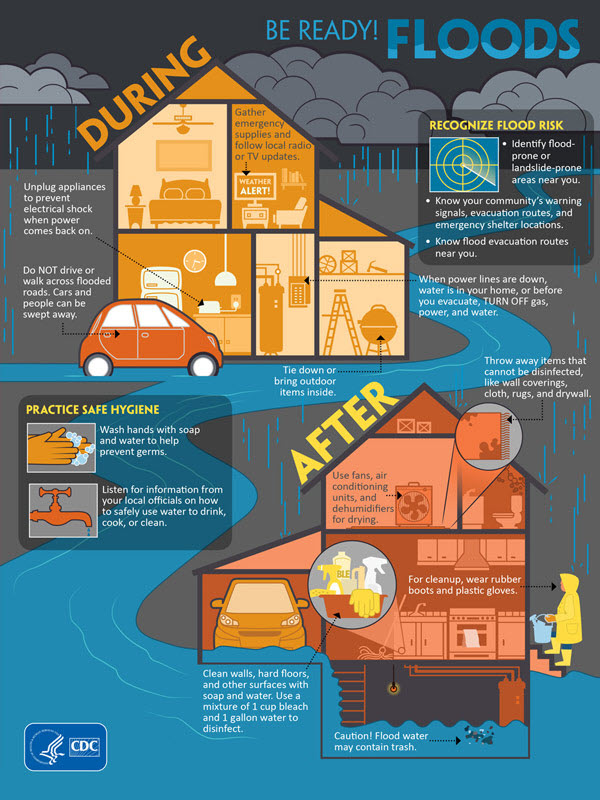
Emergency plans should include where to meet if separated, emergency phone numbers, and important documentation, among other factors.
“Make a plan for your household, including your pets so that you and your family know what to do, where to go and what you will need to protect yourselves from flooding,” according to Ready.gov.
Ensuring that a safety plan is customized to your specific daily living needs and responsibilities is important.
Plans and supplies should accommodate pets, those with disabilities and medical needs, people of different ages, and other factors relevant to your household.
In Texas, the Department of State Health Services has a customizable Emergency Plan Form.
More flood resources are available from FEMA Flood Map Service Center, Floods.gov, and the American Red Cross.
3. Turn Around, Don’t Drown
Flood waters can pose a threat to health and safety.
It’s important to always follow warnings about flooded roads and avoid driving in flooded areas.
“Floodwater can pose a drowning risk for everyone— regardless of their ability to swim. Swiftly moving shallow water can be deadly, and even shallow standing water can be dangerous for small children,” according to the CDC.
Floodwater can also contain hazardous particles and other things that are harmful to health, including:
- Physical objects such as lumber, vehicles, and debris
- Wild or stray animals such as rodents and snakes
- Household, medical, and industrial hazardous waste (chemical, biological, and radiological)
- Other germs that can lead to illness
“People underestimate the force and power of water. Many of the deaths occur in cars swept downstream. Many of these drownings are preventable. Never drive around the barriers blocking a flooded road,” the National Weather Service reports.
Exploring the Health of Your Community
Floods, big or small, can greatly affect neighborhoods and communities.
But what does the health of your community really look like?
Find out by downloading a Salud America! Health Report Card!
The report card will show you how many local children live in poverty and food deserts, how many have low food access, and how many get SNAP food benefits. Then you can compare it to your state and to the country.
Email your Health Report Card to community leaders, share it on social media, and use it to make the case to address food insecurity where help is needed most!
Explore More:
AccessBy The Numbers
142
Percent
Expected rise in Latino cancer cases in coming years