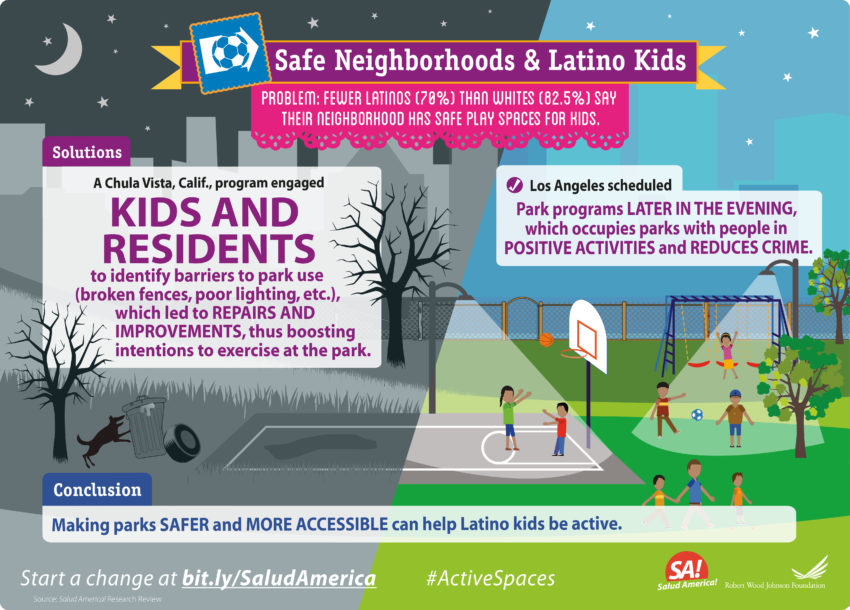
Only 70% of Latinos say their neighborhood has safe, active spaces for kids. Research shows that when communities address challenges to park use such as broken fences, poor lightening and sidewalks, more people visit community parks, according to our new infographic on safe neighborhoods. The infographic is part of Salud America!’s Active Spaces and Kids research package, which tackles the latest issues on the physical activity environment and offers recommendations. Share this infographic today! Salud America! is a Robert Wood Johnson Foundation-funded national childhood obesity prevention and communication ...
Traveling doesn't always allow time for healthy choices, especially when airports are filled with unhealthy options at every corner. But now more vegetable based options are coming to an airport restaurant near you. Many Airports are encouraging travelers to follow the 2015 Dietary Guidelines and offering up more fresh fruits, vegetables, whole grains and legumes in various ways. According to a recent article by foodtank, more than 70 percent of airport restaurants nationwide offer at least one plant-based entree, a 25 percent jump from 2001. Menus offered up include vegetable based plates with influences like Mediterranean vegetable plates and rice bowls. Chicago O'Hare is offering Bibb lettuce in Concourse G, and local vegetable shops are popping up in airport terminals in ...
Did you know that 81% of Latino neighborhoods don’t have a safe recreational facility? That means many kids lack places to play and be active, which contributes to higher rates of physical inactivity and obesity, according to a new package of research from Salud America!, a national network for childhood obesity prevention and communication funded by the Robert Wood Johnson Foundation. Salud America!’s Active Spaces and Kids research package tackles the latest issues on the physical activity environment and offers recommendations. Solutions are emerging to improve access to and safe use of active spaces: Shared use agreements are formal contracts between a school and a city, county, or sports league that outline terms for sharing existing physical activity facilities. They ...
Many kids and families have limited spaces to be physically active. What are the best ways to improve access to “active spaces” like gyms, athletic fields, parks, and playgrounds for all families, including Latinos? Many schools do not provide public access to physical activity facilities. Shared use agreements set up rules for public use of schoolyards after class. Repairing sidewalks, installing street lights, and improving parks can stimulate more physical activity. Creating safer streets can people to walk or cycle to schools, parks, and other family destinations. Also, using marketing and technology to change kids’ physical activity patterns. See the Full Research Review with references (PDF)
Read the Issue Brief in English (PDF)
Read the Issue Brief in Spanish ...
Physical activity is scientifically proven to improve health outcomes. But some kids have less safe physical activity opportunities, including fewer parks and places to walk and bike in their neighborhoods and less time for recess and P.E. in their schools. Join #SaludTues on December 15, 2015, at 1:00 PM EST to tweet about how we can use new research and stories to redefine physical activity for lifelong health, and how parents, schools, cities, nonprofits, and parks can collaborate and ensure access to #ActiveSpaces for all kids. WHAT: #SaludTues Tweetchat: “How to Increase Active Spaces for Kids”
TIME/DATE: 1-2 p.m. EST Tuesday, January 12, 2016
WHERE: On Twitter with hashtag #SaludTues
HOST: @SaludAmerica
CO-HOSTS: @AL_Research @kaboom @americawalks ...
Updated federal dietary guidelines suggest Americans should consume less sugar, fat and salt and more vegetables and whole grains, The Wall Street Journal reports. The guidelines, which are updated every five years recommend a “healthy eating pattern” with conscious decisions about what we drink and eat. “By focusing on small shifts in what we eat and drink, eating healthy becomes more manageable,” Secretary of Health and Human Services Sylvia M. Burwell said. The guidelines suggest Americans should consume: A variety of vegetables, including dark green, red and orange, legumes (beans and peas), starchy and other vegetables
Fruits, especially whole fruits
Grains, at least half of which are whole grains
Fat-free or low-fat dairy, including milk, yogurt, ...
This is part of our Food and Latino Kids: A Research Review »
Future Research Needs
This review of the evidence indicates that researchers should conduct additional and more rigorously designed studies, such as experimental or quasi-experimental studies with less reliance on self-reported data whenever possible. Future research should examine the degree to which increased access to local healthy foods impacts dietary habits and obesity in communities. Researchers also should: Identify other multilevel factors (for individuals, at homes, in neighborhoods, counties and cities), that contribute to obesity and health outcomes. Such factors include stressors, lack of time or interest in preparing healthy foods, prices for healthy foods that far exceed those for unhealthy ...
This is part of our Food and Latino Kids: A Research Review » Increased access to healthy foods in low-income neighborhoods does not necessarily ensure that it will lead to improvements in residents’ diets.
Some studies some no affect on dietary improvement
Two studies of low-income neighborhoods that have reported findings without sub-analyses have shown that increased access to healthy foods does not affect diet quality in low-income neighborhoods. A national study using longitudinal data observed that proximity to a supermarket was not related to diet quality in low-income young to middle-aged adult populations.27 In addition, the first controlled (one intervention neighborhood and one comparison neighborhood), longitudinal study of a PFFFI-funded project found that exposure ...
This is part of our Food and Latino Kids: A Research Review »
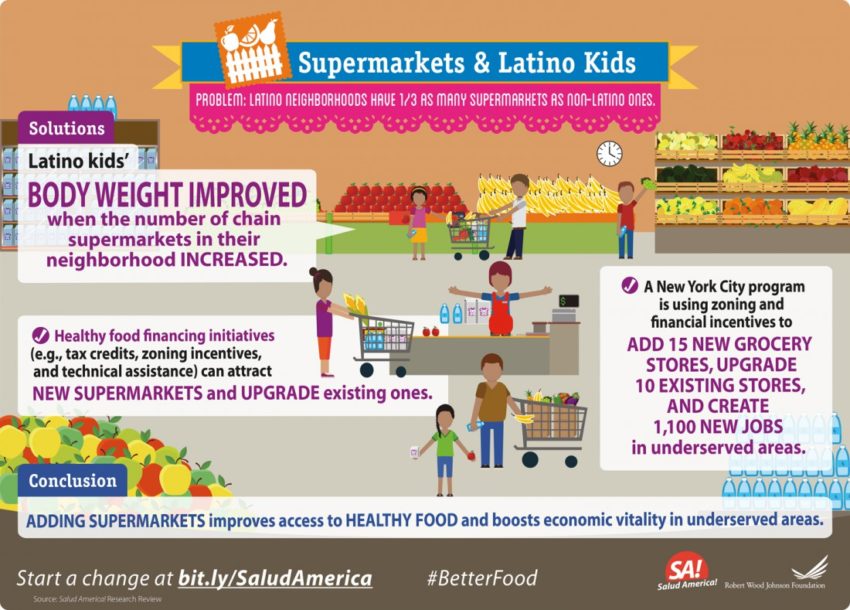
More access to supermarkets results in less obesity risk
Greater neighborhood access to supermarkets catering to low-income populations is linked to a lower prevalence of obesity in adults and children. Evidence from systematic reviews, longitudinal and cross-sectional studies collectively show the relationship between greater access to supermarkets and lower prevalence of obesity. Only two studies have analyzed the relationship between lack of local supermarket access and obesity over a period of time (2 years and 4 years). The data from these studies show mixed evidence in adults and children. One study reported that an increase in accessible supermarkets was associated with decreased BMI for adults who moved from ...