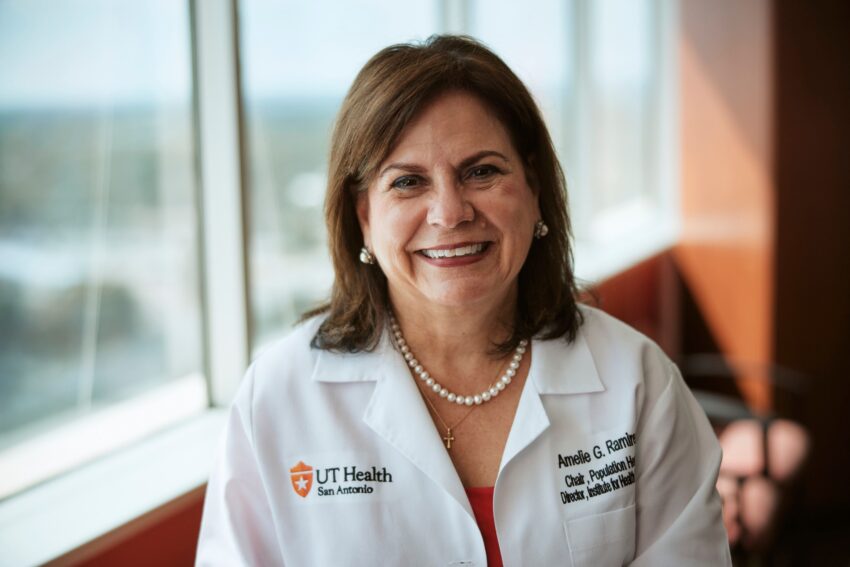
Cuando una persona dona muestras biológicas o biospecímenes—sangre, líquido, o muestras de tejido—le da a los investigadores la oportunidad de entender, tratar y prevenir de una mejor manera, condiciones médicas desde el cáncer hasta el Alzheimer. Se necesitan de manera especial muestras biológicas de latinos, quienes sufren disparidades de salud. “Los latinos que donan muestras biológicas son héroes. Sus contribuciones permiten a los investigadores hacer descubrimientos médicos y crear terapias nuevas para ayudar a millones de latinos en todo el país”, dijo la Dra. Amelie G. Ramirez, líder de Salud America! programa latino de equidad en salud del Institute for Health Promotion Research en el Department of Population Health Sciences, de UT Health San ...
A respirator keeps you from breathing in particles in the air that might hurt you, like germs, dust, and chemicals. In healthcare, we use respirators when we think we’re going to be in a situation when we could breathe in air that’s carrying infectious particles – like viruses.
Air-Purifying Respirators
There are different types of respirators available in healthcare. Air-purifying respirators work by using filters, or canisters or cartridges, to remove dangerous things from the air that you could breathe in. There are many types of air-purifying respirators. Healthcare workers often use a filtering facepiece respirator (FFR), which fit snugly against the face and cover the mouth and nose. The most common type of FFR used in healthcare is the N95 respirator – more ...
Latinos are driving the U.S. economy thanks to a rise in population, workforce participation, entrepreneurship, and economic contributions. But progress is hampered by COVID-19, discrimination, and wage disparities. “There’s no doubt Latinos are slowly being more fully integrated into the US economy. Yet there’s also no doubt there’s a long way to go, especially for first-generation Latino immigrant,” according to Lucy Perez, Bernardo Sichel, Michael Chui, and Ana Paula Calvo of McKinsey & Company, a global management consulting firm. Let’s explore how Latinos are influencing the economy now and in the future.
Latino Population Growth
Latinos account for over 18.5% of the total U.S. population. As the Latino population has continued to grow rapidly, it has ...
While most people who have COVID-19 recover completely within a few weeks, some continue to experience symptoms weeks after their initial recovery. This condition is often called Long COVID. Common signs and symptoms of Long COVID include fatigue, shortness of breath or difficulty breathing, cough, joint pain, chest pain, and even organ damage, according to the Mayo Clinic. But we don’t know everything about the long-term health effects of COVID-19 infection. You can help researchers learn more about Long COVID through research studies, such as RECOVER, a National Institute of Health (NIH) study to better prevent, test, and treat Long COVID-19 in the future. Find a recover testing site near you!
RECOVER Research Study
The NIH launched RECOVER to learn why some people ...
More than 50 million people in the US are under excessive heat warnings, and more than 25 major cities have tied or broken record-high temperatures this year, according to NPR. Heat waves are nothing new, but they are becoming increasingly more common and more severe because of climate change, which is a threat to public health, especially for Latinos. In fact, about 702 heat-related deaths occur each year due to heat stroke and related diseases. “Hot weather is associated with an increase in heat-related illnesses, including cardiovascular and respiratory complications, renal failure, electrolyte imbalance, kidney stones, negative impacts on fetal health, and preterm birth,” the Centers for Disease Control & Prevention (CDC) stated. “Specifically, death rates are noted ...
Latinos are expected to comprise well over 25% of the U.S. population by 2050. But they face health disparities in eye health, diabetes, obesity, cancer, and more, endangering the future health of the nation. Dr. Amelie G. Ramirez, director of Salud America! at UT Health San Antonio, will explore the causes of these disparities in a virtual presentation, "A New Vision for Reaching Latinos for Systemic and Behavioral Change," at 2:45 p.m. ET, July 14, 2022, at the 11th Annual Focus on Eye Health National Summit led by Prevent Blindness. The overall event, which is free, is set for July 13-14, 2022. "Our efforts must address structural inequities — from a lack of healthcare access to unaffordable housing to experiences of discrimination to a lack of diversity among health care ...
Many vaccines, including the current vaccines for COVID-19, come in small bottles with more than one dose inside. These are known as multiple-dose, or “multi-dose” vials, and can be used to vaccinate more than one patient.
Multi-Dose Vials and Infection Control
Multi-dose vials are more likely to become contaminated compared to single-dose vials, and therefore require important injection safety actions. “Multi-dose vials are more likely to get dirty because you’re putting a needle into that bottle many times to pull out each dose for each separate vaccine,” said Dr. Abigail Carlson, an infectious diseases physician with the Centers for Disease Control & Prevention (CDC), as part of CDC Project Firstline’s Inside Infection Control video series. If the vial gets ...
More than 16,000 concerned Americans sent public comments to the National Highway Traffic Safety Administration (NHTSA) urging them to make changes to their vehicle safety rating system, known as the New Car Assessment Program. Many organizations, such as the National Association of City Transportation Officials (NACTO), America Walks, and Families for Safe Streets enabled their members to submit comments. Our team at Salud America! also developed a model comment asking NHTSA for a vehicle rating system that accurately reflects the dangers vehicles pose to pedestrians, bikers, and others outside the vehicle. After all, more Americans died in motor vehicle crashes in 2021 than any other year since 2005, and the growing size and weight of vehicles is a contributor. “Driving ...
The National Academies of Sciences, Engineering, and Medicine (NASEM) has nominated an ad hoc committee to review federal policies that contribute to racial/ethnic health inequities, and recommend the most effective, promising approaches to equitably change policies. NASEM is seeking public comment on its nominees for the committee through June 20, 2022. The nominees are strong, diverse health equity experts. But none have experience in urban planning, housing, or transportation – some of the most critical social determinants of health. Use the following Salud America! model comment to tell NASEM to add committee members who are scholars in the intersection between urban planning and social determinants of health to improve their ability to make equitable policy ...